


I am delighted to share with you my now iconic article “Licensing at Lunch”. This article illuminates from both licensor and licensee perspectives key issues that must be considered and addressed in negotiating fashion license agreements. It whimsically does this through a lunch at Arno’s in New York’s garment center between two fictional characters I created – Carlo Glamoroso, a world-renowned, Italian fashion designer and Irwin Smoothtalk, the owner of Too Hot Jeans. An industry expert termed it the best stand-alone article he ever read about the essentials of licensing. I hope you enjoy it and find it helpful.
I will be delighted to help you in all your U.S. and international licensing legal needs, whether you are a brand owner licensor or a licensee of a brand, both with the license agreement itself and with agreements with licensing agents you retain to bring you licensing deals.
You can reach me at ck@dhclegal.com and at 646-428-3240. It will be my pleasure to help you. Your first consultation will be free of charge.
Introduction
Licensing continues to occupy an important place in the fashion landscape. Brand owners wish to monetize their time and money investments and to expand their product, brand, and territorial reach. Wholesalers are anxious to attach their products to brands that will maximize their profitable sales at wholesale and online.
What is a license? The grant by an intellectual property owner (the “Licensor”) to a third party (the “Licensee”) of the right to use that intellectual property (in fashion deals, typically a trademark (the “Licensed Mark”), for a specified territory (the “Territory”), for a specified term (the “Term”), for specified product categories (the “Licensed Products”) in consideration for monetary payments (“Royalties”).
Please consider the following fictional discussion and the very real issues it poses when you negotiate a licensing deal.
The Scenario

Carlo Glamoroso, a world renowned Italian designer of upscale ladies’ apparel, is considering granting a trademark license in the United States to Too Hot Jeans, a long standing Seventh Avenue wholesaler of ladies’ jeans.
Irwin Smoothtalk is Too Hot’s President and owner. Both Glamoroso and Smoothtalk wish to take advantage of each other’s assets to make a killing in the lucrative, up-scale jeans market:
Glamoroso wants to benefit from Too Hot’s production capability, sales force, and knowledge of the American market, while Smoothtalk believes that Glamoroso’s name and cachet will catapult him to the top of the designer jeans market.
Before our protagonists sit down for lunch, they should have each done their “due diligence”. Glamoroso needs to confirm that Smoothtalk can make an excellent product that reflects the “DNA” of the Glamoroso brand, can ship it timely to the desired customers and has the money to finance and grow the business. Glamoroso may also want to know if Smoothtalk is licensing the trademark of any competitor. Smoothtalk wants to make sure that retail store customers, and online consumers will want to buy Glamoroso jeans at a price which will permit him to make a good profit and pay Glamoroso the specified royalties.
Glamoroso, the great man himself, meets with Smoothtalk at Arno’s, Smoothtalk’s favorite garment center Italian restaurant. The discussion goes something like this.
The Glamoroso Trademark
Smoothtalk, having been advised by a good lawyer, asks Glamoroso over a glass of Pinot Grigio,
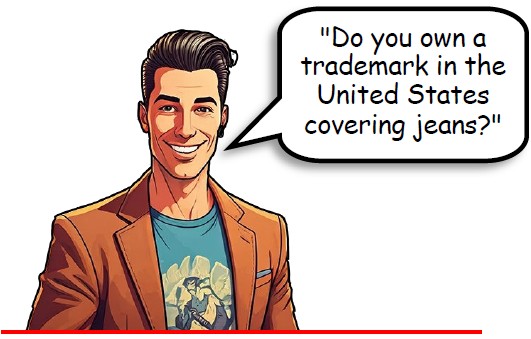
This is not a dumb question.
Trademark owners, anxious to garner royalties, sometimes enter into discussions with potential licensees for territories in which they have no trademark rights (e.g., Glamoroso may own trademark registrations in Italy, but none in the U.S.) or for a goods category for which they have no trademark registration.
Both Glamoroso and Smoothtalk have a strong interest in making sure that Glamoroso has clear trademark rights in the U.S. covering the Licensed Products.
The Grant
The waiter brings a Caesar salad for Smoothtalk and an arugula salad for Glamoroso. Smoothtalk wants to know:
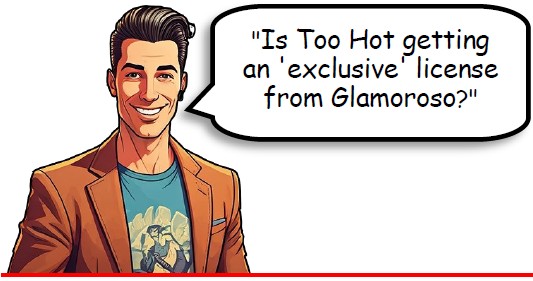
Smoothtalk wants to know.
Too Hot had better be getting an “exclusive” for women’s jeans, or else it could be making a large investment
only to find a competitor using the same trademark. Assuming it is getting an exclusive license from Glamoroso, what categories does that exclusive cover? “Too Hot” wants the license to cover as many denim categories as possible (e.g., skirts, shorts, jackets, and perhaps even casual pants in other fabrics).
Although it is in Glamoroso’s interest that Too Hot have a full denim line to sell, it must balance that interest with the opportunity cost of putting too many eggs in Too Hot’s basket, thereby limiting the potential for another license in a related category.
The Term of the License
Savoring his second glass of Pinot Grigio, Smoothtalk tells Glamoroso…
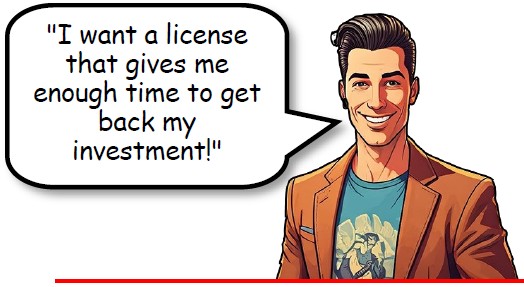
If our deal were to follow the most typical arrangement, Too Hot would receive a license for three years (with a six-month start-up), with the right to extend the license for a three year renewal term. But Smoothtalk wants a second three-year renewal term.
Smoothtalk and Glamoroso don’t know each other very well. Glamoroso is more
than a little concerned about whether he is going to work well with Smoothtalk.
And Smoothtalk is not sure how the market will receive Glamoroso jeans.
Glamoroso makes a suggestion:
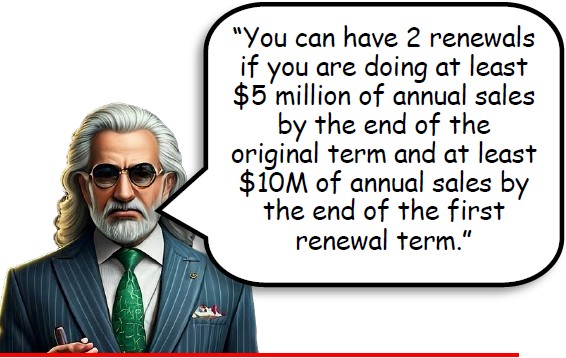
Smoothtalk accepts.
Design and Production Control
The main course arrives, veal piccata for Glamoroso and chicken scarpariello for
Smoothtalk.
Glamoroso tells Smoothtalk…
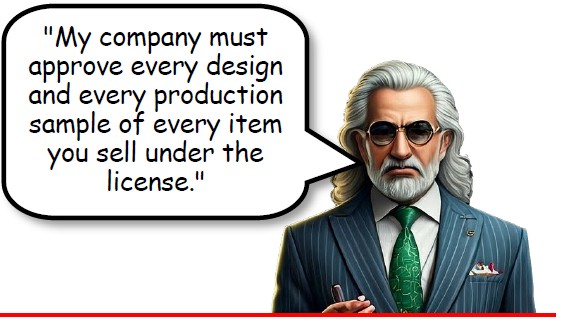
Glamoroso’s position is reasonable.
But if Smoothtalk doesn’t make sure that the approval and rejection process is rapid, he could find himself missing production dates and losing orders needed to cover his minimum royalties.
Distribution Channels
After another glass of wine, Glamoroso tells Smoothtalk…
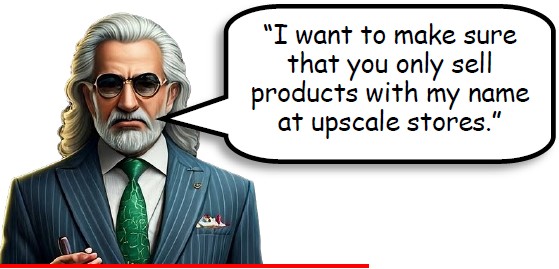
Smoothtalk says…
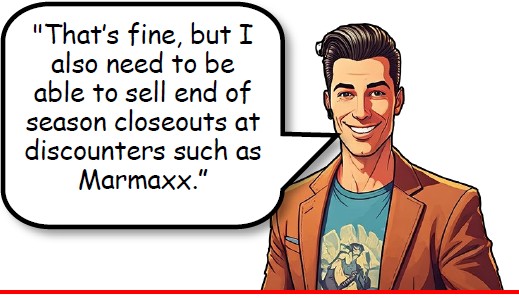
Glamoroso will want to cap those off price sales. More important, in today’s increasingly digital world, Smoothtalk wants internet rights. Glamoroso agrees to give him that right but only for sales of Licensed Products to U.S. customers, on a website Glamoroso approves.
Royalties and Advertising
Not wishing to upset their gastronomical pleasures, Glamoroso and Smoothtalk hold off talking about money issues until after their zuppa inglese and tiramisu arrive. Glamoroso tells Smoothtalk that he wants Too Hot to pay the greater of minimum annual royalties of $300,000, or percentage royalties of 12% of Too Hot’s net sales.
Glamoroso also wants another 3% to be paid to Glamoroso for advertising and social media. Smoothtalk almost chokes on his double espresso.
In virtually all license agreements, the Licensor will insist on guaranteed minimum royalties as against royalties
based on a percentage of sales, and often an advertising/social media payment or expenditure, as well.
Smoothtalk tells Glamoroso (and for good reason) that (a) twelve percent is too high, (b) he is not happy about paying such heavy minimum royalties for a trademark which has not been previously associated with jeans and (c) he is not happy about being required to pay for an expensive advertising/social media campaign he can’t control.
Glamoroso responds:
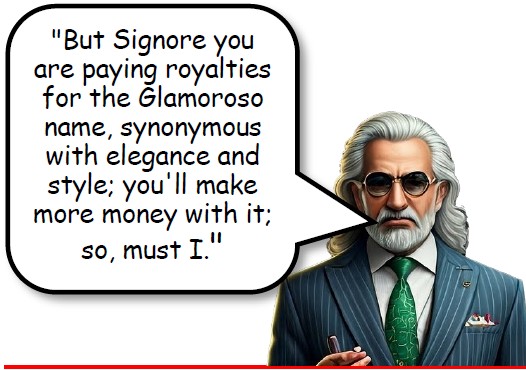
They compromise on annual minimum royalties of $200,000, percentage royalties of nine percent, and advertising/social media expenditures of three per cent, with two per cent to go to Glamoroso and one per cent to be spent by Too Hot.
Important Issues That Won’t Come Up at Lunch
Although the discussions of the principals on these business subjects may end here, there are issues that remain for the lawyers to hammer out. Termination provisions are often hotly negotiated.
The Licensor should include a long, specific list of misdeeds for which the Agreement can be terminated, with some of the worst misdeeds (e.g., sales outside the territory) being non-curable offenses, and a catch-all for all breaches. Licensees wish to get as many cure rights as possible and to limit non-curable
breaches.
Termination/Expiration poses two important issues. On termination for breach, the Licensor typically wants all unpaid minimum royalties for the remainder of the term to accelerate; the Licensee may try to cap that amount. The Licensee should also try to ensure that it can sell off its remaining inventory for a period of at least 120 days; the Licensor may well wish to preclude the sell off following a termination for a monetary breach and other serious breaches.
Glamoroso should make sure that Too Hot maintains adequate product liability insurance (at least $3 million), with Glamoroso named as an additional insured. Glamoroso wants to be protected if the indigo dye in the Glamoroso jeans bleeds on the white leather seats of a customer’s Ferrari.
Too Hot will want to be indemnified for any claim asserted by a third party that the use of the Glamoroso trademark violates the third party’s trademark rights. Glamoroso may try to limit the amount to be paid out under the indemnification to the amount of royalties paid by Too Hot. Smoothtalk should never accept that limitation.
Glamoroso should have Too Hot indemnify him for any non-trademark claim a third party asserts in connection with Too Hot’s exploitation of the Licensed Mark.
Conclusion
Don’t get lulled into ignoring key issues no matter how many license deals you have done; each agreement is different and requires your complete and careful scrutiny.