


DHC’s Economic Development and Tax Incentives Practice Group helps clients navigate tax incentive programs and economic development benefits from New York City and New York State economic development organizations. Our practice group has secured significant, often multi-million-dollar savings, for a diverse range of commercial and nonprofit clients. Meet our Economic Development and Tax Incentives Team.
NEW YORK ECONOMIC DEVELOPMENT ROUNDUP
Economic Development News & Intelligence 9/23/26
There are billions of dollars in New York tax incentives on the table right now for developers and business owners looking to expand or build — but accessing, applying for, and closing on them takes skilled legal guidance every step of the way. State Comptroller Thomas DiNapoli’s May report put a number on it: IDAs statewide granted nearly $2.1 billion in tax exemptions last year alone. Two recent deals show why that money is harder to capture than it looks. In Manhattan, the city’s IDA hit pause on a $100 million tax break for Tishman Speyer’s $2.7 billion 99 Hudson Boulevard tower, the kind of holdup that skilled and experienced government affairs professionals are often brought in to work through. Upstate, the Dutchess County IDA cleared a preliminary resolution for IBM’s proposed quantum computing facility in Poughkeepsie — a PILOT and sales tax package that could bring hundreds of jobs to the Mid-Hudson Valley, but only if the real estate, zoning, and land use pieces fall into place first. Whether a project needs financing structured, incentives negotiated, entitlements secured, or the right people at the table in Albany or City Hall, DHC’s economic development, project financing, real estate, zoning and land use, and government affairs teams handle it all under one roof — reach out if we can help.
BUILDING NEW YORK – DEVELOPMENT IN MOTION
Why New York’s Industrial Development Agencies Still Matter
More than five decades after the Legislature created IDAs to fight for jobs and investment, the tools they offer remain some of the only ones municipalities have to compete.
Seemingly every week, detractors question the need for Industrial Development Agencies (“IDAs”). They ask whether the financial incentives IDAs provide to businesses and real estate developers are legal, appropriate, and necessary. To understand why IDAs remain important today, however, it is useful to understand why the New York State Legislature created them in the first place.
The answer is straightforward: IDAs were created to promote economic development, attract and retain industry, encourage investment, create jobs, and prevent economic deterioration. More than five decades later, those objectives remain highly relevant. Throughout New York, IDAs provide an important tool for keeping businesses and investment while competing with jurisdictions that offer lower taxes and fewer regulatory and financial barriers to development.
Why New York Created IDAs
In the 1960s, New York faced significant competition for its industrial and manufacturing base. Other states sought to attract businesses through lower costs, tax advantages and other economic-development incentives. New York’s political and business leaders recognized the need for communities to have tools with which to compete for investment and jobs.

The legislation established their fundamental purpose: to promote, develop, encourage and assist industrial, manufacturing, warehousing, commercial, research and other qualifying facilities in order to advance job opportunities, general prosperity and the economic welfare of New Yorkers.

The legislative history also reflected a concern about economic competition within New York itself, including an “anti-pirating” provision intended to prevent one community from using an IDA to raid another community’s existing economic base. The basic premise has endured: local governments need economic-development tools that enable them to compete for businesses, capital investment and jobs.
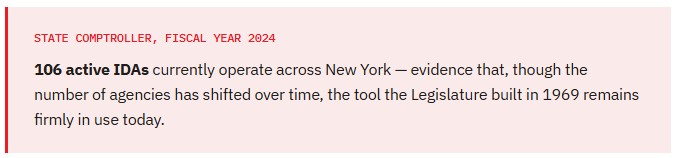
How IDAs Compete for Investment
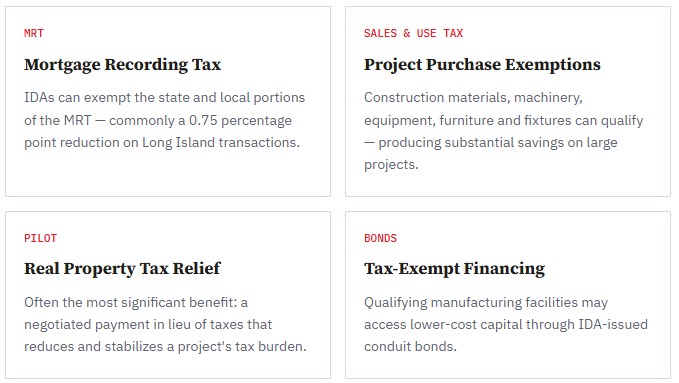
IDAs can provide financial assistance to eligible projects through several mechanisms, including exemptions from certain sales and use taxes, mortgage recording taxes and real property taxes. They may also facilitate tax-exempt bond financing for qualifying projects.
These incentives can reduce the cost of developing, expanding or modernizing a facility in New York. For businesses, that can make the difference between expanding an existing New York operation and moving that investment elsewhere. For developers, incentives can improve a project’s economics sufficiently to attract the debt and equity necessary to move a project forward.
The objective is not simply to reduce taxes. It is to encourage investment that otherwise may not occur, or may occur somewhere else.
Mortgage Recording Tax and Sales Tax
Two of the most readily quantifiable IDA benefits are exemptions from mortgage recording tax (“MRT”) and sales and use tax. For an approved IDA project, the IDA generally can exempt the state and local portions of the MRT, resulting in a substantial reduction in the project’s MRT burden. IDAs can also provide sales and use tax exemptions for qualifying purchases made in connection with an approved project — the exemption is project-specific and subject to the requirements of New York’s Industrial Development Agency law and Tax Law.
Consequently, the ability to eliminate sales tax on millions of dollars of eligible project expenditures can produce substantial savings.
The Most Important Incentive: Real Property Taxes
While sales tax and mortgage recording tax exemptions can materially reduce project costs, the most significant IDA benefit for many Long Island projects is the ability to provide real property tax relief through a payment in lieu of taxes (“PILOT”) agreement.
In a typical IDA transaction, the agency takes title to, or an interest in, the project property through a “straight lease” structure. The project company makes payments to the IDA under a negotiated PILOT agreement, and those payments are distributed to the affected taxing jurisdictions.
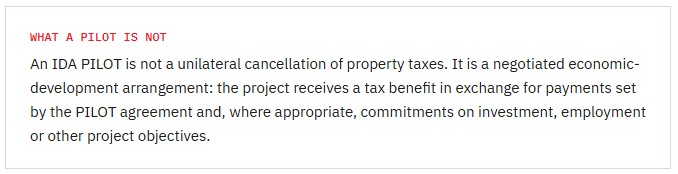
The amount and duration of a PILOT vary by project and IDA. A PILOT can therefore provide a project with a predictable and reduced tax burden during its development or stabilization period, while still providing revenue to the municipality, school district and other affected taxing jurisdictions.
In many areas of New York, where commercial real estate carries a particularly significant property-tax burden, the economics of a PILOT can be decisive. For some projects, the reduction and predictability of the property’s tax burden is what allows the project to obtain financing and achieve a viable return on investment.
Tax-Exempt Bond Financing
IDAs may also issue tax-exempt bonds for certain qualifying projects, including qualifying manufacturing facilities, subject to federal and state law. The important distinction is that the interest on qualifying tax-exempt bonds, rather than the bonds themselves, may receive favorable federal tax treatment — giving an eligible project access to lower-cost capital than conventional taxable financing, though the precise treatment depends on the type of bond and the applicable requirements of the Internal Revenue Code.
The importance of bond financing has declined somewhat from its peak in prior decades, when interest rates and the tax treatment of municipal bonds made IDA conduit financing particularly attractive. The State Comptroller has noted that outstanding IDA conduit debt has declined substantially over the past decade as private borrowing costs became more competitive. Nevertheless, bond financing remains an important tool for qualifying projects.
A Tool for Competition, Not a Substitute for Accountability
The debate over IDAs should not be reduced to whether businesses and developers should receive “tax breaks.” The more important question is whether a particular incentive produces a sufficient economic benefit to justify the public cost.
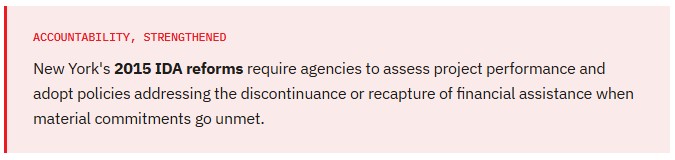
That is a legitimate question, and IDAs should be required to answer it. Projects should be evaluated individually, benefits should be transparent, job and investment commitments should be monitored, and appropriate clawback provisions should be used when recipients fail to meet material commitments.
But rejecting IDAs altogether would ignore the economic reality that led to their creation. New York competes every day with other states and jurisdictions for businesses, capital and development. If New York communities have no ability to respond to materially different tax structures and development economics elsewhere, some investment will inevitably go elsewhere.
The Legislature understood that reality in 1969. Governor Rockefeller understood it as well. The purpose of the IDA was to give local communities a mechanism to compete for investment, retain existing businesses, encourage modernization and create jobs. More than 50 years later, the underlying challenge has not disappeared — if anything, competition for businesses and capital has become more intense. IDAs remain one of the few tools available for New York municipalities to compete for private investment, retain existing businesses, encourage new development and expand the commercial tax base.
That is precisely what Governor Rockefeller envisioned when New York created IDAs in 1969 — and it remains their essential purpose today.
—————————————————
This article is for informational purposes only and does not constitute legal advice. Every situation is different, and you should consult with qualified counsel to evaluate your specific circumstances.