


No Operating Agreement, No Written Terms — Just Two Guys and a Restaurant
The Late-Night Deal-Maker — Informal Partnership
- This white paper is based on a composite of real cases handled by the DHC Hospitality & Restaurant Law Group. Names, locations, cuisines, and identifying details have been changed to protect client confidentiality. The legal principles discussed are illustrative and should not be relied upon as legal advice for any specific situation.
Some of the worst partnership disputes I see started on a cocktail napkin. Two people, a good idea, a few drinks, and a deal sealed with a handshake instead of a document. It feels like trust. It is actually a time bomb. Here is the good news, though, and it surprises people: the law does not leave you with nothing just because you never signed anything. Sometimes it fills the gaps better than the deal you would have negotiated.
The Setup
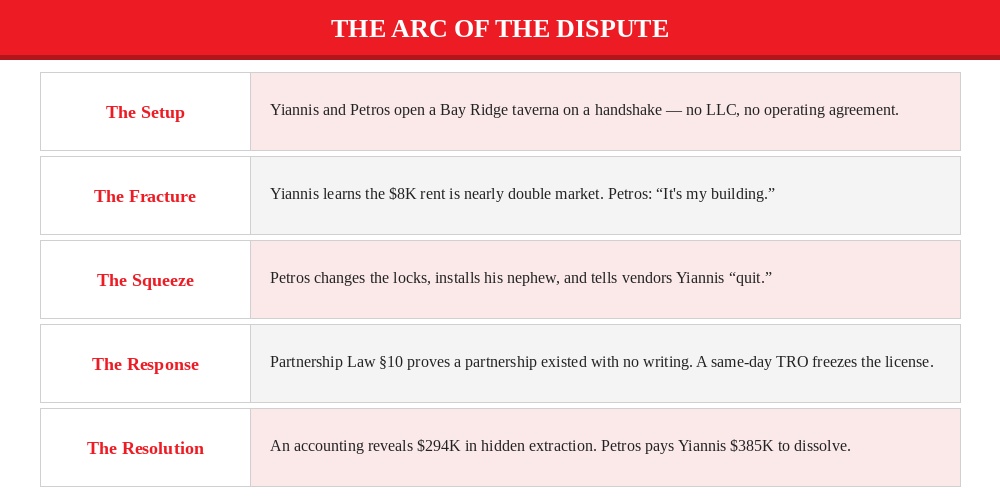
Yiannis and Petros met at a cousin’s wedding. Yiannis had spent fifteen years managing restaurants in Manhattan. Petros had cash from his family’s import business and a building in Bay Ridge with a vacant ground-floor space. Over scotch at the bar, they sketched the concept on a napkin: a modern Greek taverna. Yiannis would run it. Petros would fund it and provide the space.
They never signed an operating agreement. They never formed an LLC. They opened a joint bank account, got a liquor license in both names, agreed to a handshake lease between Petros’s building and the restaurant at $8,000 a month, and opened the doors. For three years it worked. Yiannis ran the place seven days a week. Petros collected his $8,000 in rent and pulled a $3,000 weekly draw out of the register.
The Fracture
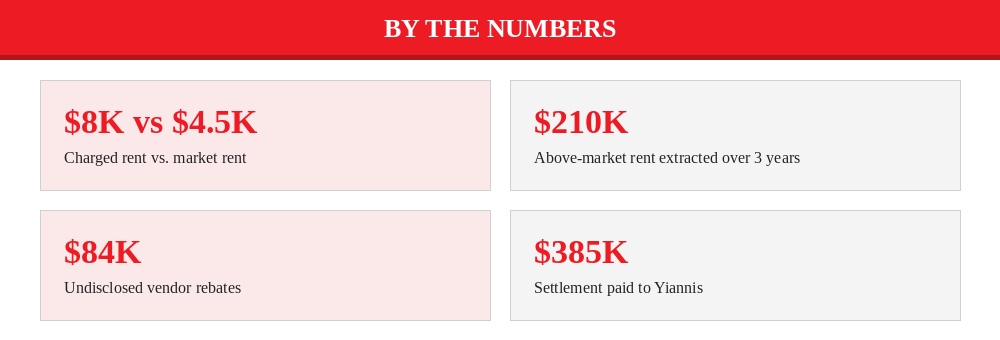
The fracture came when Yiannis found out that comparable rents on the block were $4,500, not $8,000. Petros had been charging nearly double market rate, which meant the “break-even” the restaurant had been running was actually a real profit, quietly siphoned off through the rent. When Yiannis raised it, Petros said: “It’s my building. I can charge whatever I want.” When Yiannis asked to see the books, Petros said: “What books? There’s no agreement. I own the building. You work here.”
The Squeeze
Petros changed the locks on a Sunday night. Monday morning, Yiannis’s key didn’t work. Petros had hired his nephew as the new manager and told the staff that Yiannis was “no longer involved.” He moved to transfer the liquor license to a new entity and told the vendors that Yiannis had “quit.” Yiannis had no operating agreement to point to, no partnership agreement, no formation documents. He had a napkin, a shared bank account, and three years of sweat.
The Response
Yiannis’s attorney filed a complaint asserting the existence of a general partnership under New York Partnership Law §10, which defines a partnership as an association of two or more persons to carry on as co-owners a business for profit. No written agreement is required. The evidence of partnership was everywhere: the joint bank account, the joint liquor license, shared decision-making documented in years of text messages, profit-sharing through the weekly draws, and Petros’s own statements to vendors calling Yiannis his “partner.”
At the same time, the attorney filed an emergency order to show cause seeking restoration of Yiannis’s access, a temporary restraining order stopping Petros from moving the liquor license, and an order compelling an accounting of all partnership income and expenses. The court granted the restraining order the same day.
The Resolution
Because the partnership was at-will, with no written term, either partner could dissolve it at any time. Yiannis elected to dissolve and demanded a full accounting. The accounting revealed that over three years, Petros had extracted roughly $210,000 in above-market rent and another $84,000 in undisclosed vendor rebates. Under Partnership Law’s default rules, Yiannis was entitled to fifty percent of partnership profits, adjusted upward for what Petros had improperly pulled out. The case settled with Petros paying Yiannis $385,000. Yiannis used it to open his own restaurant in Park Slope — this time with a proper LLC and a proper operating agreement.
The Lesson
Yiannis’s story has a happy ending, but do not take the wrong lesson from it. Yes, Partnership Law filled the gaps, and yes, the default rules — fifty-fifty profit sharing, full access to the books, fiduciary duties Petros could not waive because nothing was ever in writing — happened to favor him. But the absence of an agreement made everything harder, slower, more expensive, and more uncertain than it ever needed to be.
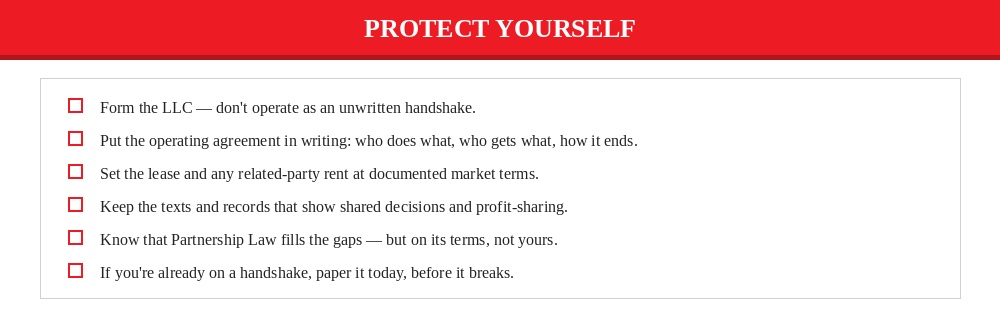
Form the LLC. Write the operating agreement. Spell out who does what, who gets what, and what happens when it ends. The twenty minutes and a few thousand dollars you spend now will save you two hundred thousand and two years later. And if you are already running on a handshake, fix it today — before the handshake breaks.
—————————————————
If you recognize your situation in this story, you’re not alone — and you have options.
The DHC Hospitality & Restaurant Law Group represents restaurant and hospitality owners in business divorce, partnership disputes, and ownership transitions throughout New York, backed by the firm’s more than 50 years of experience representing New York businesses.
Contact us for a confidential consultation:
Andreas Koutsoudakis, Esq. | Partner & Co-Chair
(212) 557-7200 | aak@dhclegal.com
This article is for informational purposes only and does not constitute legal advice. Every situation is different, and you should consult with qualified counsel to evaluate your specific circumstances.