


The Mechanical and Infrastructure Provisions Every NYC Restaurant Lease Must Address
Every restaurant needs to cook, and cooking produces exhaust, grease, and noise. In New York City, the mechanical systems that handle these byproducts—venting, grease traps, and sound attenuation—are among the most expensive, most regulated, and most litigated aspects of any restaurant lease.
I’ve seen deals fall apart over venting rights that didn’t exist, restaurants shut down over grease trap violations that could have been prevented, and operators trapped in years-long disputes with upstairs neighbors over noise and odors. These are not glamorous topics, but they are the mechanical backbone of every restaurant operation—and they need to be addressed in the lease before you sign.
This article covers the key mechanical and infrastructure provisions that every NYC restaurant lease should address.
Venting and Exhaust: The Make-or-Break Issue
A commercial kitchen requires a Type I exhaust hood with an ansul fire suppression system for any cooking that produces grease-laden vapors—which includes virtually every cooking method other than microwave and steam. The exhaust system must vent to the exterior of the building, typically through the roof, and comply with New York City mechanical code requirements.
Here’s where it gets complicated. Venting to the roof requires the landlord’s cooperation—you need the right to run ductwork through common areas, access the roof, and install a rooftop exhaust fan. In a multi-story building, the ductwork may need to run through multiple floors. In a landmarked building, the rooftop installation may require Landmarks Preservation Commission approval. In a residential building, the venting path may trigger objections from residents, co-op boards, or condominium associations.
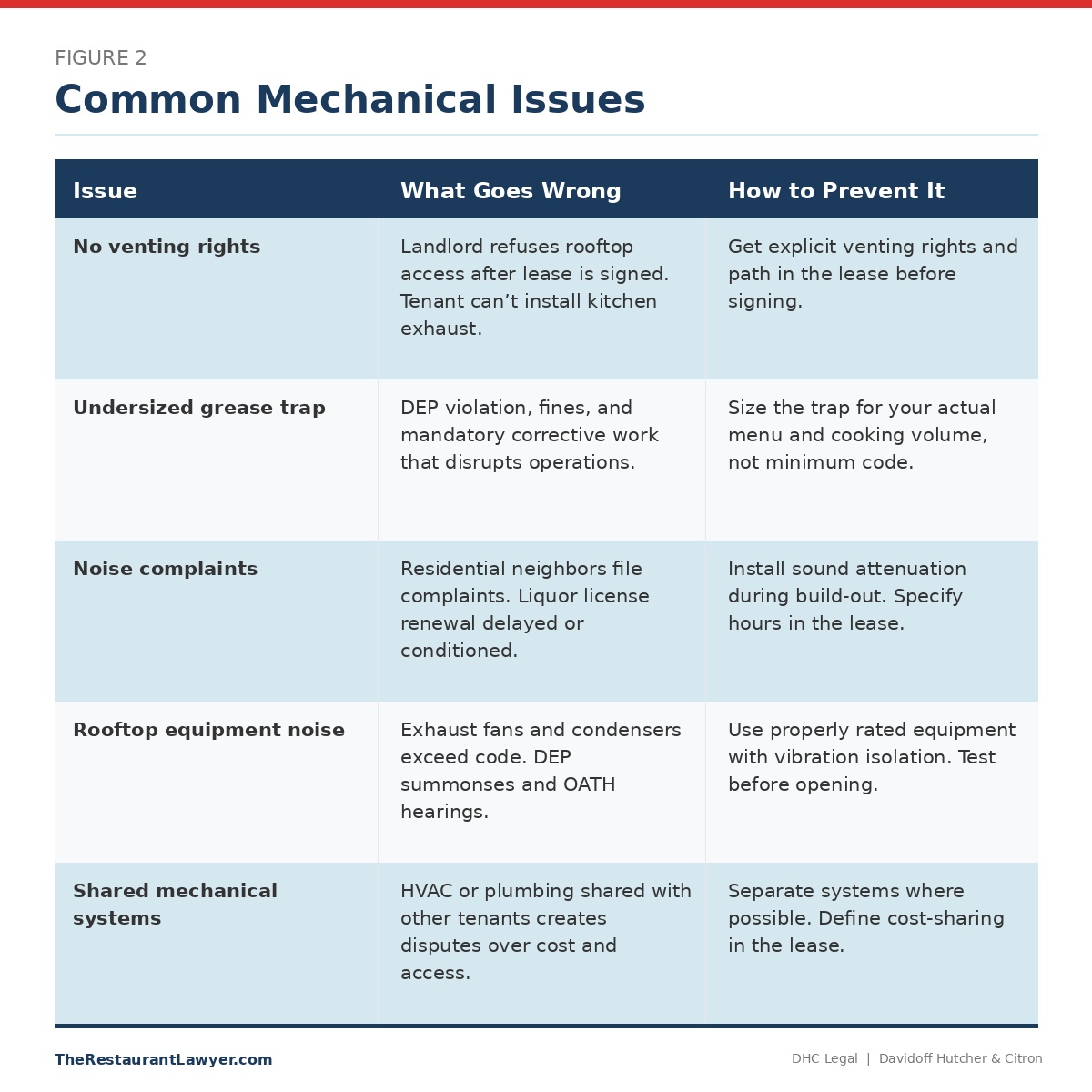
Your lease must explicitly grant you the right to install and maintain a venting system through the building to the roof. If this right is not in the lease, you don’t have it—and the landlord can refuse to grant it after the fact, effectively preventing you from operating a kitchen.
Verify before you sign. Confirm that a viable venting path exists from your space to the roof. Have your mechanical engineer inspect the building and identify any obstacles before you commit to the lease.
Specify the path in the lease. The lease or a mechanical exhibit should describe the venting route, the shaft or chase to be used, and any common-area access required.
Address maintenance and repair. Who is responsible for maintaining the exhaust system? Who pays for ductwork cleaning (required by fire code)? What happens if the system needs repair and the ductwork runs through another tenant’s space?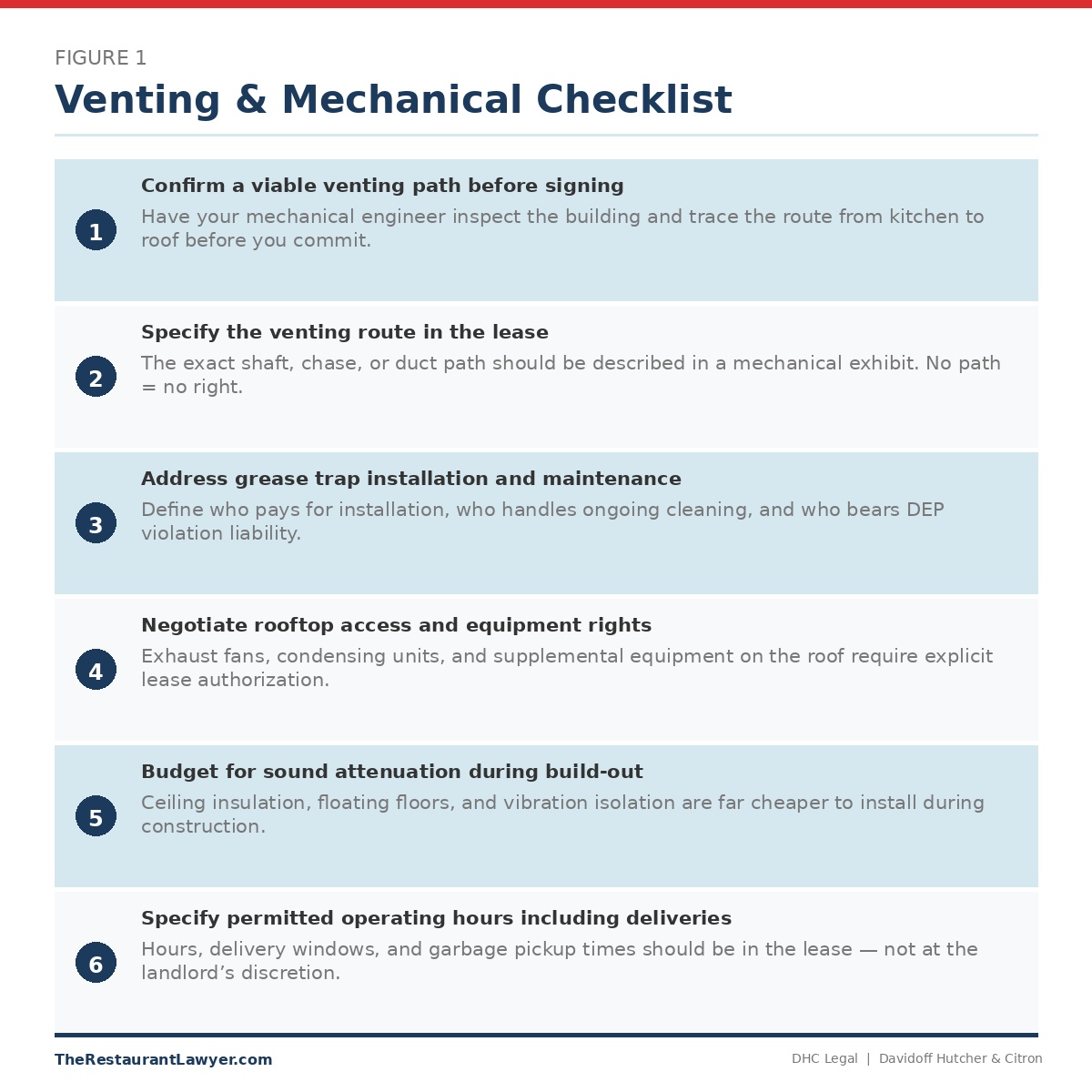
Grease Traps: Compliance and Liability
Every NYC restaurant that discharges wastewater with fats, oils, and grease (FOG) is required to install and maintain a grease trap or grease interceptor. The NYC Department of Environmental Protection (DEP) enforces grease trap regulations, and violations can result in fines, mandatory corrective work, and in severe cases, a sewer connection revocation that effectively shuts down the restaurant.
Grease trap size and placement are determined by the volume and type of food preparation. A full-service restaurant with a large kitchen will require a larger interceptor than a café with a prep-only kitchen. The trap must be accessible for cleaning, which typically means it’s installed in the floor of the kitchen or in a basement mechanical area.
Your lease should address who pays for grease trap installation, who is responsible for ongoing maintenance and cleaning (typically every 30 to 90 days), and who bears liability for DEP violations. Many landlords try to shift all grease trap responsibility to the tenant. That’s reasonable for maintenance, but the landlord should bear responsibility for any pre-existing grease trap infrastructure that doesn’t meet current code when the tenant takes possession.
Noise: The Neighbor Problem
Restaurants generate noise—kitchen exhaust fans, HVAC compressors, music, patron noise, deliveries, and garbage pickup. In a mixed-use building with residential tenants above or adjacent, noise complaints are virtually inevitable. The question is whether your lease protects you or exposes you.
NYC noise code (Administrative Code §24-218 and related provisions) sets specific decibel limits for commercial operations. Exceeding these limits can result in DEP summonses, OATH hearings, and fines. But even noise within legal limits can generate complaints from neighbors, co-op boards, and community boards that create practical problems for your business—delayed liquor license renewals, conditional permits, and hostile landlords.
Negotiate lease provisions that acknowledge the nature of restaurant operations—late hours, deliveries, kitchen noise—and protect you from landlord interference as long as you’re operating within code. If the landlord is also the landlord for residential units above, make sure the lease doesn’t give the landlord a unilateral right to restrict your hours or operations based on noise complaints alone.
Sound attenuation. Budget for professional sound engineering during the build-out. Ceiling and wall insulation, floating floors, and HVAC vibration isolation are far cheaper to install during construction than to retrofit after the neighbors start complaining.
Hours of operation. Your lease should specify your permitted operating hours, including delivery windows and garbage pickup times. Don’t leave this to the landlord’s discretion.
Rooftop equipment. Exhaust fans and condensing units on the roof generate noise that travels. Make sure your rooftop equipment meets noise code requirements and is properly isolated and maintained.
Conclusion
Venting, grease traps, and noise are the mechanical realities of operating a restaurant in New York City. They’re not negotiable—you need venting to cook, grease traps to discharge wastewater legally, and sound attenuation to coexist with your neighbors. What is negotiable is how these requirements are addressed in your lease.
A lease that ignores mechanical infrastructure or shifts all risk to the tenant is a lease that creates problems. Address these issues before you sign—not after the first noise complaint or DEP violation.
If you’re evaluating a restaurant space and want help assessing the mechanical and infrastructure provisions in the lease, let’s talk.
—————————————————
About the Author
Andreas Koutsoudakis is a Partner and Co-Chair of the Hospitality & Restaurant Law Group at Davidoff Hutcher & Citron LLP. His practice focuses on the restaurant and hospitality industry, backed by the firm’s more than 50 years of experience representing New York businesses. He can be reached at aak@dhclegal.com.
This article is for informational purposes only and does not constitute legal advice. Every situation is different, and you should consult with qualified counsel to evaluate your specific circumstances.