

What Your Lease Says You Can Do — and What It Doesn’t
The use clause is one of the most consequential provisions in any restaurant lease—and one of the most overlooked during negotiations.
I’ve seen restaurant owners spend weeks negotiating rent, free rent periods, and build-out allowances, only to sign a lease with a use clause so narrow it prevents them from adding a brunch service, switching cuisines, or bringing in a liquor license. The use clause defines what you can do in your space. If it’s drafted poorly, it defines what you can’t do—and that list can grow in ways you didn’t anticipate.
This article covers how use clauses work in NYC restaurant leases, what to negotiate for, and the specific traps that catch operators off guard.
What the Use Clause Actually Controls
At its core, the use clause specifies the permitted purposes for which you can occupy and operate in the leased premises. In a restaurant lease, this typically means something like “the operation of a full-service restaurant serving food and beverages for on-premises consumption.”
That sounds straightforward, but every word matters. “Full-service” may exclude fast-casual or counter-service models. “On-premises consumption” may exclude delivery-only or ghost kitchen operations. “Food and beverages” without specifying “alcoholic beverages” may create ambiguity about your liquor license. Landlords draft use clauses to be narrow. Your job is to make them broad enough to accommodate how your restaurant actually operates—and how it might need to evolve.
Exclusive Use: Protecting Your Concept
In a multi-tenant building or retail complex, an exclusive use clause prevents the landlord from leasing to another tenant who would directly compete with your restaurant. This is especially important in mixed-use buildings, food halls, hotel lobbies, and shopping centers where the landlord controls the tenant mix.
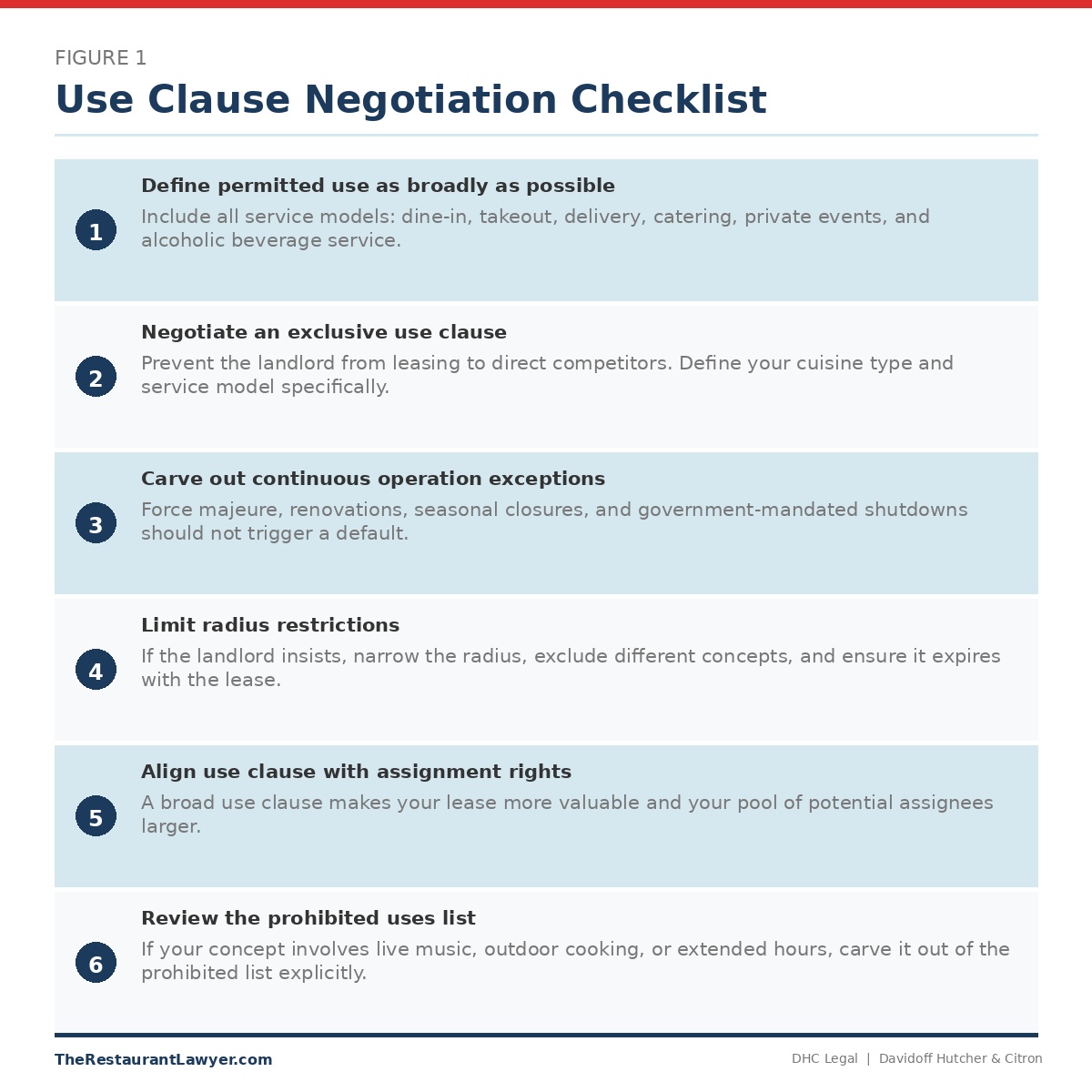
A well-drafted exclusive should cover your specific cuisine type, your service model, and your hours. If you operate a Mexican restaurant, you don’t want the landlord leasing the space next door to a taqueria. But you also need to be realistic—landlords will resist overly broad exclusives that restrict their ability to lease to any food-related tenant.
The negotiation sweet spot is usually an exclusive that covers your specific cuisine or concept within a defined area (the building, the floor, or a radius) without overreaching into categories that don’t actually compete with your operation.
Continuous Operation Clauses: The Trap Nobody Reads
Many restaurant leases include a continuous operation clause requiring the tenant to remain open for business during specified hours throughout the lease term. This sounds harmless until you need to close for renovations, deal with a kitchen fire, ride out a slow season, or respond to a public health emergency.
If your lease requires continuous operation and you close—even temporarily—the landlord may argue you’re in default. Some continuous operation clauses are tied to co-tenancy provisions in retail settings, meaning your closure can trigger other tenants’ rights. Others are tied to percentage rent calculations, giving the landlord a financial incentive to enforce them aggressively.
Negotiate carve-outs for force majeure events, renovations with landlord consent, and seasonal closures if your concept warrants them. At minimum, make sure the clause specifies that temporary closures for repairs, casualty, or government-mandated shutdowns do not constitute a default.
Radius Restrictions
Some landlords—particularly in shopping centers and hotel properties—impose radius restrictions preventing you from opening a similar restaurant within a defined geographic area. The theory is that your second location would cannibalize sales at the leased premises, reducing the landlord’s percentage rent.
For a single-location operator, this may not matter. But if you plan to grow, a broad radius restriction can limit your expansion options for the entire lease term. Negotiate the radius down to a reasonable distance, exclude different concepts or cuisine types, and make sure the restriction doesn’t survive lease termination.
Assignment and Use Clause Interaction
Your use clause directly affects your ability to assign the lease or sublease the space. If the use clause is narrowly drawn—say, “operation of a Japanese omakase restaurant”—then any assignee must operate the same concept, dramatically reducing your pool of potential buyers. A broader clause like “operation of a restaurant serving food and alcoholic beverages” gives future operators flexibility and makes your lease more valuable as an asset.
This is especially important for exit planning. If you want to sell the restaurant and assign the lease, the use clause needs to be broad enough to attract buyers who may want to operate a different concept in the same space.
Landlord Consent and Prohibited Uses
Most leases include a separate list of prohibited uses—activities the tenant cannot conduct regardless of the use clause. Common prohibited uses in restaurant leases include live entertainment above a certain decibel level, hookah or smoking lounges, adult entertainment, and certain types of food preparation that generate excessive odors or require specialized venting.
Review the prohibited use list carefully before signing. If your concept involves live music, outdoor cooking, or any activity that might fall into a gray area, get it specifically carved out of the prohibited list or specifically included in the permitted use clause. Ambiguity here always favors the landlord.
Conclusion
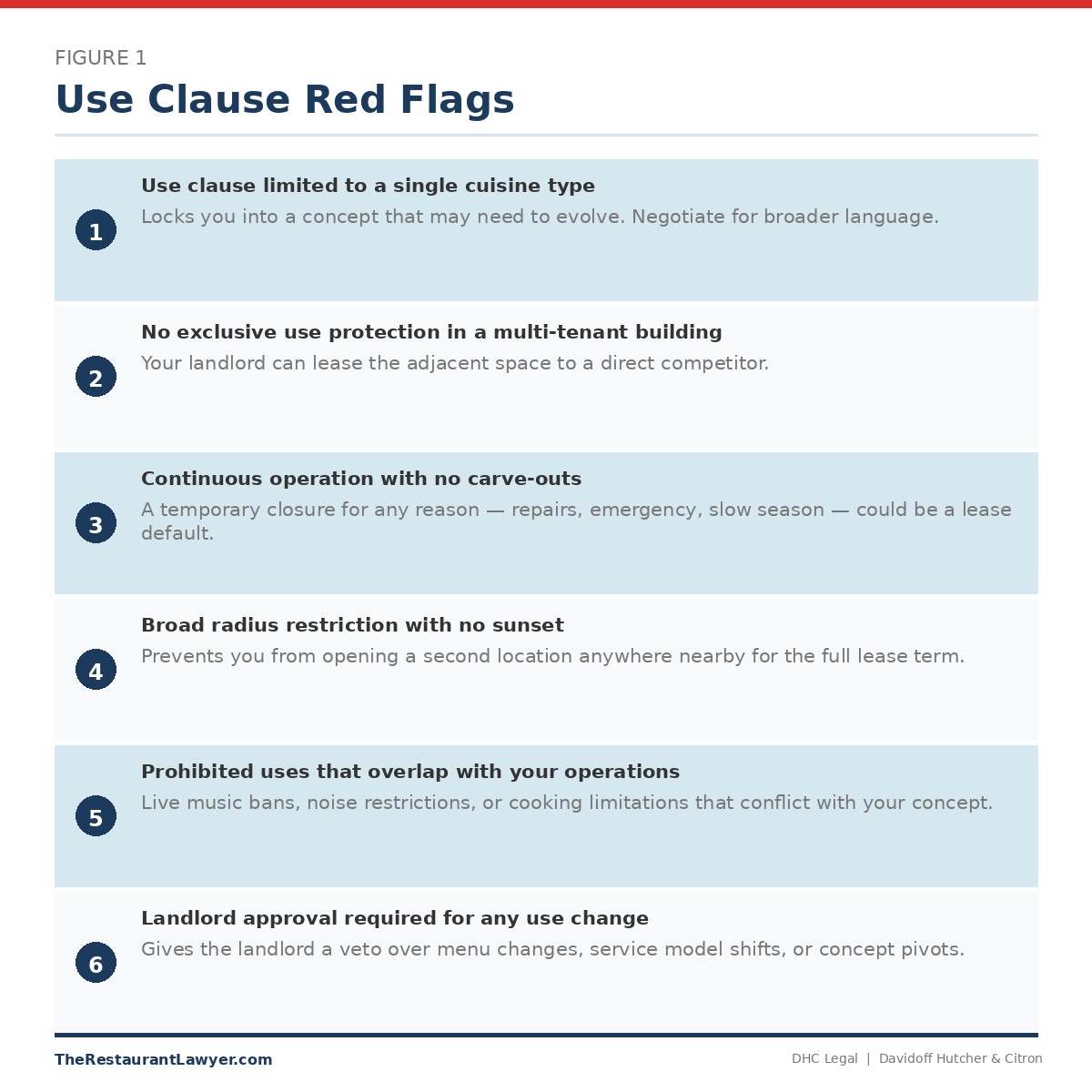
The use clause sets the boundaries of what your restaurant can be—today and for the entire lease term. A clause that’s too narrow locks you into a concept that may need to evolve. A clause without an exclusive leaves you vulnerable to direct competition from your own landlord’s other tenants. A continuous operation requirement without carve-outs turns a temporary closure into a lease default.
Negotiate the use clause with the same intensity you bring to the rent number. It’s not boilerplate—it’s the operating framework for your business.
If you’re reviewing a lease and want help evaluating the use clause and related restrictions, let’s talk.
—————————————————
About the Author
Andreas Koutsoudakis is a Partner and Co-Chair of the Hospitality & Restaurant Law Group at Davidoff Hutcher & Citron LLP. His practice focuses on the restaurant and hospitality industry, backed by the firm’s more than 50 years of experience representing New York businesses. He can be reached at aak@dhclegal.com.
This article is for informational purposes only and does not constitute legal advice. Every situation is different, and you should consult with qualified counsel to evaluate your specific circumstances.