


When the Third Partner Becomes the Swing Vote in Someone Else’s War
Three-Way Dispute — Coalition Dynamics
- This white paper is based on a composite of real cases handled by the DHC Hospitality & Restaurant Law Group. Names, locations, cuisines, and identifying details have been changed to protect client confidentiality. The legal principles discussed are illustrative and should not be relied upon as legal advice for any specific situation.
Three-partner restaurants have a hidden instability built right into the math. The moment two partners disagree, the third stops being a colleague and becomes an electorate — and the other two stop persuading each other and start campaigning. I have watched good restaurants grind to a halt this way, not because anyone was acting in bad faith, but because nobody designed the governance to survive an alliance.
The Setup
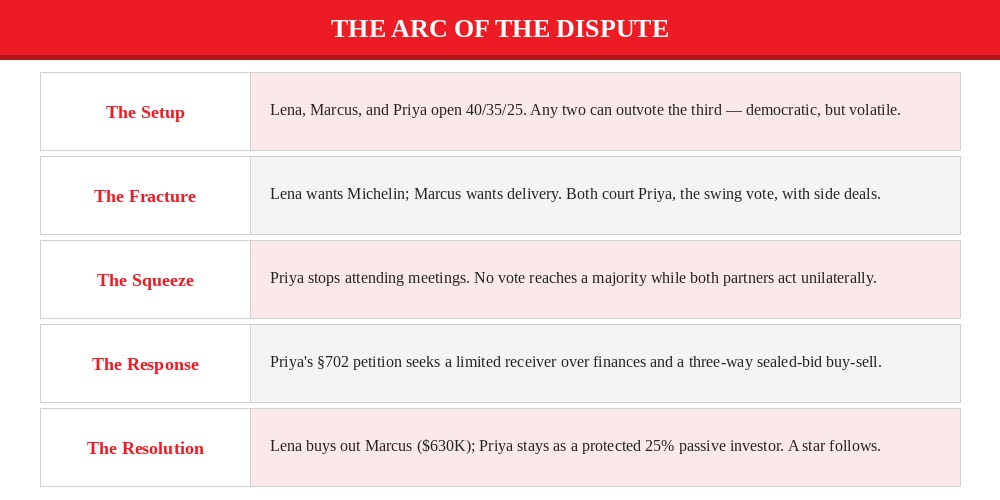
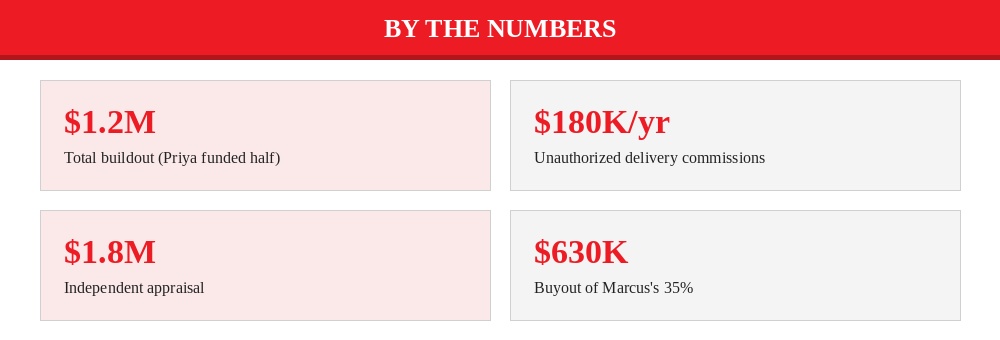
Lena (forty percent), Marcus (thirty-five percent), and Priya (twenty-five percent) opened a contemporary Indian restaurant in the East Village. Lena was the chef. Marcus ran the front of house and the beverage program. Priya was the investor, putting in $600,000 of the $1.2 million buildout while Lena and Marcus each contributed $300,000. The operating agreement required a majority-in-interest vote for major decisions. Since no one held a majority alone, any two of the three could outvote the third — democratic in theory, volatile in practice.
The Fracture
By year three, Lena and Marcus wanted fundamentally different restaurants. Lena wanted a Michelin star — elevated plating, premium ingredients, tasting menus. Marcus wanted delivery and catering — volume over exclusivity. Both visions were legitimate, and they were completely incompatible. Priya became the swing vote, and both of the others began courting her — not on the merits, but with side deals. Marcus offered to back her request for higher distributions if she voted for delivery. Lena offered to reduce Priya’s capital call on the kitchen renovation if she backed the Michelin push. The partnership turned into a political campaign with Priya as the voter.
The Squeeze
The squeeze came from both sides at once. Lena, sensing Priya drifting toward Marcus, started making kitchen decisions unilaterally — premium ingredients, a new pastry chef, menu changes — without the required vote. Marcus retaliated by signing a delivery-platform contract committing the restaurant to thirty-percent commissions Lena had never agreed to. Priya, exhausted by the lobbying, stopped coming to member meetings entirely — and without her, no vote could reach a majority. The restaurant was deadlocked on every strategic question while both working partners made unauthorized moves the operating agreement didn’t allow.
The Response
It was Priya’s attorney — not Lena’s or Marcus’s — who filed the petition, under LLC Law §702, arguing it was no longer reasonably practicable to carry on the business: the members couldn’t reach the required majority, both working partners were acting without authority, the strategic direction was incoherent, and the governance breakdown was doing real financial harm — the unauthorized delivery deal alone was costing $180,000 a year in commissions Priya had never approved. The petition asked the court to appoint a limited receiver over financial decisions to stop further unauthorized spending, and proposed a three-way sealed-bid buy-sell.
The Resolution
Mediation produced something better than dissolution. Rather than tear the restaurant down, the mediator proposed a restructuring: Lena would buy Marcus’s thirty-five percent (valued at $630,000 against an $1.8 million appraisal of the whole), and Priya would stay on as a twenty-five percent passive investor — but with real protection this time: quarterly reporting, an annual independent audit, consent rights over related-party deals, and a put option letting her sell at appraised value after year five. Marcus took his proceeds and opened his own delivery-focused concept. Lena pursued the star, and earned it within eighteen months.
The Lesson
The three-partner structure can work beautifully, but only if the operating agreement anticipates coalitions. The swing-vote problem will paralyze governance even when nobody is acting in bad faith — so you have to design around the human tendency to build alliances.
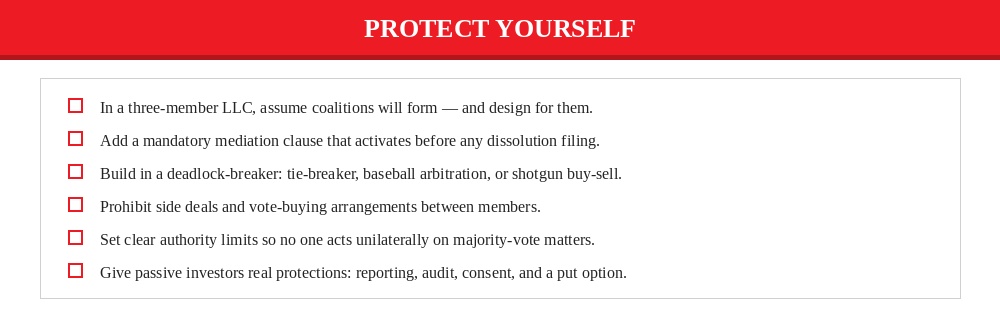
Build the guardrails in at formation. A three-way partnership without a tie-breaker and clear authority limits isn’t a partnership — it’s a pending election.
—————————————————
If you recognize your situation in this story, you’re not alone — and you have options.
The DHC Hospitality & Restaurant Law Group represents restaurant and hospitality owners in business divorce, partnership disputes, and ownership transitions throughout New York, backed by the firm’s more than 50 years of experience representing New York businesses.
Contact us for a confidential consultation:
Andreas Koutsoudakis, Esq. | Partner & Co-Chair
(212) 557-7200 | aak@dhclegal.com
This article is for informational purposes only and does not constitute legal advice. Every situation is different, and you should consult with qualified counsel to evaluate your specific circumstances.