

In a restaurant sale, the letter of intent sets the price and the purchase agreement decides how much of it the seller keeps. One owner capped what she could owe after closing and gave back $52,500; another signed the buyer’s draft and gave back $810,000.
Selling the Restaurant: The Purchase Agreement
- This white paper is based on a composite of real matters handled by the DHC Hospitality & Restaurant Law Group. Names, locations, cuisines, and identifying details have been changed to protect client confidentiality. The legal principles discussed are illustrative and should not be relied upon as legal advice for any specific situation.
Most owners think the negotiation ends when the letter of intent is signed and the price is set. It does not. The purchase agreement decides what the seller promises about the business, how long those promises last, and how much the buyer can take back if one of them turns out to be wrong. This is the story of an owner who negotiated those terms as hard as she negotiated the price, and of a peer who signed the buyer’s form so he could close by year end.
The Offer
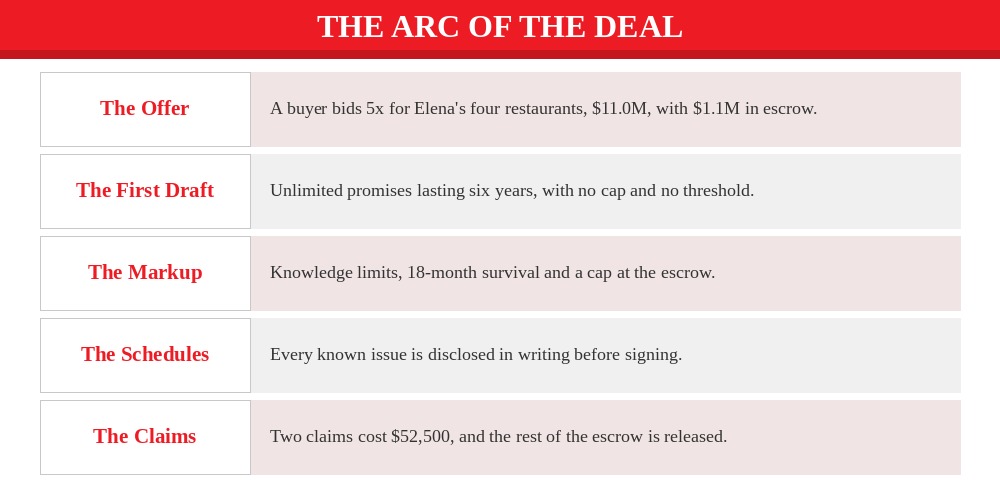
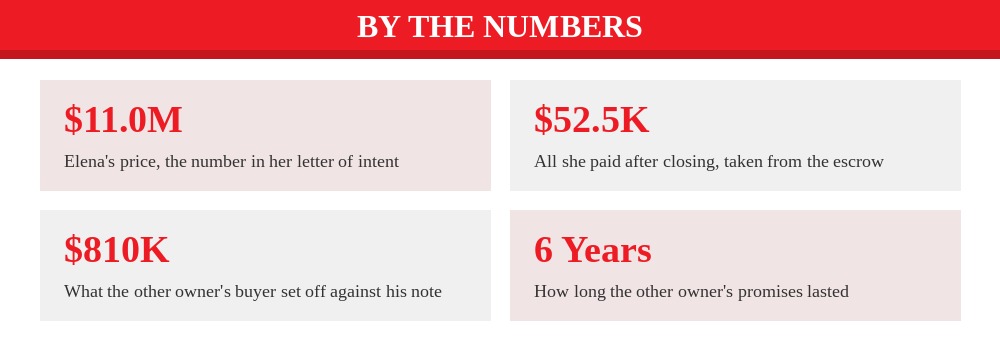
Elena built a four-location Mediterranean group in Queens and Brooklyn over eleven years. The four restaurants brought in about $17 million a year in sales and earned about $2.2 million before interest, taxes, depreciation and amortization. A buyer backed by a family office offered five times earnings, $11.0 million, for the assets. The letter of intent set the price and provided that ten percent of it, $1.1 million, would be held in escrow after closing. It left everything else to the purchase agreement.
The First Draft
The buyer’s counsel sent the first draft three weeks after the letter was signed. In it, Elena promised that every employee had been paid correctly for the past six years and that the business had complied with every law, whether or not she knew of a problem. Each promise would last six years after closing. Her liability for a broken promise had no ceiling and no threshold, so the buyer could claim the cost of a single repair, and once the escrow ran out the buyer could pursue her personally.
The Markup
Elena’s deal counsel returned a markup within a week. Promises about the operations were limited to what Elena and her managers actually knew. Ordinary promises would last eighteen months, long enough for the buyer to run a full year of books and file its first tax returns. Promises about her title to the assets and her taxes would last until the limitations period for those claims ran. Her total liability for ordinary promises was capped at the $1.1 million escrow, and the escrow was the buyer’s only source of recovery for them. The buyer could make no claim until its losses passed $82,500, three quarters of one percent of the price, and then only for the amount above that figure. The agreement made these terms the buyer’s only remedy, except for actual fraud, so a claim could not be restyled as negligence to get around the cap. The buyer accepted most of the markup. Its diligence had found nothing Elena had not already disclosed, and it had little reason to insist on protection against risks it had already priced.
The Schedules
Every exception to a promise went into the disclosure schedules, in writing and in detail. They listed a pending slip-and-fall claim covered by insurance, a health department violation that had been corrected, a walk-in cooler at one location that would need replacement within two years, and a payroll review Elena had commissioned the year before, with the back pay she had paid. The agreement said that a problem disclosed in the schedules could not be the basis of a claim after closing.
The Other Owner
An owner Elena knew from the industry sold his three-location group the same year for $7.5 million. He wanted to close before year end, and he signed the buyer’s draft with few changes. His promises had no knowledge limit and lasted six years. His liability had no cap and no threshold, and the buyer could set off any claim against the $1.5 million note it owed him for part of the price. His escrow was released after twelve months.
The Claims
Eighteen months after closing, Elena’s buyer had made two claims: a supplier rebate dispute of $40,000 and a former server’s wage claim that settled for $95,000. The total, $135,000, passed the $82,500 threshold by $52,500, and that amount came out of the escrow. The remaining $1,047,500 was released to her on schedule, and she never wrote a check. Fourteen months after her colleague’s closing, a former line cook brought a class action against his buyer over wages from the years before the sale. The buyer was named as the successor employer alongside him, so the defense fell to it, and it looked to him for the money. It settled the case for $640,000 and spent $85,000 on the defense. It then claimed another $85,000 for a cooler repair and a disputed common-area charge under one of the leases. With the escrow already released, the buyer stopped paying his note and set off the full $810,000, more than ten percent of his price, two years after he thought the deal was done.
The Lesson
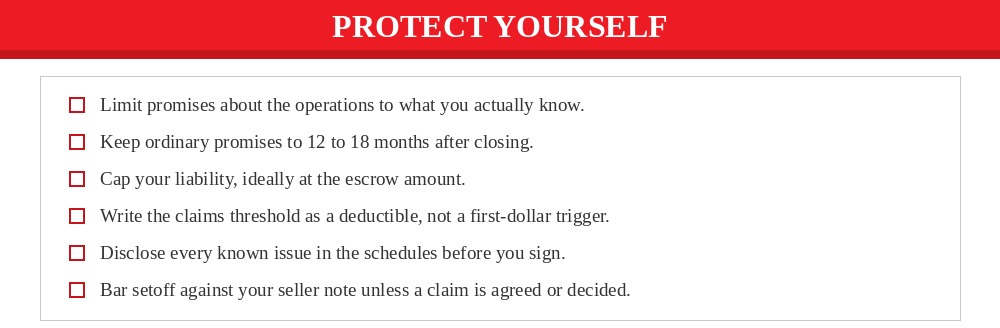
The letter of intent sets the price, and the purchase agreement decides how much of it you keep. Limit promises about the operations to what you and your managers actually know. Keep ordinary promises short, twelve to eighteen months, and give longer periods only to promises about title and taxes. Cap your liability, ideally at the escrow, and make the escrow the buyer’s only source of recovery for ordinary claims. Set a threshold the buyer’s losses must pass before any claim, and write it as a deductible so you pay only the excess. Disclose every known issue in the schedules, and say in the agreement that a disclosed problem cannot support a claim. Do not let the buyer set off claims against a note it owes you unless the claim has been agreed or finally decided.
Elena’s business had the same ordinary problems as her colleague’s. The difference was that she settled, before she signed, how long her promises would last and how much they could cost her.
If you recognize your situation in this story, you are not alone, and you have options.
The DHC Hospitality & Restaurant Law Group represents restaurant and hospitality owners in sales, acquisitions, partnership disputes, and ownership transitions throughout New York, backed by the firm’s more than 50 years of experience representing New York businesses.
—————————————
Contact us for a confidential consultation:
Andreas Koutsoudakis, Esq. | Partner & Co-Chair
(212) 557-7200 | aak@dhclegal.com
This article is for informational purposes only and does not constitute legal advice. Every situation is different, and you should consult with qualified counsel to evaluate your specific circumstances.