


When One Working Partner Carries the Weight and the Other Cashes the Checks
Two Working Partners — Asymmetric Effort
- This white paper is based on a composite of real cases handled by the DHC Hospitality & Restaurant Law Group. Names, locations, cuisines, and identifying details have been changed to protect client confidentiality. The legal principles discussed are illustrative and should not be relied upon as legal advice for any specific situation.
Not every business divorce starts with a fight. Some start with a slow fade — a partner who comes in later, then less often, then barely at all, while the paycheck stays exactly the same. There is no lock change, no emptied account, no dramatic confrontation. There is just one partner working eighty hours a week and another collecting half of everything for ten. It is one of the most common situations I see, and one of the least understood, because the disengaging partner rarely thinks of himself as doing anything wrong.
The Setup
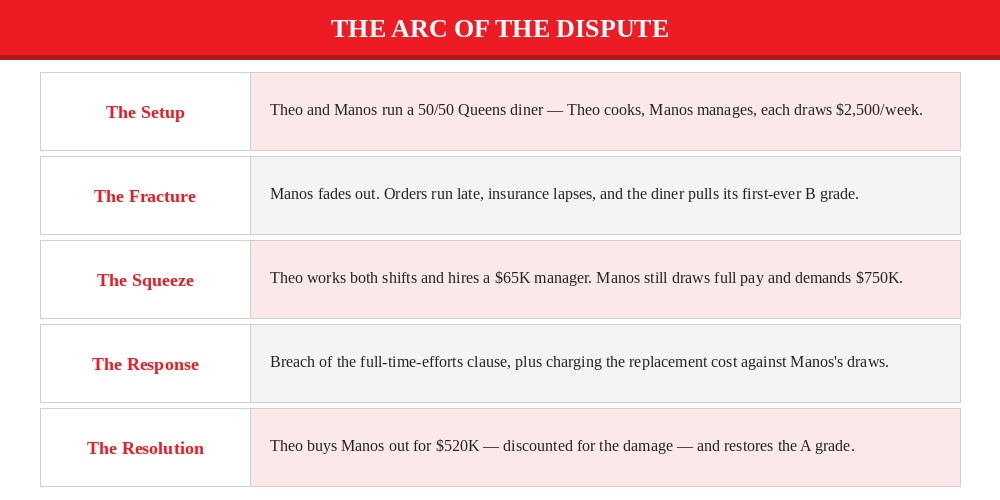
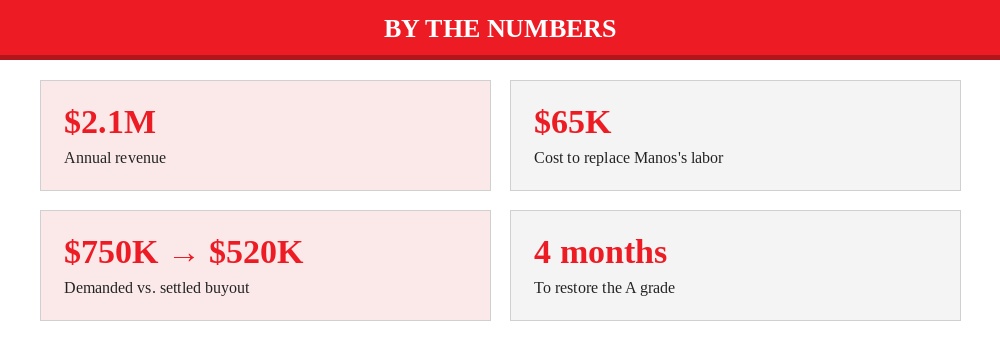
Theo and Manos opened a Greek diner in Forest Hills as equal partners. Both were hands-on from the start. Theo ran the kitchen, six in the morning to three in the afternoon, six days a week. Manos ran the front of house and the business side — vendor orders, payroll, banking — from three until close. A classic division of labor: Theo cooked, Manos managed. They each drew $2,500 a week and split whatever was left fifty-fifty each quarter. For three years, both men worked every shift, and the diner did a steady $2.1 million a year.
The Fracture
Then Manos started coming in later, then less often, telling Theo he was “handling things remotely.” But the vendor orders were going in late, the payroll was occasionally wrong, and the bookkeeping was falling behind. Health-inspection prep, which Manos had always run, got neglected — and the diner pulled its first non-A grade in its history, a B. By the next year, Manos was showing up maybe twice a week for a few hours. Theo was covering both shifts, six in the morning to eleven at night, seven days a week. He hired a front-of-house manager to fill the gap, at $65,000 a year. Manos kept drawing his $2,500 a week and his half of every distribution.
The Squeeze
This wasn’t a classic squeeze-out. Manos wasn’t trying to push Theo out; he was just checking out — a real-estate side business, a new relationship, and a fading appetite for the grind of diner life. But disengagement has consequences. Theo was working double for the same pay, the food was slipping, and the $65,000 cost of replacing Manos’s labor came straight out of the margin both men shared. When Theo finally confronted him, Manos called his contributions “strategic, not operational,” and when Theo pointed to the three-months-behind bookkeeping, the lapsed insurance, and two vendor accounts sent to collections, Manos shrugged: “If you don’t like how I do things, buy me out.” His number was $750,000 — half the diner’s value — for a partner who hadn’t worked a full week in eighteen months.
The Response
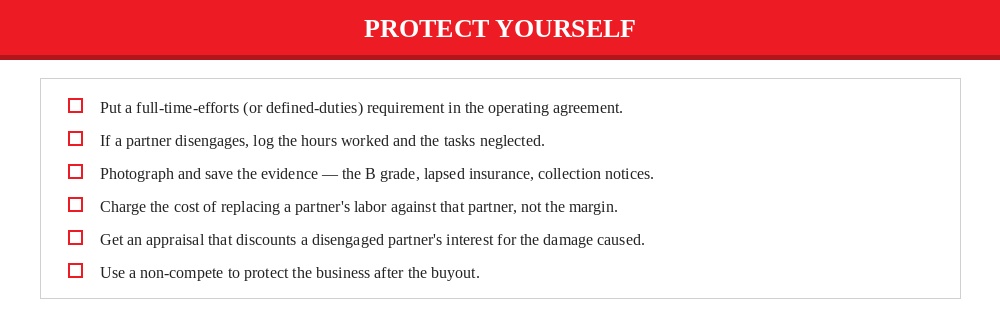
Theo’s attorney worked two tracks. First, breach of the operating agreement: the OA required both members to devote their full-time efforts to the business, and Manos’s withdrawal was a material breach that opened the door to terminating his management role and adjusting his compensation. Second, the economics: the fifty-fifty draw rested on an assumption that both partners would contribute equally, and the $65,000 cost of replacing Manos’s labor was a direct consequence of his breach — a cost that belonged against his draws, not the diner’s shared margin.
The attorney also retained an appraiser, who valued the diner at $1.4 million but argued Manos’s half should be discounted for the damage his absence had caused: the B grade (an estimated fifteen percent hit to foot traffic), the lapsed insurance, the delinquent vendor accounts, and the months of unreconstructed books.
The Resolution
The case settled in a structured buyout. Theo bought Manos’s fifty percent for $520,000 — well below the $750,000 Manos had demanded, reflecting the damage — financed over three years and secured by the diner’s assets. Manos signed a two-year, three-mile non-compete. Theo hired a full-time operations manager and had the diner back to an A grade within four months.
The Lesson
There are two lessons here. For the working partner: document the disparity. Keep a log of hours and tasks, photograph the B grade, save the collection notices, screenshot the bookkeeping dashboard with its empty months. That record is the foundation of both the breach claim and the valuation discount.
And for the partner who is coasting: your fifty percent is worth half of a well-run business, not half of one you’re letting rot. The longer you coast, the less your share is worth — because the damage gets charged against you at the buyout table.
—————————————————
If you recognize your situation in this story, you’re not alone — and you have options.
The DHC Hospitality & Restaurant Law Group represents restaurant and hospitality owners in business divorce, partnership disputes, and ownership transitions throughout New York, backed by the firm’s more than 50 years of experience representing New York businesses.
Contact us for a confidential consultation:
Andreas Koutsoudakis, Esq. | Partner & Co-Chair
(212) 557-7200 | aak@dhclegal.com
This article is for informational purposes only and does not constitute legal advice. Every situation is different, and you should consult with qualified counsel to evaluate your specific circumstances.