


When a Surviving Spouse Inherits a Partnership Interest They Never Asked For
The Silent Spouse — Inherited Interest
- This white paper is based on a composite of real cases handled by the DHC Hospitality & Restaurant Law Group. Names, locations, cuisines, and identifying details have been changed to protect client confidentiality. The legal principles discussed are illustrative and should not be relied upon as legal advice for any specific situation.
Grief is a terrible negotiating position, and the people on the other side of these cases know it. A spouse inherits half of a restaurant they only ever saw from the dining room, the surviving partner says “don’t worry, I’ll take care of everything,” and for a while the checks come and everyone stays polite. Then the checks slow down, the questions go unanswered, and the inheritance quietly shrinks. I want every surviving spouse to understand one thing up front: what you inherited is not a favor. It is a legal right with a determinable value.
The Setup
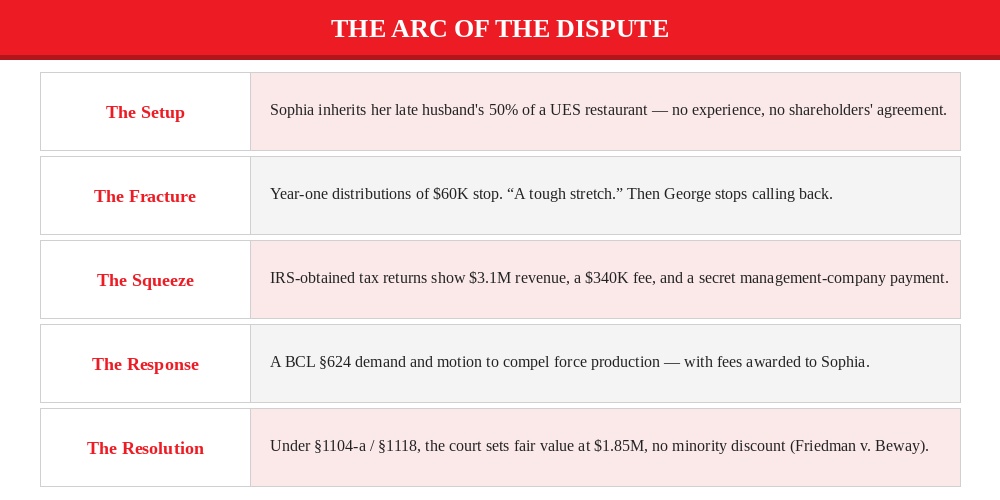
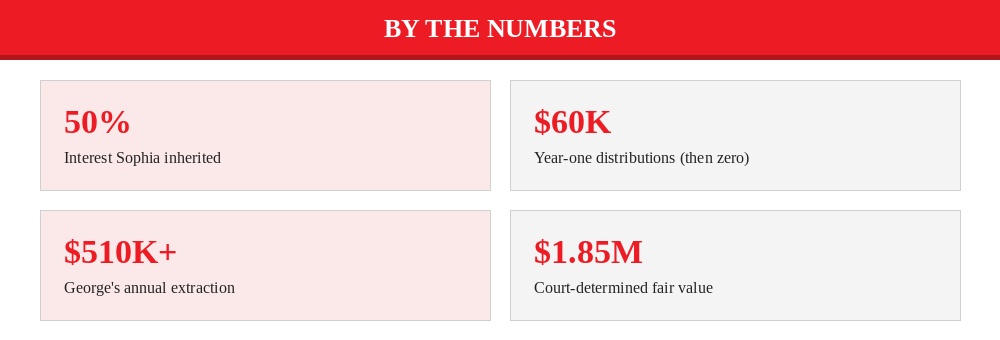
Sophia never wanted to be in the restaurant business. Her husband Stavros and his childhood friend George had opened Kali Orexi, a Greek seafood restaurant on the Upper East Side. Stavros ran the front of house, George ran the kitchen. They were fifty-fifty in a corporation, with nothing beyond a standard certificate of incorporation — no shareholders’ agreement at all. When Stavros died unexpectedly, Sophia inherited his fifty percent. She was fifty-three, had two teenagers, no restaurant experience, and half of a business she had only ever experienced as a customer.
The Fracture
George was sympathetic at first. He told Sophia he would take care of everything and that she would receive quarterly distributions. For the first year, he sent $15,000 a quarter — $60,000 in all. Sophia had no way to know whether that was fair, generous, or a fraction of what she was owed. She had no access to the financials and no idea what to ask for. In year two, the distributions simply stopped. The restaurant was “going through a tough stretch.” When she asked for statements, the accountant was “backed up.” When she asked again, George stopped returning her calls.
The Squeeze
Sophia hired an accountant friend to look at the restaurant’s tax returns, which she was able to obtain from the IRS because the K-1 income reported on her own return gave her the right to request the entity’s return. The returns told a very different story than “a tough stretch.” The restaurant had done $3.1 million in revenue in the most recent year, reporting just $95,000 in net income after George’s management fee of $340,000. And buried in the return were payments of $96,000 to “George K. Management LLC” — a separate fee on top of his salary, paid to an entity Sophia had never heard of.
The Response
Sophia’s attorney served a demand under BCL §624 for inspection of all corporate books and records. When George blew the statutory deadline, the attorney filed a motion to compel — which the court granted, ordering production within twenty days and awarding Sophia her attorney’s fees for having to bring the motion.
The records revealed that George’s total extraction — salary, the management-company fee, personal expenses, and a below-market rent credit for the apartment he kept above the restaurant — exceeded $510,000 a year. On a restaurant doing $3.1 million, that left essentially nothing for Sophia’s half. George was treating a shared enterprise as his personal income vehicle.
The Resolution
Sophia filed a petition under BCL §1104-a alleging oppression. George elected to purchase her shares under §1118 at fair value. The valuation fight came down to two things: how much of the management fee was excess (the expert put a comparable role at $200,000 to $240,000, making roughly $100,000 to $140,000 a year recoverable as self-dealing) and the unauthorized management-company payments. The court set fair value at $1.85 million for Sophia’s fifty percent — with no minority discount, under Friedman v. Beway. George financed the buyout over four years, secured by the restaurant’s assets and his personal guaranty.
The Lesson
Sophia’s story is every silent spouse’s story: you inherit an interest in a business you don’t understand, managed by someone who tells you to trust him, and your rights erode quietly until the picture is unrecognizable. The surviving partner’s promise to “take care of everything” is not a substitute for financial transparency, real governance, and your own independent counsel.

Get your own attorney — not the restaurant’s, not the family’s — within ninety days of inheriting the interest. The sooner you understand what you own, the better you can protect it.
—————————————————
If you recognize your situation in this story, you’re not alone — and you have options.
The DHC Hospitality & Restaurant Law Group represents restaurant and hospitality owners in business divorce, partnership disputes, and ownership transitions throughout New York, backed by the firm’s more than 50 years of experience representing New York businesses.
Contact us for a confidential consultation:
Andreas Koutsoudakis, Esq. | Partner & Co-Chair
(212) 557-7200 | aak@dhclegal.com
This article is for informational purposes only and does not constitute legal advice. Every situation is different, and you should consult with qualified counsel to evaluate your specific circumstances.