


When part of the price is paid after closing, the seller becomes the buyer’s lender. One owner secured her note and defined her earnout and collected every dollar; another trusted the buyer’s accounting and collected $400,000 of the $4 million he was owed.
Selling the Restaurant: Seller Notes and Earnouts
- This white paper is based on a composite of real matters handled by the DHC Hospitality & Restaurant Law Group. Names, locations, cuisines, and identifying details have been changed to protect client confidentiality. The legal principles discussed are illustrative and should not be relied upon as legal advice for any specific situation.
Most owners count the full price on the day the letter of intent is signed. When part of that price is a note the buyer will pay over time, or an earnout tied to future results, the owner is lending money to the buyer and betting on a business she no longer runs. The purchase agreement decides whether that money is ever paid. This is the story of an owner who protected the money she had not yet received, and of a peer who assumed it would arrive.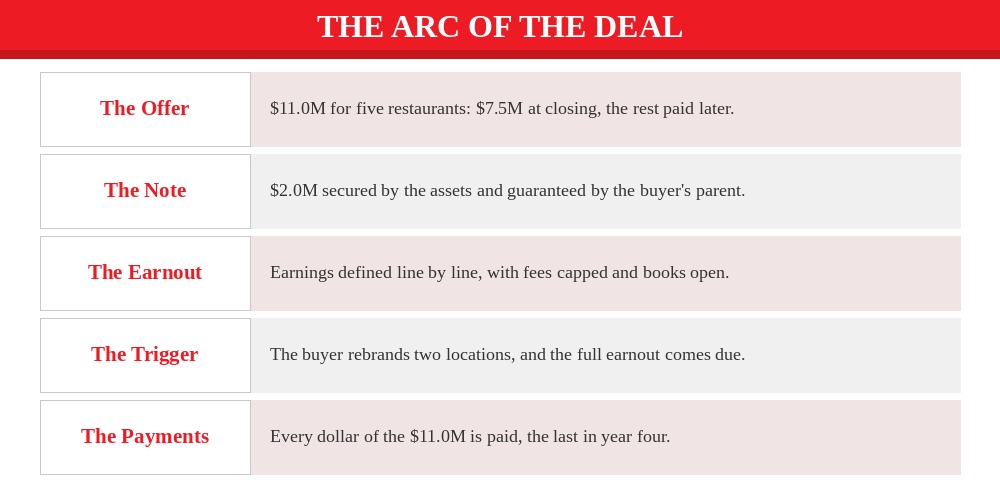
The Offer
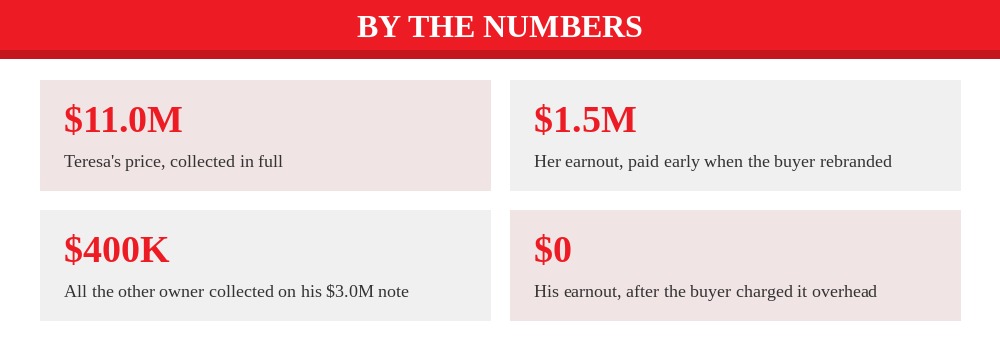
Teresa built a five-location Mexican group in Manhattan and Brooklyn over twelve years. The five restaurants brought in about $15 million a year in sales and earned about $2.0 million before interest, taxes, depreciation and amortization. A regional operator offered $11.0 million. Of that, $7.5 million would be paid in cash at closing and $2.0 million by a note payable over four years at seven percent interest. The last $1.5 million was an earnout: $750,000 for each of the two years after closing in which the five restaurants earned at least $2.0 million.
The Note
Teresa’s counsel treated the note as a loan to a borrower she did not know. The buyer’s parent company guaranteed it, and it was secured by a lien on the restaurants’ equipment and other assets, second only to the buyer’s bank. A default on the bank loan was also a default on her note. Counsel negotiated the subordination agreement with the bank before closing, not after. It let Teresa be paid on schedule as long as the bank loan was current, and it limited the bank’s freeze on her remedies to 120 days. The buyer could withhold a note payment for an indemnity claim only if the claim had been agreed or finally decided, and only up to the amount of the claim.
The Earnout
Counsel defined earnings in the agreement, line by line, using the same accounting Teresa had used to run the business, so the buyer could not load the five restaurants with its own corporate overhead. Management fees charged to the restaurants were capped at two percent of sales. The buyer agreed to run the restaurants in the ordinary course, under their existing name, and to send Teresa monthly statements, and Teresa’s accountant could review the books each year. If the buyer sold the restaurants, or closed or rebranded any of them before the earnout period ended, the full $1.5 million became due at once.
The Other Owner
An owner Teresa knew from the industry sold his four-location group the same year for $8.0 million: $4.0 million in cash, a $3.0 million note and an earnout of up to $1.0 million. The note was unsecured, had no guaranty and was fully subordinated to the buyer’s bank. The earnout was based on net income as the buyer calculated it, with no definition and no right to see the books.
The Payments
In the second year, Teresa’s buyer converted two of the five restaurants to its own concept. Counsel sent a demand under the acceleration clause, and the buyer paid the full $1.5 million earnout within sixty days rather than litigate a clause it had signed. Every note payment arrived on schedule, and the last one cleared four years after closing. Her colleague’s buyer charged its corporate overhead to his restaurants, and its statements showed a loss in both earnout years, so the earnout paid nothing. In the second year the buyer defaulted on its bank loan, and the bank blocked further payments on his note. The buyer then filed for bankruptcy, and he became an unsecured creditor. He had received $400,000 on the note before the payments stopped, and he collected nothing more.
The Lesson
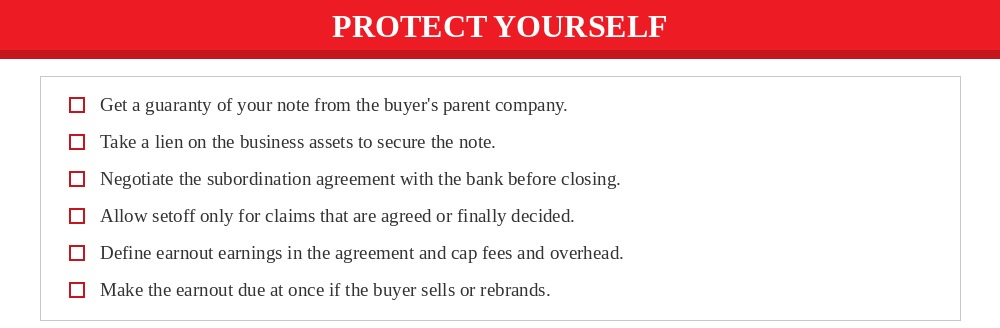
Any part of the price paid after closing is a loan to the buyer, and it is only as good as the terms behind it. Ask for a guaranty from the buyer’s parent and a lien on the business assets. Make a default on the buyer’s bank loan a default on your note, and negotiate the subordination agreement before closing, with payments allowed while the bank loan is current and a short, fixed standstill. Allow setoff only for claims that have been agreed or finally decided. Define earnout earnings in the agreement, cap the overhead and fees the buyer can charge to the restaurants, and require monthly statements with an annual review by your accountant. Make the full earnout due if the buyer sells the restaurants or closes or rebrands any of them.
Teresa’s buyer was no more reliable than her colleague’s. She wrote down, before closing, how she would be paid if the buyer’s plans changed, and when they did, the agreement answered for her.
If you recognize your situation in this story, you are not alone, and you have options.
The DHC Hospitality & Restaurant Law Group represents restaurant and hospitality owners in sales, acquisitions, partnership disputes, and ownership transitions throughout New York, backed by the firm’s more than 50 years of experience representing New York businesses.
—————————————
Contact us for a confidential consultation:
Andreas Koutsoudakis, Esq. | Partner & Co-Chair
(212) 557-7200 | aak@dhclegal.com
This article is for informational purposes only and does not constitute legal advice. Every situation is different, and you should consult with qualified counsel to evaluate your specific circumstances.