


When Your Partner’s Side Business Becomes Your Restaurant’s Biggest Expense
Management Company Conflict — Affiliated-Entity Self-Dealing
- This white paper is based on a composite of real cases handled by the DHC Hospitality & Restaurant Law Group. Names, locations, cuisines, and identifying details have been changed to protect client confidentiality. The legal principles discussed are illustrative and should not be relied upon as legal advice for any specific situation.
A management company is not a bad thing. Plenty of restaurants run better because someone professional is handling payroll, vendors, and compliance. The trouble starts when that management company is owned by one of your partners — because now the person on one side of the contract is also sitting on the other, and every fee, every allocation, every rebate is a decision they get to make about their own paycheck. The structure isn’t the problem. The unwatched structure is.
The Setup
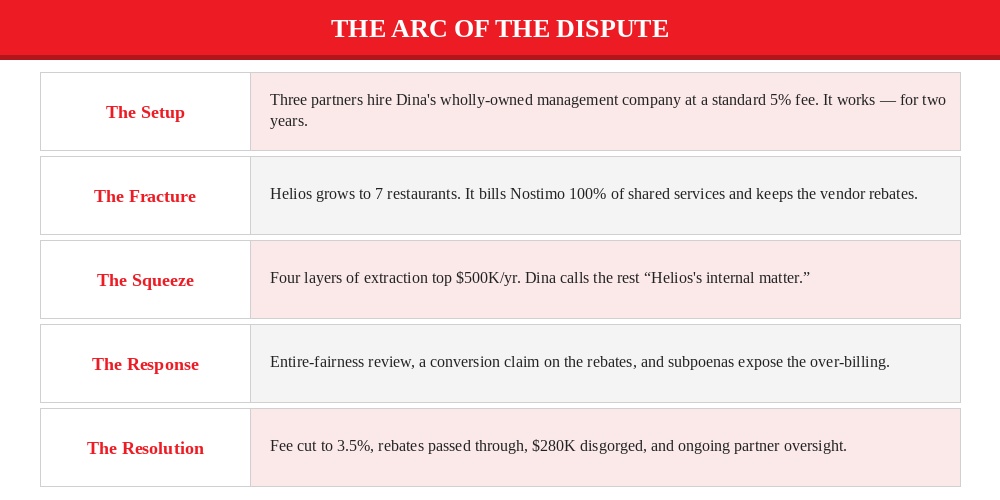
Three partners opened Nostimo Group to run a high-end Mediterranean restaurant in Midtown. Alex (forty percent) was the executive chef and creative force. Dina (thirty-five percent) was the operations partner, with a decade of running restaurants for a major hospitality group. Costa (twenty-five percent) funded the buildout. The operating agreement named Dina managing member and authorized the company to retain a management firm for operational support. Everyone understood that firm would be Dina’s own company, Helios Hospitality Management, which she owned outright. At a five-percent-of-revenue fee, it was a standard arrangement, and for two years it worked exactly as intended. The restaurant did $3.8 million, then $4.6 million, and earned a Michelin Bib Gourmand.
The Fracture
Then Helios started managing other restaurants. First one, then three, then seven. Dina’s attention spread across a portfolio, but Helios’s fee from Nostimo didn’t shrink to match — if anything, the charges grew. Helios began billing Nostimo for “shared services” — accounting staff, HR, technology — that it was now spreading across all seven restaurants, while charging Nostimo as if it bore one hundred percent of the cost. Alex caught it in the food numbers: the cost percentage crept from twenty-eight to thirty-three. Dina blamed the vendors. Alex called the vendors himself. Prices hadn’t moved. What had changed was that Helios was now negotiating volume discounts across all seven restaurants and keeping the rebates at the Helios level instead of passing them through. Nostimo was paying list price while Helios pocketed the spread.
The Squeeze
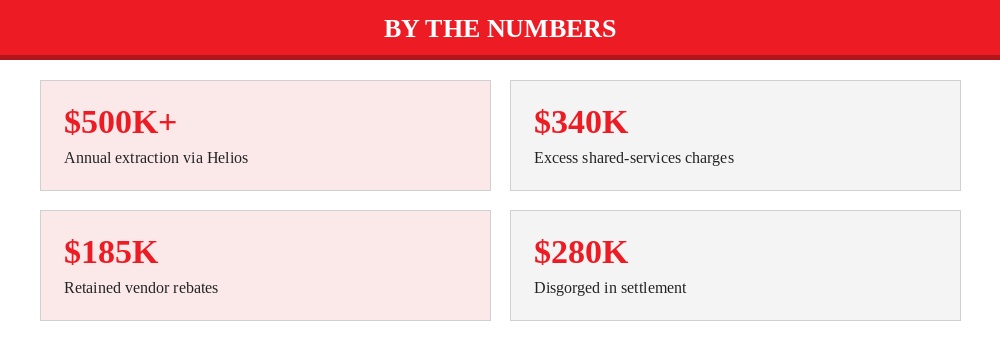
When Alex and Costa demanded a full accounting of every payment to Helios, the shared-services allocations, and the vendor rebates, Dina produced a one-page summary of the five-percent fee and nothing else, calling the rest “Helios’s internal matter.” By then Helios was extracting value four ways: the management fee on rising revenue; shared-services charges allocated entirely to Nostimo while spread across seven clients; vendor rebates kept rather than credited; and Dina’s separate managing-member salary on top of all of it. Total extraction topped $500,000 a year — on a restaurant whose operating margin, before management charges, left far less than that to go around.
The Response
Alex and Costa’s attorney came at it from three directions. First, the management arrangement was an interested-party transaction — Dina sat on both sides — and the new terms (the shared-services charges, the retained rebates, the dual compensation) had never been disclosed to or approved by the disinterested members. Under the entire-fairness standard, Dina bore the burden of proving each piece of it was fair. Second, the vendor rebates were entity property: Helios negotiated them using Nostimo’s purchasing volume, so they belonged to Nostimo, and keeping them was conversion. Third, the shared-services allocation was simply wrong — the fair share was a seventh, or a revenue-weighted slice, not the whole.
Subpoenas to Helios’s bank, the shared vendors, and Helios’s own accounting records filled in the rest: over three years, roughly $340,000 in excess shared-services charges and $185,000 in retained rebates, on top of the fees and salary.
The Resolution
The case settled in mediation. Dina agreed to restructure the management agreement on arm’s-length terms — a 3.5 percent fee, a proportional shared-services allocation, and all vendor rebates passed through to Nostimo; to disgorge $280,000; to cut her managing-member salary to a benchmarked $150,000; and to submit all future Helios-Nostimo transactions to Alex and Costa for approval. The restaurant kept operating, all three partners intact, under a revised agreement that finally treated Helios as what it was: a related-party vendor subject to oversight. Dissolution would have destroyed a restaurant worth more than $5 million; reformed governance preserved it.
The Lesson
Dina’s story is more common every year as the industry professionalizes. The management-company model isn’t the danger. The danger is letting a partner-owned management company operate without treating it, from day one, as the related-party transaction it is.
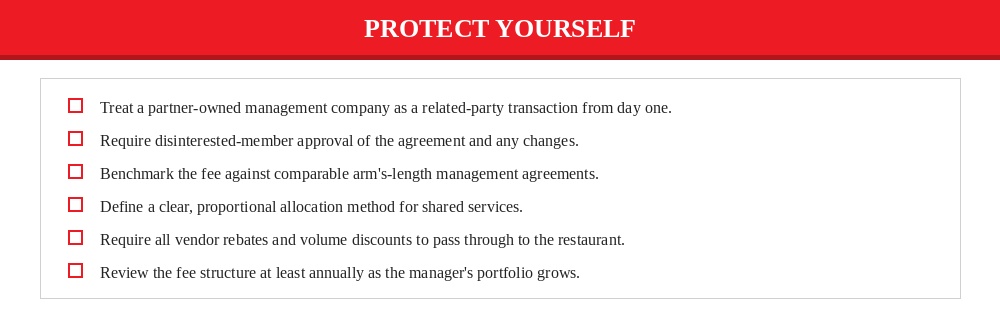
The management company’s success should never come at the restaurant’s expense. If a partner owns it, watch it like one.
—————————————————
If you recognize your situation in this story, you’re not alone — and you have options.
The DHC Hospitality & Restaurant Law Group represents restaurant and hospitality owners in business divorce, partnership disputes, and ownership transitions throughout New York, backed by the firm’s more than 50 years of experience representing New York businesses.
Contact us for a confidential consultation:
Andreas Koutsoudakis, Esq. | Partner & Co-Chair
(212) 557-7200 | aak@dhclegal.com
This article is for informational purposes only and does not constitute legal advice. Every situation is different, and you should consult with qualified counsel to evaluate your specific circumstances.