

When Your Partner Holds the One Asset You Can’t Replace
Liquor License Leverage — Regulatory Asset as Squeeze Tool
- This white paper is based on a composite of real cases handled by the DHC Hospitality & Restaurant Law Group. Names, locations, cuisines, and identifying details have been changed to protect client confidentiality. The legal principles discussed are illustrative and should not be relied upon as legal advice for any specific situation.
A liquor license is the one asset in a bar that you cannot simply replace over a weekend. It takes months to get a new one, and during those months the bar can’t serve, which means it can’t pay rent, which means it may not survive. So when a license sits in one partner’s personal name instead of the company’s, that partner is holding something close to a kill switch — and in a dispute, some partners will absolutely reach for it. The fix is almost embarrassingly simple, which is exactly why nobody gets around to it until it’s too late.
The Setup
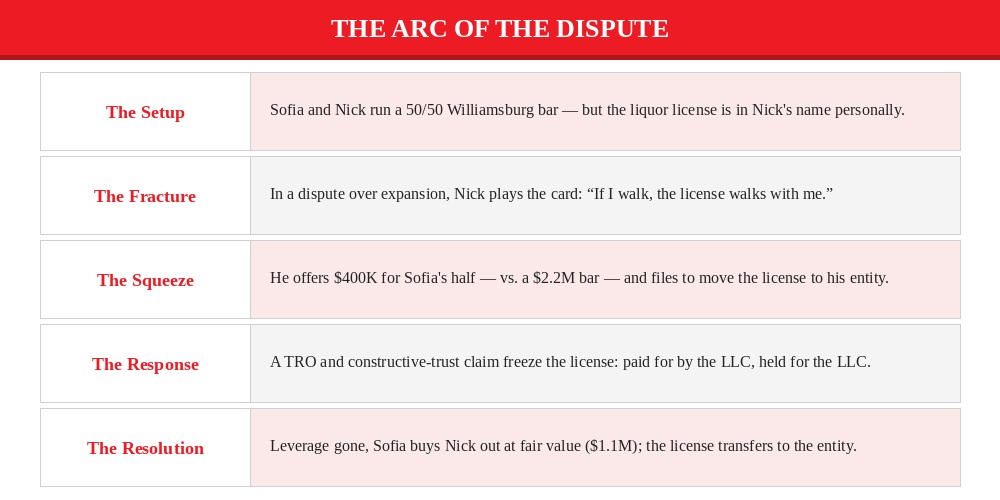
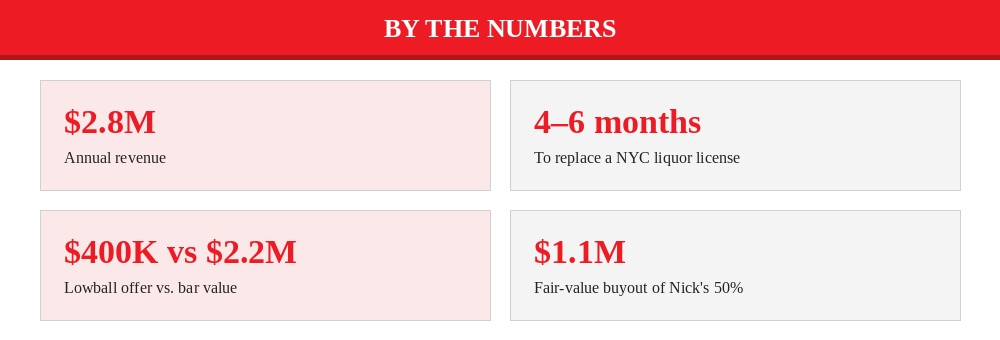
Sofia (fifty percent) and Nick (fifty percent) ran a rooftop cocktail bar in Williamsburg through an LLC. The concept worked — $2.8 million a year, strong margins off the beverage program, a two-year waitlist for weekend reservations. The bar’s most valuable assets were a below-market lease Sofia had landed through a family connection to the landlord, and its full liquor license. That license was in Nick’s name. Not the LLC’s — Nick’s, personally. It was a decision made at formation, when an individual application was simpler than one for a brand-new LLC, with a plan to transfer it to the company once things stabilized. That transfer never happened.
The Fracture
When the relationship soured over whether to open a second location, Nick played a card Sofia hadn’t seen coming: “The license is mine. If I walk, it walks with me. And you can’t get a new one for six months — if you can get one at all.” He was right about the timeline. A full New York City liquor license takes four to six months — a new application, a community-board hearing, SLA approval — and during that stretch the bar couldn’t serve alcohol, couldn’t really operate, couldn’t pay rent, and would fall into lease default. A single regulatory asset gave Nick leverage far beyond his fifty percent.
The Squeeze
Nick used it exactly as you would expect. He offered to buy Sofia’s half for $400,000 — less than three months’ revenue, against a bar worth around $2.2 million. The implicit threat sat underneath the number: take the lowball, or I take the license and the bar goes dark. He reinforced it by filing a change-of-ownership inquiry with the SLA, the first step toward moving the license to a new entity he controlled.
The Response
Sofia’s attorney moved on two fronts at once. First, an emergency TRO barring Nick from transferring, surrendering, modifying, or letting the license lapse while the dispute was pending. The argument: although the license sat in Nick’s name, it had been obtained with company funds — the application fees, legal costs, and compliance expenses were all paid by the entity — for the company’s benefit and its business. Under constructive-trust principles, Nick held the license for the LLC no matter whose name was on the certificate.
Second, a substantive claim for a constructive trust on the license, with every element met: a fiduciary relationship between fifty-fifty partners, a promise to transfer the license to the company, the company’s payment of all license costs in reliance, and Nick’s unjust enrichment in using it to extract a below-market buyout. The court granted the TRO, ordering Nick to take no action on the license without its approval.
The Resolution
With the license frozen, Nick’s leverage evaporated — he could no longer threaten to walk with it, because the court wouldn’t let him. The conversation turned to fair value. An independent appraiser put the bar at $2.2 million, and Sofia bought Nick’s half for $1.1 million, financed over four years. As part of the deal, the license was finally and formally transferred to the LLC, with an SLA attorney making sure the transfer was properly documented and approved.
The Lesson
Nick’s story exposes one of the most dangerous and most common governance gaps in the bar business: the license held in an individual’s name rather than the entity’s. It creates a single point of leverage that any partner can exploit in a dispute, and it is everywhere — especially in bars formed before LLC applications became routine.
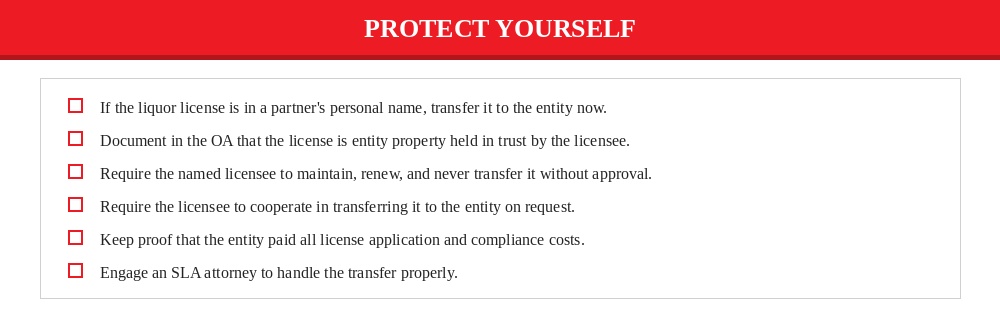
If your license is in a partner’s personal name, transfer it to the entity — now. Until you do, document it as entity property held in trust, and don’t let it become a hostage.
—————————————————
If you recognize your situation in this story, you’re not alone — and you have options.
The DHC Hospitality & Restaurant Law Group represents restaurant and hospitality owners in business divorce, partnership disputes, and ownership transitions throughout New York, backed by the firm’s more than 50 years of experience representing New York businesses.
Contact us for a confidential consultation:
Andreas Koutsoudakis, Esq. | Partner & Co-Chair
(212) 557-7200 | aak@dhclegal.com
This article is for informational purposes only and does not constitute legal advice. Every situation is different, and you should consult with qualified counsel to evaluate your specific circumstances.