


When the Money Partner Crosses the Line from Oversight to Interference
Investor Overreach — The Reverse Squeeze
- This white paper is based on a composite of real cases handled by the DHC Hospitality & Restaurant Law Group. Names, locations, cuisines, and identifying details have been changed to protect client confidentiality. The legal principles discussed are illustrative and should not be relied upon as legal advice for any specific situation.
Most of these stories feature an operator squeezing an investor. This one runs the other way. The squeeze doesn’t always come from the person running the restaurant — sometimes it comes from the person who wrote the check and then decided he’d rather be the chef. He doesn’t withhold information or pad his fees. He just starts running the kitchen he was never hired to run, and uses his money as a club when the actual chef tells him to stop. Capital buys you rights. It does not buy you a station on the line.
The Setup
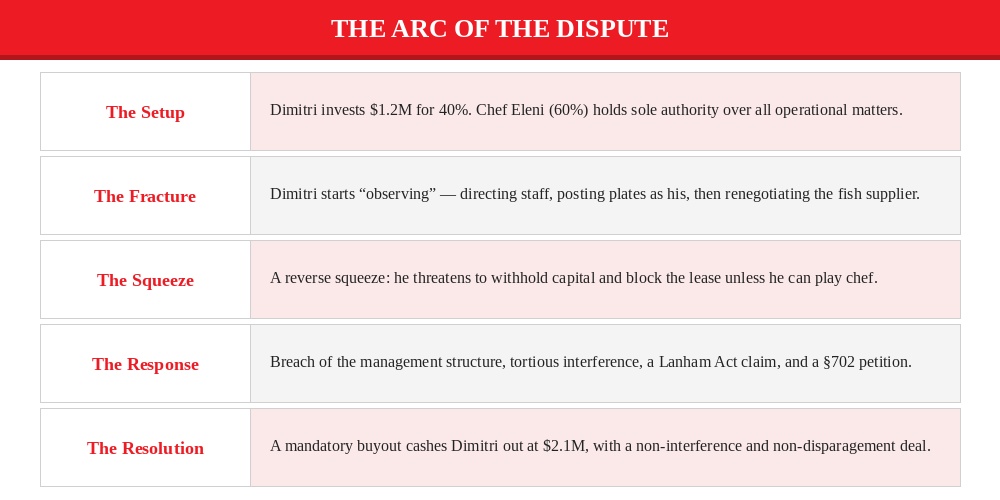
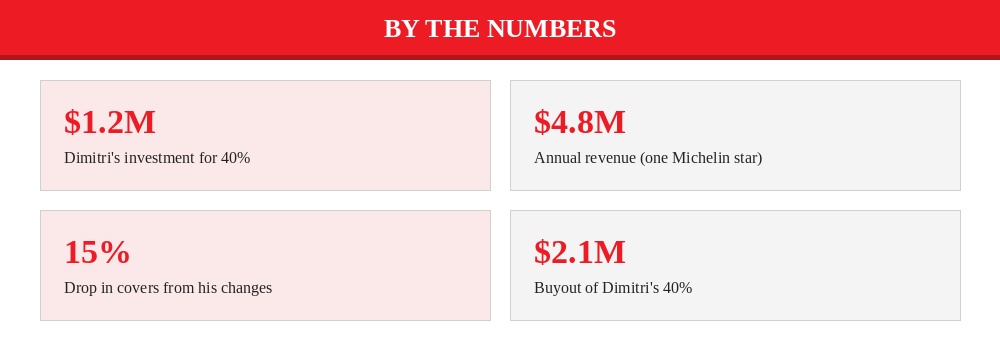
Dimitri invested $1.2 million for a forty percent interest in a fine-dining Greek restaurant run by Chef Eleni (sixty percent), one of the most respected chefs in New York’s Greek dining scene. The operating agreement was clear: Eleni was the managing member with sole authority over all culinary, creative, and operational matters. Dimitri was the capital partner, with approval rights over major financial decisions — expenditures over $100,000, new debt, related-party deals — and the right to quarterly reports. For the first year it was ideal. Eleni created, Dimitri funded, and the restaurant earned rave reviews, a Michelin star, and $4.8 million in revenue. Dimitri told everyone at his country club about “his restaurant.”
The Fracture
The trouble started when Dimitri began treating the restaurant as his personal project instead of his investment. He showed up during service to “observe.” He cornered the sommelier with wine-list suggestions. He told the GM to rearrange the dining room. He emailed Eleni articles about “trending cuisines” and floated adding a sushi section to the Greek menu. He brought friends in and instructed the kitchen to cook off-menu, then photographed the plates and posted them as “my latest creation.” Eleni tolerated it — until Dimitri crossed a real line: he called the restaurant’s primary fish supplier directly and renegotiated the pricing himself, without Eleni’s knowledge, accepting lower-quality product to get a lower price. When the fish came in below her standards and she found out why, the partnership was over.
The Squeeze
This was a reverse squeeze — the money partner pressuring the chef, not through financial manipulation but through operational interference that threatened the restaurant’s quality, reputation, and Michelin star. Dimitri was contacting vendors directly, directing staff against the chef’s decisions, reducing covers by fifteen percent with his dining-room changes, misrepresenting his role online, and degrading the food itself. When Eleni told him to stop, he threatened to withhold his capital-call commitment for a planned renovation and to vote against the lease renewal — financial leverage aimed at forcing her to accept his meddling. The message was plain: let me play chef, or I’ll strangle the business.
The Response
Eleni’s attorney framed the case as a breach of the operating agreement’s management structure. The agreement gave Eleni sole authority over all culinary, creative, and operational matters, and every one of Dimitri’s incursions — the vendors, the staff directives, the dining-room changes, the supplier renegotiation — was a separate breach of that exclusive authority. The attorney added a tortious-interference claim for the fish-supplier episode, which damaged the entity’s relationship with its supplier, and treated the social-media misrepresentations as both a breach of the OA’s publicity provision and a potential Lanham Act false-designation claim. Finally, Eleni petitioned under LLC Law §702, arguing that Dimitri’s persistent interference made it not reasonably practicable to carry on the business under the very agreement that gave her sole operational control.
The Resolution
The case resolved in a mandatory buyout. Dimitri’s forty percent was valued at $2.1 million, against a $5.25 million enterprise reflecting the star and the revenue trajectory. Eleni financed it through a new investor who bought a twenty percent passive stake for $1.05 million and a bank loan secured by the restaurant’s assets. Dimitri took his $2.1 million — a strong return on his $1.2 million — and signed a comprehensive non-interference and non-disparagement agreement on the way out.
The Lesson
Dimitri’s story is a reminder that the squeeze-out doesn’t always come from the operator. Money partners can squeeze too — not by hiding the books, but by overstepping their role and using financial leverage to force their way into decisions the operating agreement reserves for someone else. For investors, the line is bright: your capital gives you reporting, approval rights, and distributions. It does not give you the right to run the kitchen, manage the staff, or renegotiate with vendors.
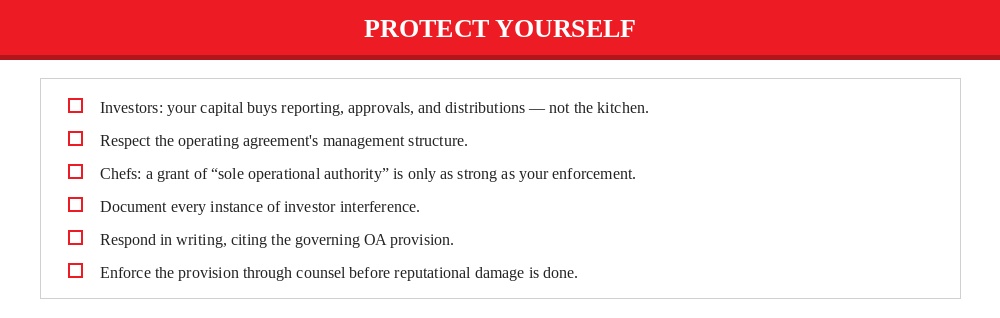
And for chefs: your grant of “sole operational authority” is only as strong as your willingness to enforce it. Document every incursion, respond in writing, and enforce the provision through counsel if you have to — before the interference causes the kind of reputational damage a Michelin inspector won’t forgive.
—————————————————
If you recognize your situation in this story, you’re not alone — and you have options.
The DHC Hospitality & Restaurant Law Group represents restaurant and hospitality owners in business divorce, partnership disputes, and ownership transitions throughout New York, backed by the firm’s more than 50 years of experience representing New York businesses.
Contact us for a confidential consultation:
Andreas Koutsoudakis, Esq. | Partner & Co-Chair
(212) 557-7200 | aak@dhclegal.com
This article is for informational purposes only and does not constitute legal advice. Every situation is different, and you should consult with qualified counsel to evaluate your specific circumstances.