


DHC’s Economic Development and Tax Incentives Practice Group helps clients navigate tax incentive programs and economic development benefits from New York City and New York State economic development organizations. Our practice group has secured significant, often multi-million-dollar savings, for a diverse range of commercial and nonprofit clients. Meet our Economic Development and Tax Incentives Team.
NEW YORK ECONOMIC DEVELOPMENT ROUNDUP
Economic Development News & Intelligence 10/14/26
There are billions of dollars in New York tax incentives on the table right now for developers and business owners looking to expand or build, but accessing, applying for, and closing on them takes skilled legal guidance every step of the way. Take IBM’s proposed quantum computing facility in Poughkeepsie, which just cleared a key environmental review step (the Town Planning Board found no significant adverse impact under SEQRA) while it also seeks a PILOT and sales tax package from the Dutchess County IDA. Incentives, environmental review, and local approvals all have to move in step. In Manhattan, Tishman Speyer’s $100 million tax break for 99 Hudson Boulevard isn’t expected back before the city’s IDA until November 17, a reminder that big deals often need government affairs professionals working behind the scenes alongside the attorneys out front. And in Brooklyn, Empire State Development holds a public hearing October 22 on conveying a state-owned Clinton Hill site for a $111 million, roughly 125-unit affordable housing project, where land use, public process, and financing all intersect. Whether a deal needs financing structured, incentives negotiated, entitlements secured, or the right people at the table in Albany or City Hall, DHC’s economic development, project financing, real estate, zoning and land use, and government affairs teams handle it all under one roof. Reach out if we can help.
BUILDING NEW YORK – DEVELOPMENT IN MOTION
The IDA Mortgage Recording Tax Exemption: A Significant — and Often Overlooked — Financing Advantage in New York
A Tax That Adds Up Fast
New York State has one of the most expensive real estate financing environments in the country. Anyone who has closed a commercial real estate transaction here knows that the closing costs alone can be staggering — and one of the largest line items is the mortgage recording tax (“MRT”). For businesses and developers undertaking capital projects in New York, the MRT can represent hundreds of thousands, or even millions, of dollars in upfront costs. What many of those same businesses and developers do not know is that there is a legitimate, well-established mechanism to eliminate that cost entirely — through the mortgage recording tax exemption available via New York State’s Industrial Development Agencies (“IDAs”).
Having negotiated and closed numerous multi-million-dollar IDA incentive packages throughout my career — both inside government and in private practice — I can tell you that the MRT exemption is one of the most financially impactful benefits IDAs can provide, particularly for capital-intensive projects with significant debt financing. Yet it remains one of the least understood incentives in the IDA toolkit.

Understanding the Mortgage Recording Tax in New York
Before appreciating the value of the exemption, it helps to understand exactly what the MRT is and what it costs.
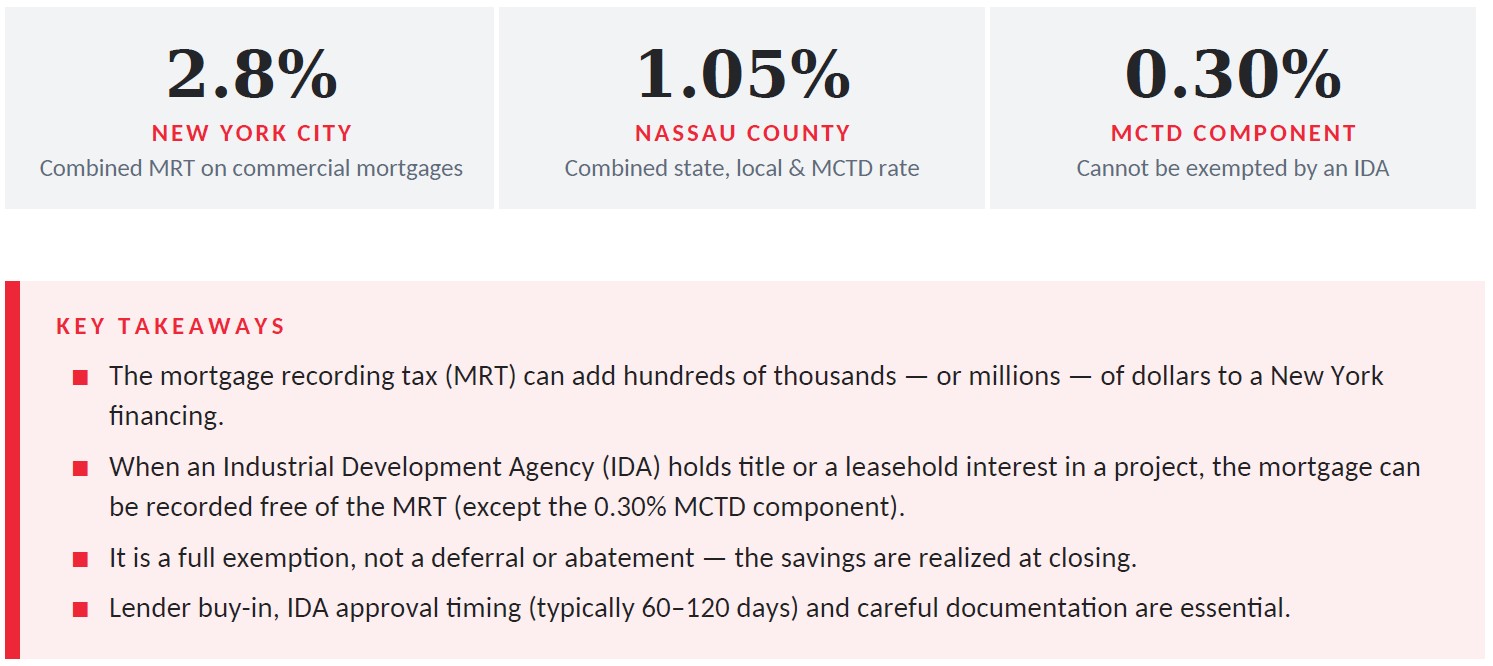
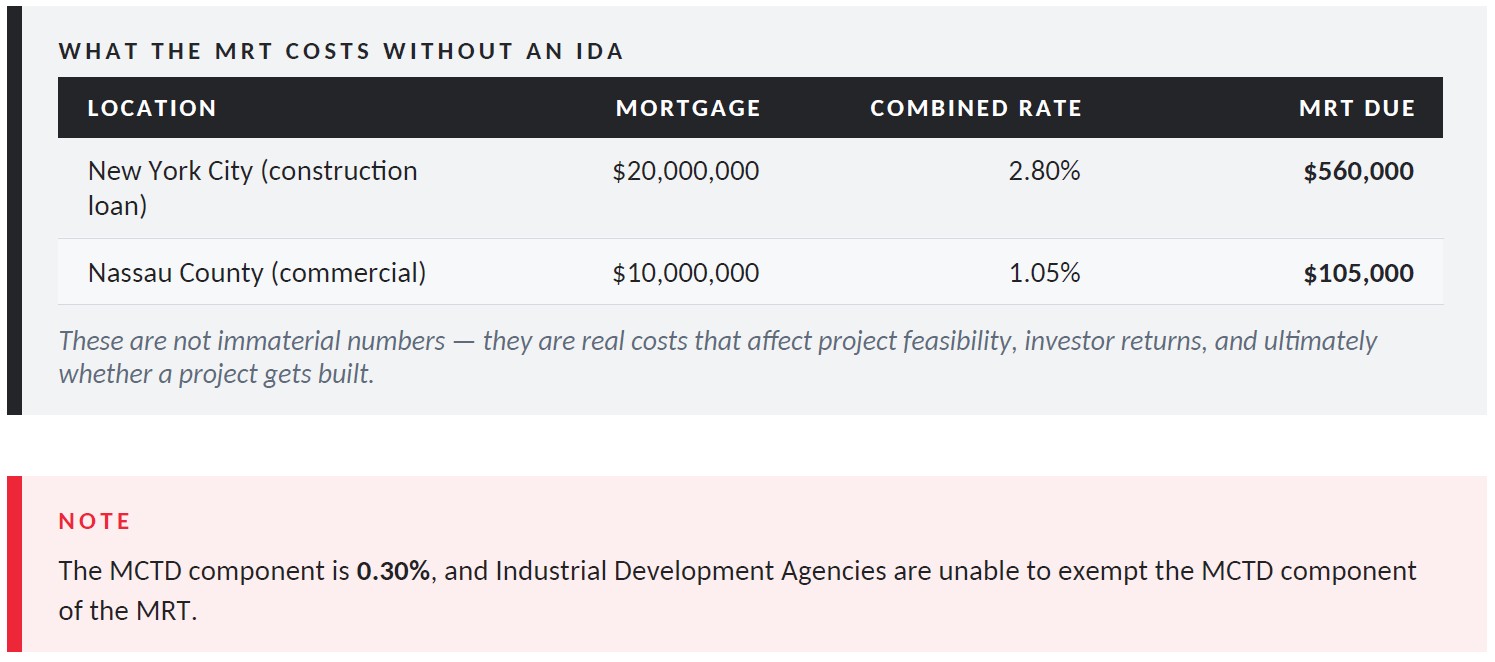
In New York State, the MRT is imposed on the privilege of recording a mortgage on real property. The tax is calculated as a percentage of the principal amount of the mortgage. In New York City, the combined MRT on commercial mortgages, inclusive of local taxes, state, taxes, and the Metropolitan Commuter Transportation District (MCTD) tax is 2.8% of the mortgage amount. In Nassau County the combined rate — inclusive of state, local, and MCTD components — is 1.05%. Even outside of the New York metropolitan area, the MRT represents a meaningful transaction cost on any sizeable financing.
How the IDA Mortgage Recording Tax Exemption Works
IDAs are public benefit corporations established under New York State’s General Municipal Law Article 18-A. A cornerstone of an IDA’s statutory power is the ability to hold title to — or a leasehold interest in — project property on behalf of an approved project. Because IDAs are governmental entities, they are exempt from the mortgage recording tax under New York State Tax Law.
When an IDA takes title to or a leasehold interest in a project and a mortgage is recorded in connection with that project, the IDA’s governmental status passes through to the transaction, shielding the financing from the MRT. The result: a mortgage that might otherwise cost hundreds of thousands of dollars to record is recorded tax-free.
The mechanics typically work as follows. The IDA enters into a lease agreement with the project operator (the business or developer), and the project operator’s lender takes a mortgage on the project operator’s interest. Because the IDA has a legal interest in the property, the mortgage recording is exempt from the tax. The lender, the borrower, and their respective counsel coordinate with IDA counsel to structure the financing so that the exemption is properly documented and preserved at closing.
It is worth noting that this is not a deferral or an abatement — it is a full exemption. The tax is not owed and does not accrue. The savings are realized immediately at closing.
The Real-World Impact
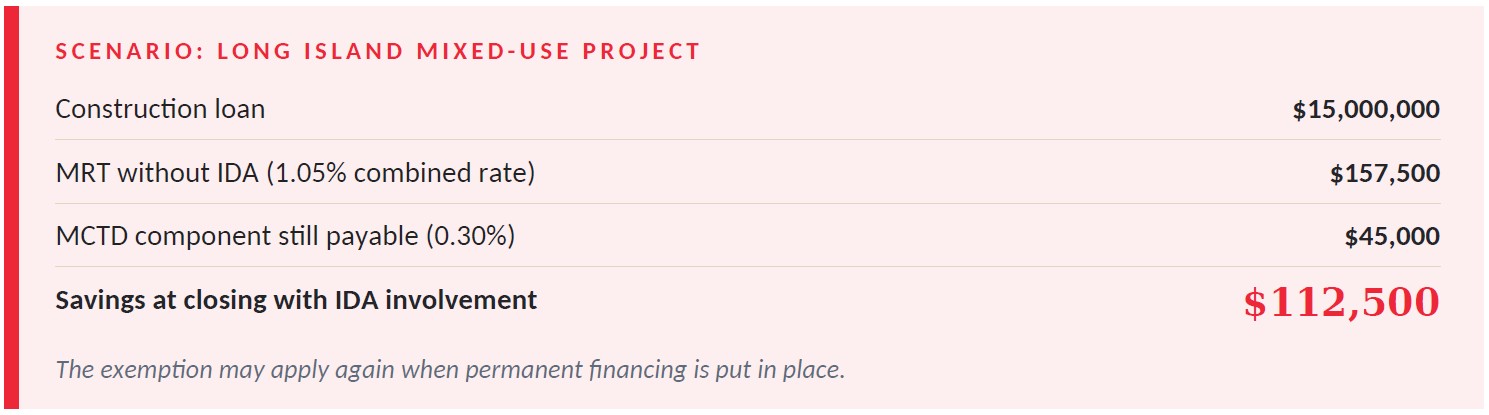
In my practice, the MRT exemption frequently becomes one of the deciding factors for whether a client pursues IDA benefits in connection with a financing. Consider a scenario I encounter regularly: a real estate developer is planning a mixed-use project on Long Island. The project requires a construction loan of $15 million. Without IDA involvement, the developer faces an MRT cost of approximately $157,000 at the construction loan closing, and potentially again when permanent financing is put in place.
With IDA involvement, the majority of those costs disappear with the total savings equal to $112,500. That is capital that can be redeployed into the project itself — additional amenities, enhanced construction quality, or simply improved returns for the development’s investors.
For manufacturing companies, biomedical firms, and other businesses undertaking significant capital expenditures with accompanying debt financing, the calculus is the same. The MRT exemption is not a minor line-item benefit. On sufficiently large financings, it can single-handedly justify the cost and effort of the IDA application process.
Structuring Considerations and the Importance of Experienced Counsel
The MRT exemption does not happen automatically. It requires careful coordination among the IDA, the project operator, the lender, and their respective counsel. Several structuring considerations deserve close attention.
First, the lender must be willing to participate in an IDA-structured financing. Most sophisticated commercial lenders — regional banks, national lenders, and institutional capital sources alike — are familiar with IDA transactions and comfortable lending into this structure, but it is important to confirm lender receptivity early in the process.
Second, the IDA approval must be in place prior to the closing. IDAs conduct a public approval process, which includes a public hearing and a SEQRA review, before formally approving a project. The timeline for IDA approval varies by agency but typically ranges from 60 to 120 days. Planning ahead is essential.
Third, the IDA’s lease structure must be properly documented. An IDA transaction involves a suite of agreements — typically a lease agreement, a leaseback agreement, a project agreement, and various ancillary instruments — all of which must be coordinated with the lender’s loan documents. Errors or omissions in this documentation can jeopardize the exemption and create significant complications at closing and beyond.
Finally, like all IDA benefits, the MRT exemption comes with compliance obligations. If the project fails to meet its commitments, the IDA may have recapture rights. While the mechanics of recapturing an MRT exemption are more complex than recapturing a sales tax benefit — since the tax was never paid to begin with — the contractual exposure under the IDA project agreement is real, and it must be understood before benefits are accepted.
Who Should Be Thinking About This?
Any business or developer that is (1) planning a capital project in New York State that meets IDA eligibility criteria, and (2) intends to finance that project with debt secured by real property, should be evaluating the MRT exemption as part of their overall project planning.
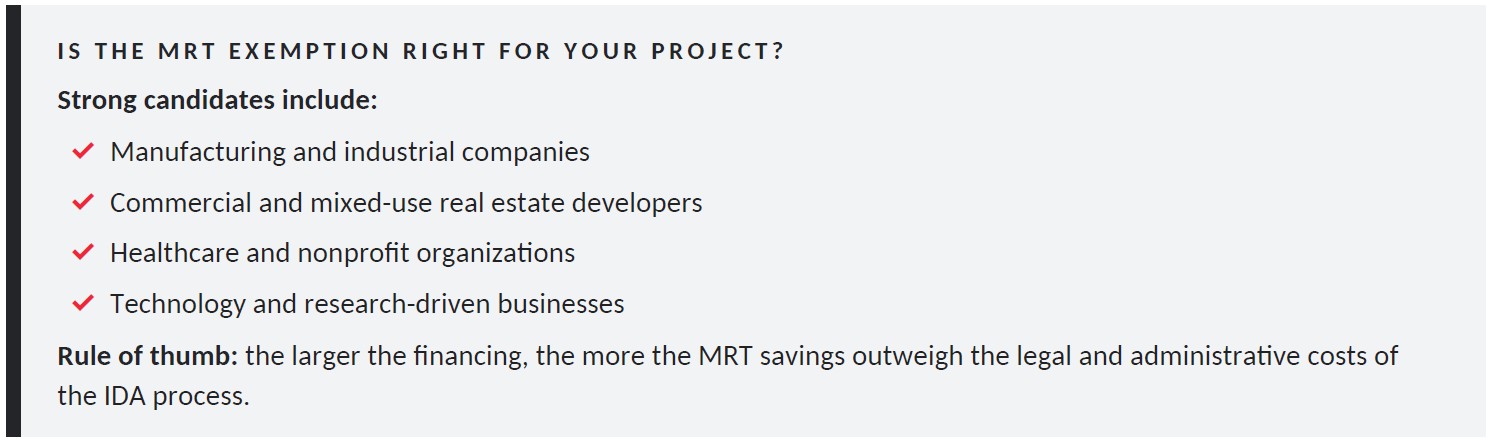
The size of the project matters. For smaller projects with modest financing, the IDA process may not be cost-effective relative to the MRT savings. But as project size and financing amounts increase, the MRT exemption alone can generate savings that dwarf the legal and administrative costs of pursuing IDA benefits — particularly when combined with the property tax exemption and sales tax exemption that IDAs also provide.
The Bottom Line
New York’s mortgage recording tax is a significant and unavoidable cost for most real estate financings in this state. But for businesses and developers willing to engage the IDA process, it is a cost that can be entirely eliminated. Combined with the sales tax exemption and property tax benefits that IDAs also offer, the MRT exemption is part of a powerful suite of incentives that can fundamentally improve the economics of a New York capital project.
The businesses that consistently access these benefits are not larger or more sophisticated than those that do not. They simply have advisors who know where to look — and start the conversation early enough to make it happen.
—————————————————
This article is for informational purposes only and does not constitute legal advice. Every situation is different, and you should consult with qualified counsel to evaluate your specific circumstances.