


When Your Partner Replicates Your Concept Without Calling It a Franchise
Concept Replication — Intellectual Property & Brand Diversion
- This white paper is based on a composite of real cases handled by the DHC Hospitality & Restaurant Law Group. Names, locations, cuisines, and identifying details have been changed to protect client confidentiality. The legal principles discussed are illustrative and should not be relied upon as legal advice for any specific situation.
In this industry, a great concept is dangerously easy to copy — and the person best positioned to copy it is usually your own partner. The one handling business development has the recipes, the brand, the vendor relationships, the systems. If he decides to build a second restaurant that looks suspiciously like the first, under a different name and a different entity, he can tell himself he hasn’t taken anything at all. He has. The law just calls it by other names: corporate opportunity, trade secret, breach of loyalty.
The Setup
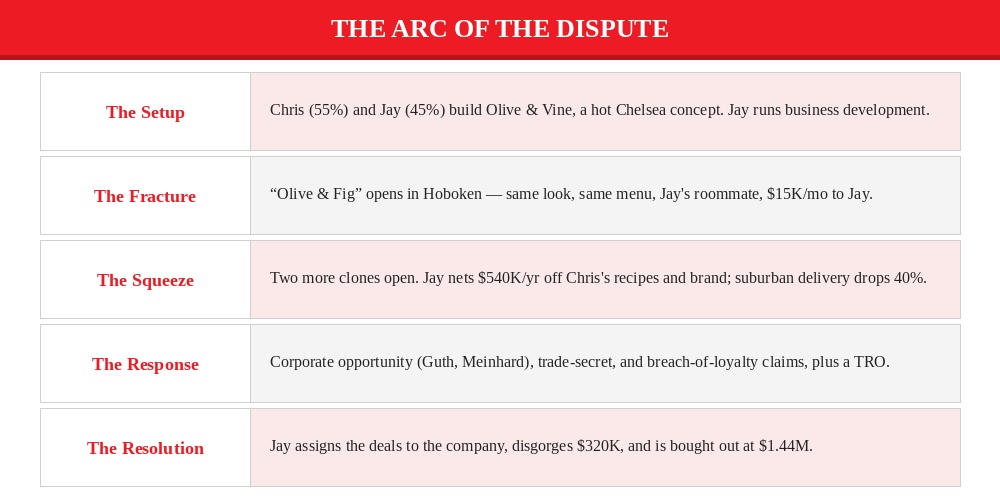
Chris (fifty-five percent) and Jay (forty-five percent) built a fast-casual Mediterranean concept called Olive & Vine in Chelsea that became one of the city’s hottest lunch spots. The menu was Chris’s creation — a proprietary blend of Lebanese, Greek, and Israeli street food built for counter service. The branding was distinctive: olive green and white, a hand-drawn logo, signature packaging. The restaurant did $3.2 million in year two at a sixteen percent margin, and investors were calling. Jay handled business development — the investor calls, the second-location scouting, the licensing conversations. The operating agreement let him pursue opportunities for the company but required member approval for anything over $50,000 or any commitment longer than a year.
The Fracture
Chris found out from a friend’s Instagram story that a restaurant called Olive & Fig had opened in Hoboken. Same olive-green-and-white scheme. Same counter-service format. Same menu categories, same flavor profiles. Different name, different entity, different owner on paper — but the owner was Jay’s college roommate, and the “consulting agreement” between Jay and the Hoboken entity paid Jay $15,000 a month. Chris looked closer. Olive & Fig used the same produce supplier, the same packaging vendor, and the same custom spice blends Chris had spent two years developing. Those recipes weren’t public. Jay had handed them over.
The Squeeze
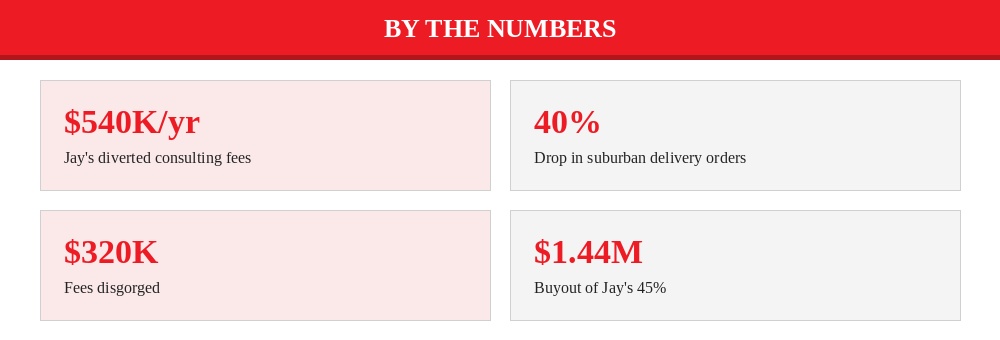
Within six months, two more Olive & Fig locations opened — Jersey City and Stamford — each paying Jay $15,000 a month through a separate LLC. Jay was quietly building a de facto franchise on Chris’s recipes, Chris’s brand, and Chris’s concept, pulling in $540,000 a year in personal consulting fees, with no knowledge or participation by the company. And the Chelsea location was suddenly seeing something it never had: competition. Customers who used to travel in from New Jersey had a local option now, and delivery orders from the suburbs fell forty percent.
The Response
Chris’s attorney came at it on four fronts. First, corporate-opportunity diversion: every location Jay helped open was in the company’s line of business, used the company’s intellectual property, and was discovered through Jay’s position as the company’s business-development partner — so under Guth v. Loft and Meinhard v. Salmon, those opportunities belonged to Olive & Vine, not to Jay. Second, misappropriation of trade secrets: the spice blends, recipes, and vendor relationships were the company’s confidential property, disclosed to a competitor without authorization. Third, breach of fiduciary duty: the consulting arrangement was an undisclosed conflict that violated Jay’s duty of loyalty. Fourth, a constructive trust on Jay’s interests in the three Olive & Fig locations and disgorgement of every consulting fee.
The TRO application sought to immediately stop the Olive & Fig entities from using the company’s recipes, blends, and brand elements, and to bar Jay from consulting for any competing concept.
The Resolution
Facing the trade-secret and corporate-opportunity claims, Jay settled comprehensively: he assigned the three consulting agreements to Olive & Vine (the $540,000 annual revenue now flowed to Chris’s entity), disgorged $320,000 in fees already collected, accepted a permanent injunction against competing with or replicating the concept, and sold his forty-five percent at a fair value of $1.44 million reflecting the enhanced enterprise. Chris used the settlement to do it right — a real franchise model, with proper agreements, quality controls, and royalties — and grew Olive & Vine to twelve locations in three years.
The Lesson
Jay’s scheme was sophisticated, but the vulnerability it exploited is ordinary: in restaurants, intellectual property protection is usually informal, and the partner who handles development has access to everything worth taking. If your concept is replicable, protect it on paper before someone replicates it off the books.

These provisions cost nothing to include at formation. They are worth millions the day you need them.
—————————————————
If you recognize your situation in this story, you’re not alone — and you have options.
The DHC Hospitality & Restaurant Law Group represents restaurant and hospitality owners in business divorce, partnership disputes, and ownership transitions throughout New York, backed by the firm’s more than 50 years of experience representing New York businesses.
Contact us for a confidential consultation:
Andreas Koutsoudakis, Esq. | Partner & Co-Chair
(212) 557-7200 | aak@dhclegal.com
This article is for informational purposes only and does not constitute legal advice. Every situation is different, and you should consult with qualified counsel to evaluate your specific circumstances.