


How Forensic Discovery Broke Through One Partner’s Financial Fortress
The Gatekeeper — Information Withholding & Forensic Discovery
- This white paper is based on a composite of real cases handled by the DHC Hospitality & Restaurant Law Group. Names, locations, cuisines, and identifying details have been changed to protect client confidentiality. The legal principles discussed are illustrative and should not be relied upon as legal advice for any specific situation.
There is a particular kind of partner who runs the numbers like a vault — you see what he wants you to see, and not one page more. “The accountant is migrating systems.” “The POS is being updated.” “The commissary is under renovation.” Every excuse is plausible on its own and absurd all together. Here is what I tell clients staring down a gatekeeper: stop arguing about the reports. Stop begging for access. Go to the source. The bank does not lie. The register does not lie. And neither of them works for your partner.
The Setup
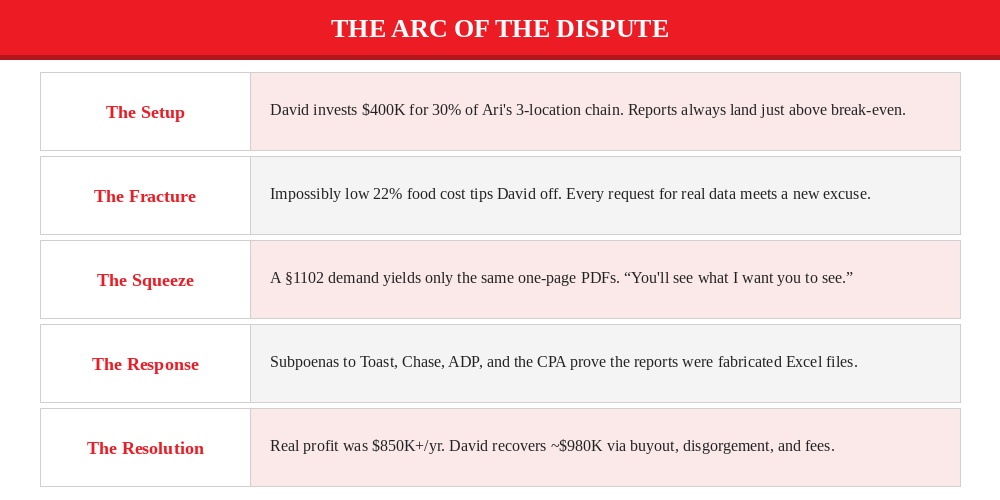
David was a hospitality consultant who invested $400,000 for a thirty percent interest in a three-location fast-casual chain run by Ari, who held the other seventy percent as managing member. The operating agreement gave Ari authority over all operational and financial matters and required quarterly reports to every member. For the first year, the reports came — clean one-page summaries showing each location’s revenue and expenses, with a bottom line that always seemed to land just above break-even.
The Fracture
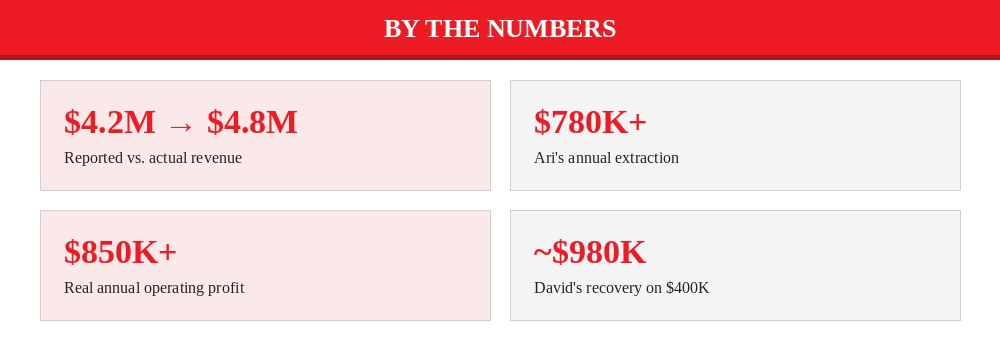
David’s background told him something was off. Three locations doing a combined $4.2 million a year, breaking even? The food-cost percentages in Ari’s reports were impossibly low — twenty-two percent for a concept that should have run twenty-eight to thirty. Either Ari had discovered a miracle of cost control, or the numbers weren’t real. When David asked questions, Ari had an answer for each one: renegotiated vendor contracts, reduced waste, a new POS that “tracks everything.” Plausible one at a time, implausible together. Every request to see the actual data met a new excuse.
The Squeeze
After eighteen months of deflection, David sent a formal §1102 books-and-records demand. Ari responded by producing a stack of printed PDFs — the same one-page summaries David had already seen, plus bank statements for only two of the three locations. No QuickBooks file. No POS export. No vendor invoices. No payroll records. The message was unmistakable: you’ll see what I want you to see, and nothing more.
The Response
David’s attorney didn’t waste a week arguing about the adequacy of the production. He went around Ari entirely, serving subpoenas on every third party that held independent records. Toast produced transaction-level data for all three locations — every sale, void, comp, and discount, timestamped to a terminal and a server. JPMorgan Chase produced statements for all entity accounts, including two David had never known existed. ADP produced payroll showing forty-seven employees, several with names matching Ari’s relatives. And the entity’s own CPA, once subpoenaed, produced work papers establishing that the “quarterly reports” were not generated from QuickBooks at all — they were hand-built Excel files that did not match the underlying accounting.
The forensic accountant reassembled the real picture. The three locations were doing $4.8 million, not $4.2 million — Ari had been underreporting revenue by $600,000. His total extraction, between management fees to himself and two affiliated LLCs, family payroll, personal expenses, and a commissary lease with a company he owned, topped $780,000 a year. The “break-even” reports were fiction; real operating profit was over $850,000 annually, and David’s thirty percent share of it had been quietly diverted for three years.
The Resolution
With the forensic record assembled, David’s attorney filed for breach of fiduciary duty, breach of the operating agreement, fraud, conversion, and an accounting. None of the third-party evidence came from Ari, so none of it could be waved away — and that made settlement the only rational move. Ari agreed to buy out David’s thirty percent at an independently appraised fair value of $585,000, disgorge $340,000 in diverted profits, reimburse David’s legal and forensic-accounting fees, and restructure the two undisclosed accounts. Total recovery, roughly $980,000 on a $400,000 investment — pulled entirely from records Ari thought he controlled.
The Lesson
The gatekeeper’s entire power depends on controlling the flow of information. Break that control — with third-party subpoenas that bypass him entirely — and the whole edifice collapses. He may have controlled what his partner saw, but he could not control what the institutions recorded.
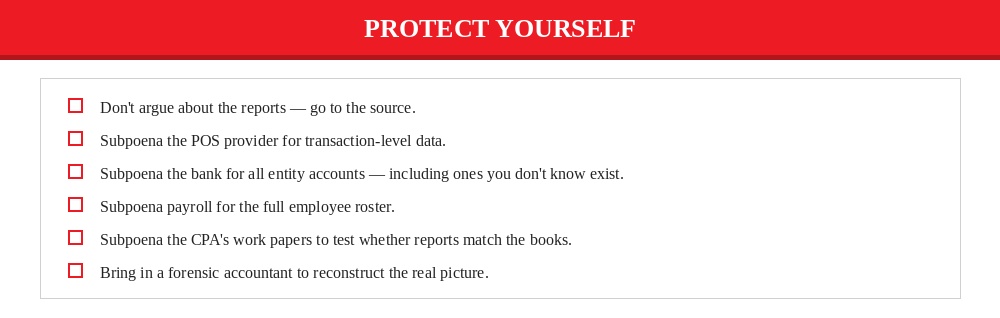
Don’t argue about the reports. Don’t beg for access. Go to the source. The records are there, waiting to be found, and in the right hands they tell the whole story.
—————————————————
If you recognize your situation in this story, you’re not alone — and you have options.
The DHC Hospitality & Restaurant Law Group represents restaurant and hospitality owners in business divorce, partnership disputes, and ownership transitions throughout New York, backed by the firm’s more than 50 years of experience representing New York businesses.
Contact us for a confidential consultation:
Andreas Koutsoudakis, Esq. | Partner & Co-Chair
(212) 557-7200 | aak@dhclegal.com
This article is for informational purposes only and does not constitute legal advice. Every situation is different, and you should consult with qualified counsel to evaluate your specific circumstances.