


When Your Investment Disappears Into Someone Else’s Management Fee
Money Partner vs. Founding Chef — The Investor’s Perspective
- This white paper is based on a composite of real cases handled by the DHC Hospitality & Restaurant Law Group. Names, locations, cuisines, and identifying details have been changed to protect client confidentiality. The legal principles discussed are illustrative and should not be relied upon as legal advice for any specific situation.
Investors tell me the same thing all the time: “I trusted him. We’d been friends for years.” I understand the instinct, but I have to be blunt about it — trust is not a governance structure. Friendship will not stop a partner from quietly tripling his own salary, and it will not put money back in your pocket once it’s gone. This is the story of an investor who learned that the hard way, and then learned the more useful lesson: when a partner won’t show you the books, the books are still there. You just have to know where to look.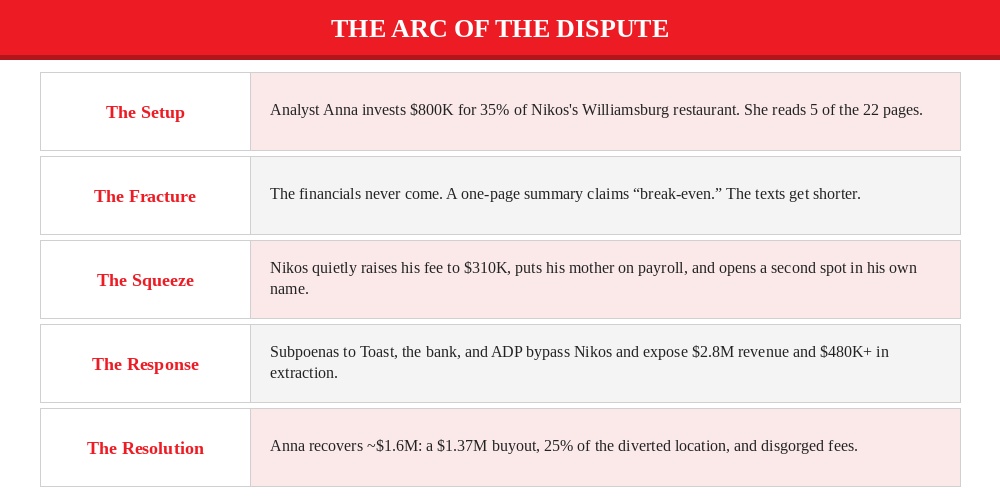
The Setup
Anna had never worked in a restaurant. She was a financial analyst who had done well in tech — well enough to have capital to deploy and a desire to put it into something she could touch. When her college friend Nikos pitched his Mediterranean concept, a polished-casual spot in Williamsburg built around grilled whole fish and natural wine, Anna saw the numbers and the neighborhood and said yes.
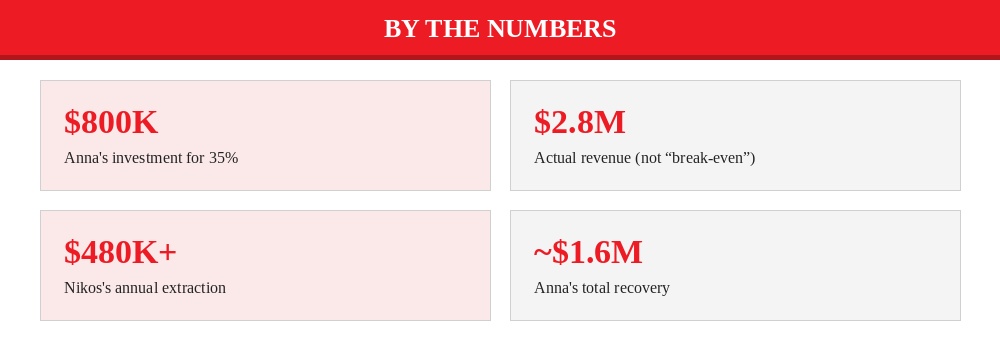
She invested $800,000 for a thirty-five percent interest in Taverna Nea LLC. Nikos held sixty-five percent and would serve as managing member and executive chef. The operating agreement ran twenty-two pages. Anna read the first five. She trusted Nikos — they had been friends for fifteen years — and that trust did the reading for her.
The Fracture
The restaurant opened strong. Nikos sent Anna photos of packed dining rooms and glowing press. What he did not send was financial statements. When Anna asked, Nikos said the accountant was “still pulling things together.” Four months in, she got a single-page summary claiming the restaurant was “operating at break-even.” No profit-and-loss statement. No bank records. No detail of any kind.
Anna did not push. She did not want to be the investor who micromanaged the chef. So she waited. Months passed. No distributions. Nikos’s replies to her texts got shorter. When she asked to come by and look at records, he was “too busy during service” and suggested next month. Next month never came. That silence, she would later understand, was the message.
The Squeeze
Fourteen months after opening, Anna learned three things in quick succession. First, Nikos had raised his management fee from $180,000 to $310,000 — without telling her or seeking her approval. Second, his mother was on the payroll as a “consultant” at $7,500 a month, an arrangement Anna had never heard of. Third, Nikos had signed a lease for a second location in Park Slope through a separate LLC he owned one hundred percent, and had quietly recruited Taverna Nea’s sous chef to run its kitchen.
Anna found out none of this from Nikos. She found out from a mutual friend who got invited to the soft opening of the second restaurant and posted a photo. Same menu. Same branding. Different name on the door, and her money nowhere on the cap table.
The Response
Anna’s attorney moved fast, and the speed mattered. Within seventy-two hours: a books-and-records demand under LLC Law §1102. Within two weeks: subpoenas served directly on Toast (the point-of-sale provider), JPMorgan (the bank), and ADP (the payroll company) — all served on the third parties, bypassing Nikos entirely. Within thirty days: a verified complaint asserting breach of fiduciary duty, breach of the operating agreement, diversion of a corporate opportunity, fraud, and conversion, plus an application for a constructive trust over the Park Slope LLC.
The third-party records told the story Nikos had spent a year hiding, and they told it in numbers he could not argue with, because they came from his own bank and his own register. The restaurant was generating $2.8 million a year at a fourteen percent net margin — nowhere near “break-even.” Nikos’s total extraction, between his fee, his mother’s consulting payments, and personal expenses run through the entity, topped $480,000 a year. The money that should have been split between two members was being consumed entirely by one.
The Resolution
Facing a documentary record he could not dispute, Nikos settled. Anna received a buyout of her thirty-five percent at fair value — with no minority discount — of $1.37 million; a twenty-five percent interest in the Park Slope LLC, the opportunity he had diverted; disgorgement of $140,000 in excess management fees; and reimbursement of her legal fees. Total recovery, roughly $1.6 million on an $800,000 investment.
The Lesson
Anna’s story makes two points worth tattooing on every investor’s forearm. The first: trust is not a governance structure. Friendship did not stop Nikos from raising his fee by $130,000 in the dark, putting his mother on the payroll, or opening a competing restaurant with the leverage Anna’s money created. The second is more hopeful. The information exists even when the partner won’t share it. Modern point-of-sale systems, banks, and payroll companies keep records that can’t be altered and can be pulled through legal process without the controlling partner’s cooperation. The question is never whether the evidence exists — it’s whether anyone is looking.

The lesson for every investor: read all twenty-two pages, insist on quarterly reporting from day one, and remember that when the reports stop coming, that silence is the message.
—————————————————
If you recognize your situation in this story, you’re not alone — and you have options.
The DHC Hospitality & Restaurant Law Group represents restaurant and hospitality owners in business divorce, partnership disputes, and ownership transitions throughout New York, backed by the firm’s more than 50 years of experience representing New York businesses.
Contact us for a confidential consultation:
Andreas Koutsoudakis, Esq. | Partner & Co-Chair
(212) 557-7200 | aak@dhclegal.com
This article is for informational purposes only and does not constitute legal advice. Every situation is different, and you should consult with qualified counsel to evaluate your specific circumstances.