


Two Equal Partners, One Expiring Lease, and No Way to Decide
The 50/50 Deadlock
- This white paper is based on a composite of real cases handled by the DHC Hospitality & Restaurant Law Group. Names, locations, cuisines, and identifying details have been changed to protect client confidentiality. The legal principles discussed are illustrative and should not be relied upon as legal advice for any specific situation.
Not every partnership dispute has a villain. Some of the hardest ones I handle are between two decent people who simply want different things and have given themselves no way to break a tie. Fifty-fifty feels fair when you sign it. It is fair — right up until the day you disagree, and then it is a math problem with no solution: fifty plus fifty equals zero when the two halves point in opposite directions.
The Setup
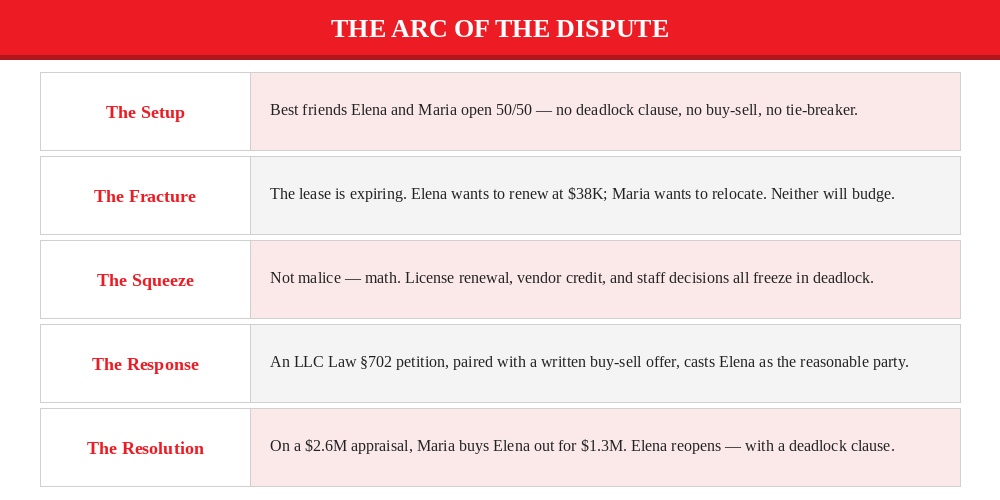
Elena and Maria opened Osteria Maria Elena together — best friends since high school. Elena ran the kitchen, Maria ran the business: finances, vendors, the lease, the insurance. They split everything fifty-fifty through an LLC with a simple operating agreement that required majority consent for major decisions, which in a two-member company meant unanimous consent. There was no deadlock-breaking provision. No buy-sell clause. No mediation requirement. Nobody had thought about what would happen if the two best friends ever disagreed.
The Fracture
For five years they agreed on everything, or close enough. Then the lease came up. The five-year term was expiring in ninety days, and the landlord offered a ten-year extension at $38,000 a month, up from $28,000. Elena wanted to sign — she loved the location, the regulars, the kitchen she had designed. Maria thought the rent was too high and wanted to move to a bigger space in a cheaper neighborhood, expand the concept, add a rooftop bar. Both visions were reasonable. Neither would budge. And the operating agreement required both of them to agree on any lease or renewal. The clock kept ticking.
The Squeeze
There was no squeeze here, and that is exactly what made it dangerous. This was deadlock — two people with equal power and incompatible visions and a hard deadline closing in. While they argued, the decisions piled up. The liquor license renewal was due in forty-five days and the SLA application needed a confirmed location. A key vendor wanted to know whether to extend the restaurant’s credit. The sous chef was fielding offers and wanted to know if the place even had a future. The deadlock was strangling the business — not through malice, but through arithmetic.
The Response
Elena’s attorney filed a petition under LLC Law §702, seeking dissolution on the ground that it was not reasonably practicable to carry on the business in conformity with the operating agreement. The petition came with two things: a detailed affidavit documenting every decision the company could not make because of the deadlock, with the financial cost of each delay; and a written buy-sell proposal — Elena offered to buy Maria’s half at a price set by an independent appraiser, or to sell her own half to Maria at that same price.
That proposal changed everything. It told the court Elena was the reasonable party — not trying to destroy the business, just seeking a rational exit. It told Maria that Elena was serious. And it put a concrete number on the table, which moved the conversation from abstract disagreement to economic reality.
The Resolution
Maria accepted the buy-sell framework. An independent appraiser valued the restaurant at $2.6 million. Maria elected to buy Elena’s fifty percent for $1.3 million — she had family capital and a plan for the relocation she had wanted all along. Elena used the proceeds to open a smaller, more intimate place in her preferred neighborhood, this time with an operating agreement that included a deadlock-breaking mechanism, a mandatory buy-sell trigger, and a mediation escalation clause.

The Lesson
Elena and Maria’s story is the purest form of business divorce: no villain, no victim, just two people who wanted different things from the same business. The lesson is about governance design, not bad faith. If you are forming a fifty-fifty partnership — in a restaurant or anything else — you must build in a way to break a tie.
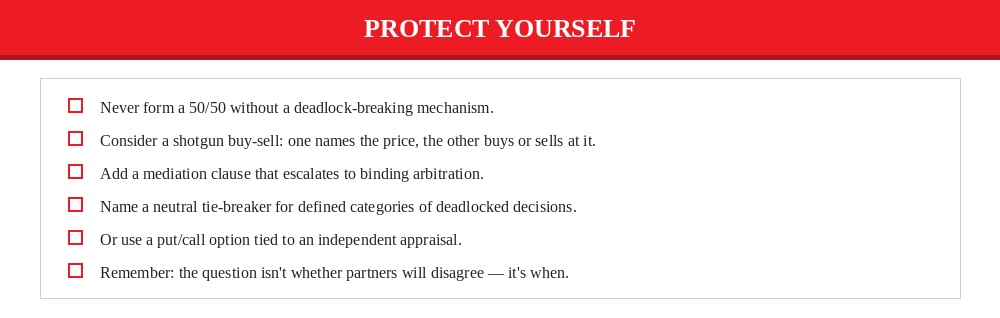
Without one of these mechanisms, a fifty-fifty partnership is a time bomb. The question is never whether the partners will disagree — it’s when.
—————————————————
If you recognize your situation in this story, you’re not alone — and you have options.
The DHC Hospitality & Restaurant Law Group represents restaurant and hospitality owners in business divorce, partnership disputes, and ownership transitions throughout New York, backed by the firm’s more than 50 years of experience representing New York businesses.
Contact us for a confidential consultation:
Andreas Koutsoudakis, Esq. | Partner & Co-Chair
(212) 557-7200 | aak@dhclegal.com
This article is for informational purposes only and does not constitute legal advice. Every situation is different, and you should consult with qualified counsel to evaluate your specific circumstances.