


Handling New York Commercial Leases in Bankruptcy
For most New York restaurants, the lease is the business. You can change the menu, rebrand, or swap out equipment—but if you lose the right space, at the wrong time, the restaurant may not survive.
Bankruptcy can give restaurant owners powerful tools to deal with landlord pressure, rent arrears, and bad lease terms. But it can also be unforgiving if you miss deadlines or mishandle negotiations.
The Automatic Stay: Hitting Pause on Evictions
When your restaurant entity files for bankruptcy, an “automatic stay” kicks in. It’s one of the most immediate and powerful protections in the Bankruptcy Code—but it has real limits you need to understand.
FIGURE 1: The Automatic Stay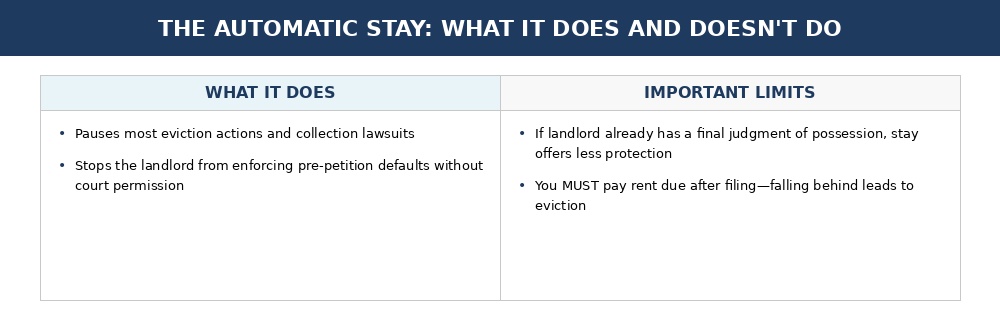
That second limit is critical. The automatic stay buys you time, but it doesn’t make rent disappear. Miss your post-petition rent and you can find yourself back in eviction court fast.
Assumption, Rejection, and Renegotiation
In Chapter 11 (including Subchapter V), commercial leases are treated as “executory contracts”—both sides still have material duties to perform. You generally have three options:
FIGURE 2: Three Options for Your Lease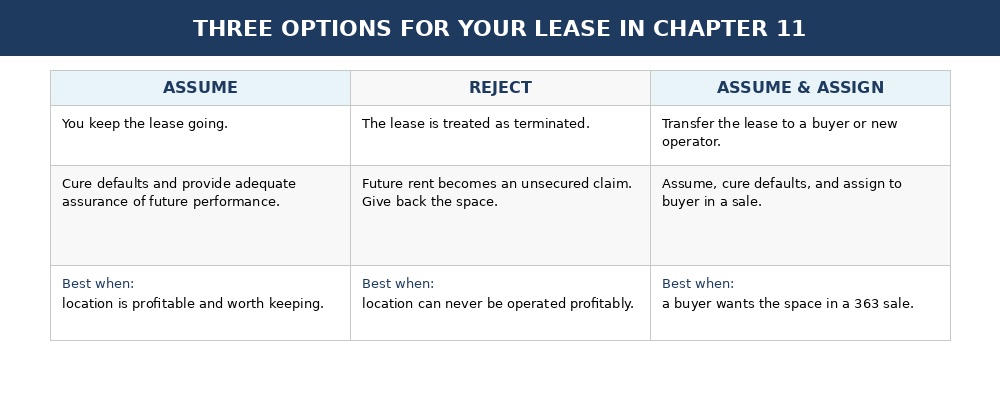 There are strict timelines—measured in months, not years—for deciding what to do with non-residential leases in Chapter 11. Miss them, and you can lose the lease automatically, without a fight.
Rent Arrears and Personal Guarantees
Most New York restaurant leases come with significant rent arrears after tough periods—and a personal guarantee by the owner or principals.
Bankruptcy can help by:
- Allowing arrears to be spread out over time under a plan
- Treating some landlord claims as unsecured
- Providing leverage to renegotiate rent, extend terms, or modify other provisions
But here’s the catch every restaurant owner needs to understand: a corporate bankruptcy doesn’t automatically wipe out a personal guaranty. The guarantor usually remains on the hook unless there is a separate personal resolution or filing.
Multi-Location and Co-Tenancy Issues
If you operate multiple locations, the analysis gets more complex:
- Cross-default provisions: Landlords for different sites may be watching each other, and some have provisions tying locations together.
- Anchor-tenant and co-tenancy clauses: In malls and mixed-use properties, these can impact traffic and your bargaining dynamics.
Bankruptcy allows you to “cherry-pick” leases—keeping profitable locations and rejecting losers—but only if your entity structure and guarantees support that strategy. This is exactly why how you set up your entities at the start matters so much.
FIGURE 3: Lease Strategy Checklist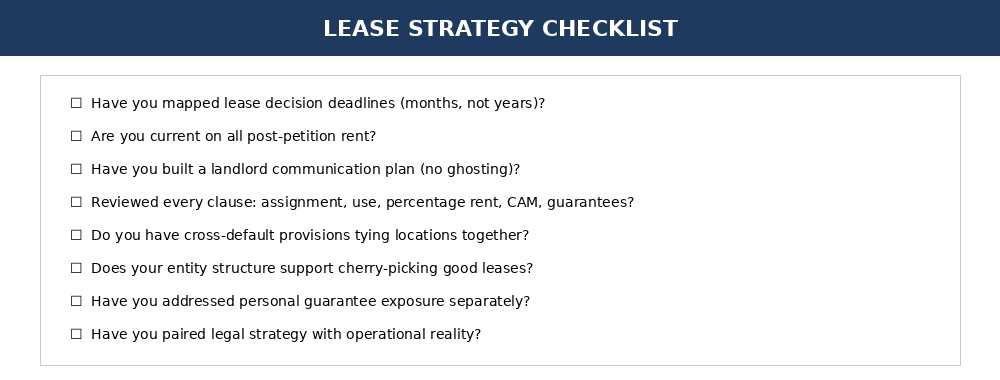
Conclusion
Your lease can be your restaurant’s biggest asset—or its biggest anchor. Bankruptcy gives New York restaurant owners tools to restructure lease obligations, save good locations, and exit bad ones, but only if they understand the rules and move early.
If you’re behind on rent or facing eviction, talk to counsel before the marshal arrives. In many cases, a well-planned Chapter 11 provides options that simply don’t exist once the lease is gone.
—————————————————
About the Author
Andreas Koutsoudakis is a Partner and Co-Chair of the Hospitality & Restaurant Law Group at Davidoff Hutcher & Citron LLP. His practice focuses on the restaurant and hospitality industry, backed by the firm’s more than 50 years of experience representing New York businesses. He can be reached at aak@dhclegal.com.
This article is for informational purposes only and does not constitute legal advice. Every situation is different, and you should consult with qualified counsel to evaluate your specific circumstances.