


How to Navigate Partner Exits, Buyouts, and New Investment Without Losing Control
Ownership changes are inevitable in the lifecycle of most restaurant businesses. A partner retires, a buyout closes, a new investor comes in, a divorce forces a restructuring—the trigger varies, but the risk is the same: if you don’t protect your position during the transition, you can lose control, lose value, or lose both.
I’ve represented restaurant owners on every side of ownership transitions—the one selling, the one buying, the one staying, and the one getting pushed out. The owners who come through these transitions in good shape are almost always the ones who addressed ownership change mechanics in their operating agreement before the change happened. The ones who didn’t are the ones litigating.
This article covers the strategies that actually protect your interests when ownership is shifting—and the mistakes that leave you exposed.
What Triggers Ownership Changes in Restaurants
Understanding the common triggers helps you build the right protections in advance. Most restaurant ownership changes fall into one of six categories.
Voluntary exit. A partner decides to leave—retirement, relocation, career change, or simply wanting out of the business. This is the most manageable scenario when the operating agreement addresses it.
Buyout. One or more partners choose to buy out another’s stake, often after internal disagreements or a strategic decision to consolidate control.
New investment. A new investor joins the business, requiring a reallocation of equity. This can shift control dynamics and dilute existing owners.
Death or disability. A partner’s ownership interest becomes subject to estate proceedings or guardian management. Without a buy-sell agreement, the surviving partners may end up co-owning a restaurant with the deceased partner’s heirs.
Divorce. A partner’s ownership share becomes subject to equitable distribution in a matrimonial proceeding. The non-owner spouse may claim a right to a portion of the business’s value—or worse, a seat at the table.
Financial distress. A partner’s personal financial problems—bankruptcy, creditor judgments, tax liens—can put their ownership interest at risk of seizure or forced sale.
The Operating Agreement: Your First and Best Protection
Every protection strategy starts with the operating agreement. If your agreement doesn’t address ownership changes, you’re relying on default rules under New York LLC law or partnership law—and those default rules rarely favor the staying owner.
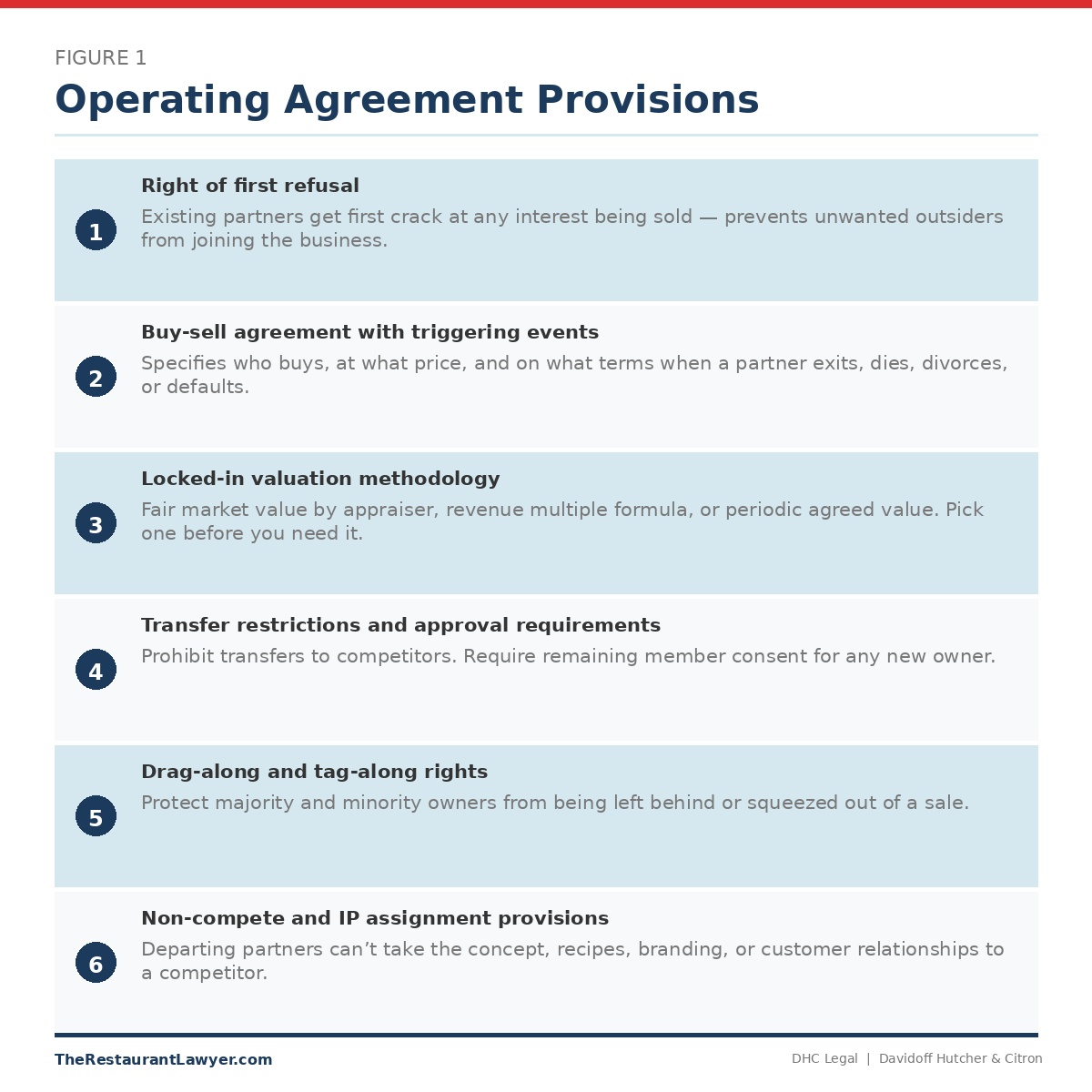
Right of first refusal. Before any partner can sell or transfer their interest to an outsider, the remaining partners get the right to match the offer and purchase the interest themselves. This prevents you from waking up one morning with a new partner you never chose.
Buy-sell agreement. Specifies what happens when a triggering event occurs—who buys, at what price, on what terms. Without this, every ownership change becomes a negotiation from scratch.
Valuation methodology. Lock in how the business will be valued during a transition. Fair market value by an independent appraiser, a formula based on revenue multiples, or a periodic agreed-upon valuation—pick one and put it in writing.
Transfer restrictions. Limit who can receive a transferred interest. Standard provisions prohibit transfers to competitors, require transferee approval by remaining members, and restrict transfers to family members without consent.
Drag-along and tag-along rights. Drag-along rights let a majority owner force minority owners to join a sale to a third party. Tag-along rights let minority owners participate in a sale initiated by the majority. Both protect against being left behind or squeezed out.
Protecting Yourself During the Transition
Even with strong agreement provisions, the transition period itself creates risk. Departing partners may try to take assets, relationships, or staff. Incoming partners may try to renegotiate terms after the deal is nominally closed. The business itself can suffer from distraction and uncertainty.
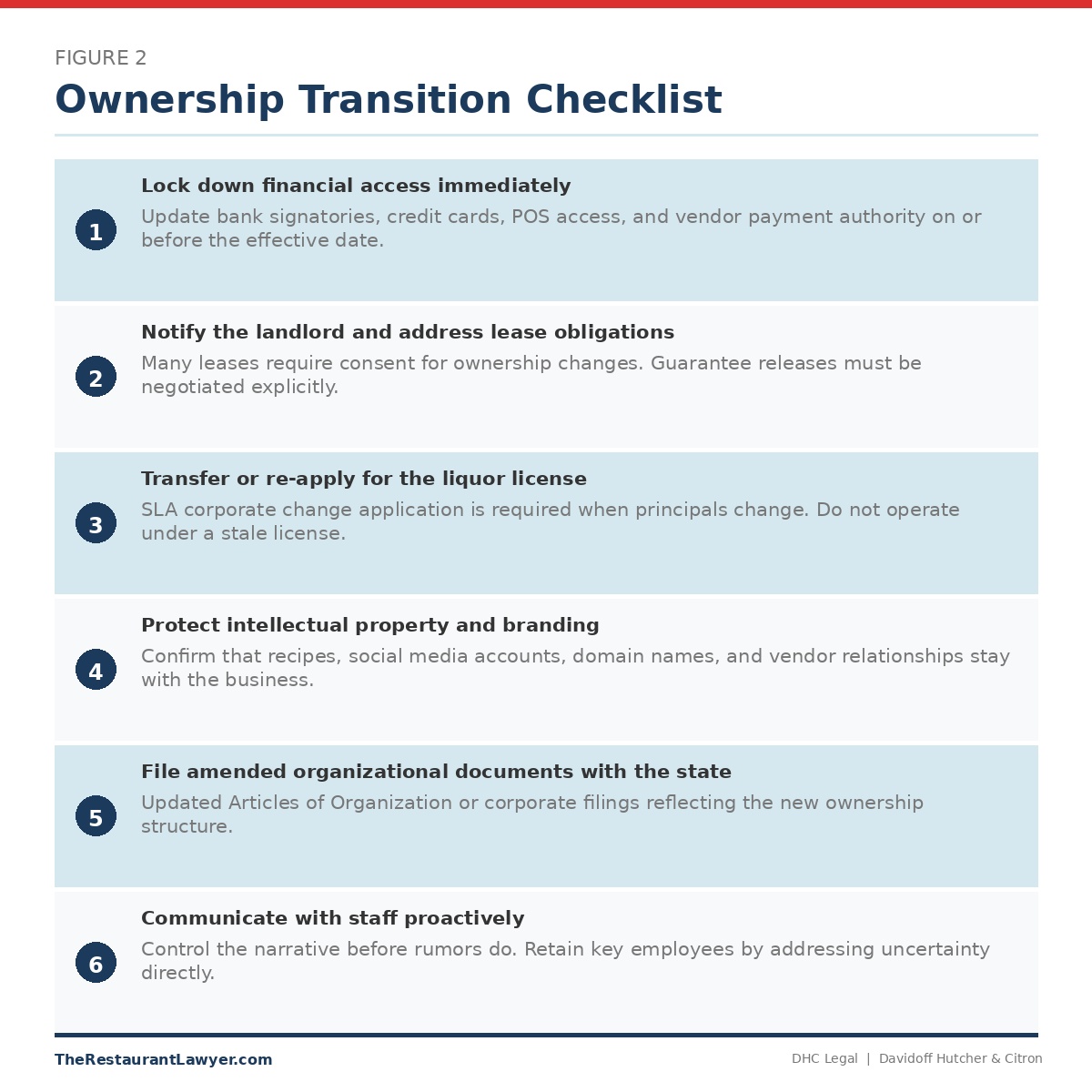
Lock down financial access immediately. Update bank account signatories, credit card authorizations, and POS system access on or before the effective date. A departing partner with continued access to business accounts is a liability.
Address the lease. If the departing partner is on the lease or the personal guarantee, the landlord needs to be involved. Many leases require consent for ownership changes—failure to notify can constitute a default.
Transfer the liquor license. If the departing partner is a principal on the SLA license, you need a corporate change application or a new license application. You cannot operate under a license that lists a principal who is no longer involved in the business.
Protect intellectual property. Recipes, branding, social media accounts, customer lists, vendor relationships—make sure everything that belongs to the business stays with the business. This should be addressed in the operating agreement but confirmed in the transition documents.
Communicate with staff. Employees will hear about ownership changes whether you tell them or not. Control the narrative. Uncertainty drives turnover, and losing key staff during a transition can damage the business far more than the ownership change itself.
When Ownership Changes Lead to Disputes
Not every ownership transition goes smoothly. When disputes arise, they typically center on valuation disagreements, allegations of self-dealing during the transition, or claims that one side failed to honor the terms of the buy-sell agreement.
If you’re heading into a contested ownership change, the most important thing you can do is get counsel involved early—before positions harden, before assets are moved, and before the relationship deteriorates to the point where litigation is the only option.
Conclusion
Ownership changes don’t have to be destructive. With the right provisions in your operating agreement—right of first refusal, buy-sell mechanics, clear valuation methodology, and transfer restrictions—transitions can be orderly and fair. Without them, every change becomes a negotiation, a power struggle, or a lawsuit.
If you’re anticipating an ownership change or want to build transition protections into your operating agreement before they’re needed, let’s talk.
—————————————————
About the Author
Andreas Koutsoudakis is a Partner and Co-Chair of the Hospitality & Restaurant Law Group at Davidoff Hutcher & Citron LLP. His practice focuses on the restaurant and hospitality industry, backed by the firm’s more than 50 years of experience representing New York businesses. He can be reached at aak@dhclegal.com.
This article is for informational purposes only and does not constitute legal advice. Every situation is different, and you should consult with qualified counsel to evaluate your specific circumstances.