


A Special Report · New York Hospitality Law
– What Moved, What It Means, and What to Do This Week.
Between November 2025 and May 2026, four things moved in New York hospitality law that change how operators should think about exposure: the Court of Appeals rewrote good-guy guarantor liability; Albany broke open the three-tier alcohol system in narrow but useful ways; the §191 amendment cut downside on weekly-pay claims while the §740 expansion increased downside on retaliation; and the city’s interagency enforcement on outdoor dining and FDNY hood compliance finally has teeth.
– I / SETTING
What Six Months Did.
Six months is a short window. Six months that include a Court of Appeals reversal, a budget-bill amendment with retroactive reach, three separate State Liquor Authority reforms, and an interagency enforcement program ramping back up after a two-year ramp-down is something else.
What follows is the version I would give an operator over coffee — what changed, what it means, and what to do this week. The detail is here for the restaurateur who wants to follow the reasoning. The short version is at the back, and it is the part you can actually hand to a general manager.
– II / WAGE & HOUR
Compliance Floor Up, Exposure Recalibrated.
The January 1, 2026 numbers are settled.
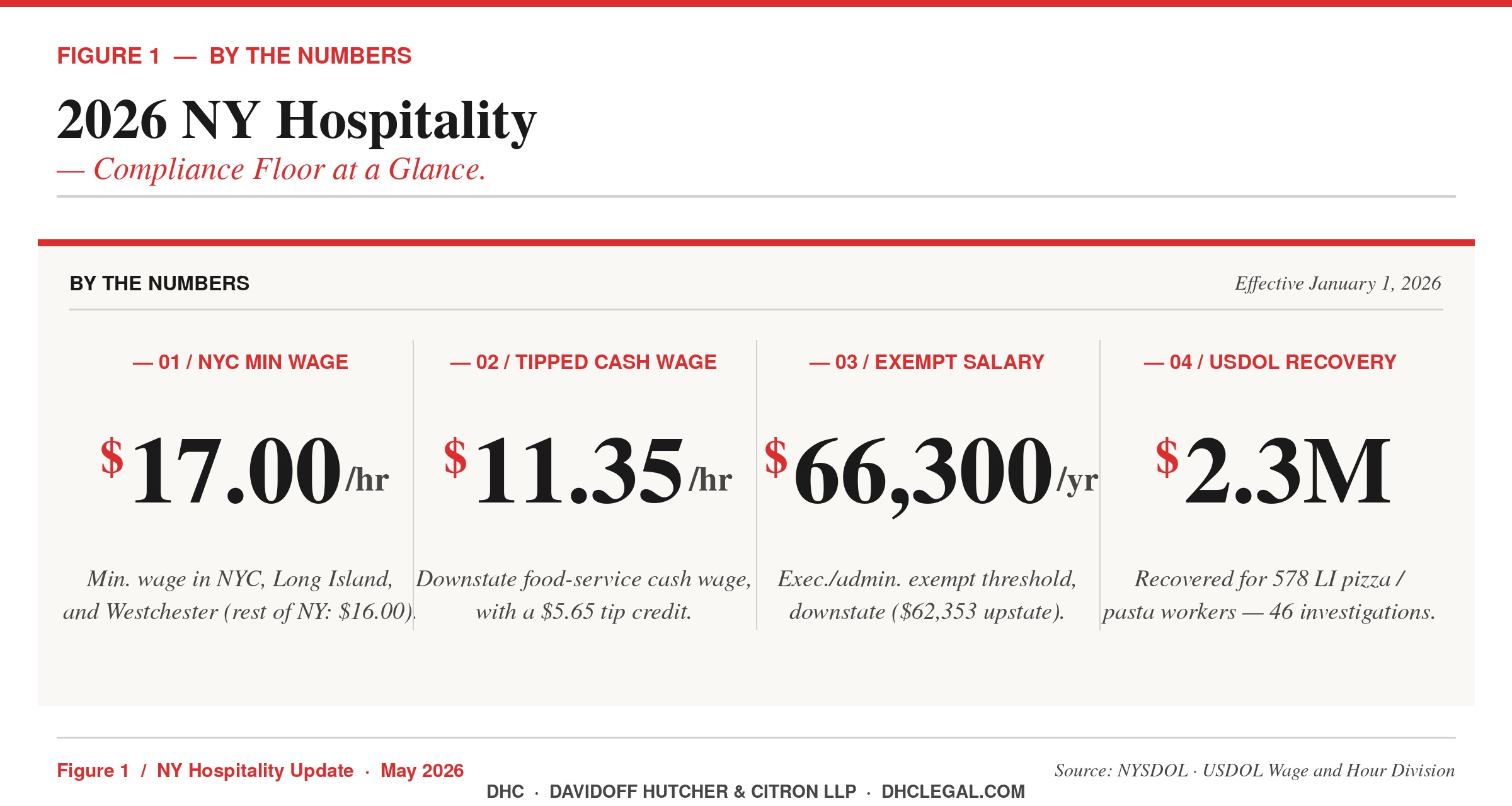
NYC, Long Island, and Westchester minimum wage moved to $17.00; the rest of the state to $16.00. Tipped food-service workers downstate: $11.35 cash plus a $5.65 tip credit. The exempt salary threshold for executive and administrative employees jumped to $1,275 per week downstate ($66,300) and $1,199.10 per week upstate ($62,353). Spread-of-hours, meal credits, and uniform maintenance allowances all moved with the floor.
If your payroll vendor did not refresh LS-54 / LS-58 rate notices and your wage statements on January 1, you are now generating stale §195 paperwork every pay cycle. That is exactly what NYSDOL and the plaintiffs’ bar audit first.
Federal enforcement is vertical, and still running.
USDOL Wage and Hour’s multi-year initiative against Long Island full-service pizza and pasta restaurants is up to 46 investigations and $2.3 million recovered for 578 workers, with six-figure civil money penalties on top. The agency keeps running the same model — concentrated, vertical, repeat-offender — in other markets. Do not assume the lane is closed to you.
§195 standing — the federal/state split is now structural.
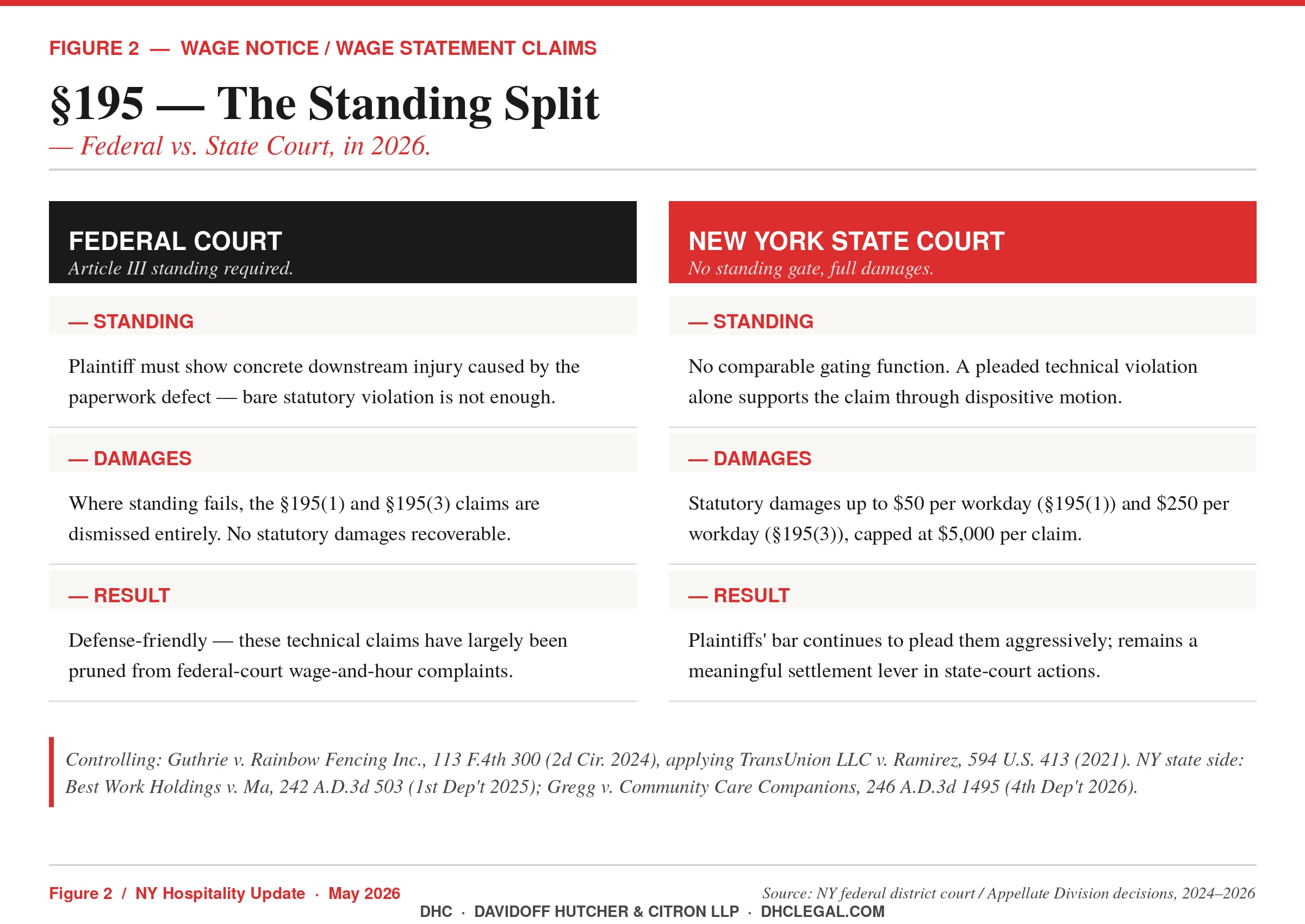
Federal courts have continued to dismiss §195(1) rate-notice and §195(3) wage-statement claims for lack of Article III standing where the plaintiff cannot show concrete downstream injury from the paperwork defect. The Second Circuit’s decision in Guthrie v. Rainbow Fencing Inc., 113 F.4th 300 (2d Cir. 2024), applying TransUnion LLC v. Ramirez, 594 U.S. 413 (2021), is now the controlling Article III standard for §195 claims in the Second Circuit. State courts have not adopted that gating function — Best Work Holdings (New York) LLC v. Ma, 242 A.D.3d 503 (1st Dep’t 2025), and Gregg v. Community Care Companions, Inc., 246 A.D.3d 1495 (4th Dep’t 2026), confirm that a pleaded statutory violation supports the claim without a federal-style injury showing. Pending Assembly legislation would recalibrate damages so forum choice stops driving outcomes.
§191 — the May 2025 amendment is real relief, but narrow.
The Governor’s May 9, 2025 budget bill (L. 2025, c. 56, pt. U, §1) amended Labor Law §198 — the remedies provision governing §191(1)(a) violations — effective May 9, 2025. For first-time violations of the manual-worker weekly-pay rule where wages were otherwise paid on regular semi-monthly pay days, damages are now limited to lost interest on the delayed amounts — not 100% liquidated damages. Liquidated damages on subsequent violations require a prior final finding and order by NYSDOL or a court (no pending administrative or judicial review, and the time for review expired).
The statute speaks prospectively to conduct occurring after May 9, 2025; whether courts will apply the new damages cap to pre-enactment conduct in pending cases is an open question. Several plaintiffs’ firms have challenged retroactive application on Contracts Clause and due-process grounds; those challenges are pending. For now: a meaningful exposure reduction for employers whose manual workers are paid semi-monthly with otherwise clean payroll histories.
§740 — broader, more punitive, more often pleaded.
The 2022 amendments (L. 2021, c. 522, eff. Jan. 26, 2022) dramatically broadened §740: independent contractors and former employees are now covered, the protected-disclosure standard dropped from actual violation to reasonable belief, the limitations period doubled to two years, and remedies now include punitive damages, front pay, and civil penalties up to $10,000. Retaliation now expressly includes threats to contact U.S. immigration authorities about the employee or the employee’s family or household members — a real and specific exposure in this industry.
We are seeing §740 claims plead alongside ordinary wage-and-hour complaints after almost any termination that follows an internal complaint. Pending Senate legislation would extend §740 further — not law yet, but a signal worth tracking.
Tip credit — 80/20 still binds in New York.
The Fifth Circuit’s August 23, 2024 decision in Restaurant Law Center v. U.S. Department of Labor, 115 F.4th 396 (5th Cir. 2024), vacated the federal 80/20/30 rule (29 C.F.R. §531.56(f)). New York’s parallel rule is regulatory — the Hospitality Industry Wage Order at 12 NYCRR Part 146, specifically §146-2.9 — and is unaffected by the federal decision. The Wage Order still prohibits the tip credit on any day where a tipped employee spends more than two hours or 20% of a shift on non-tipped work. Mandatory service charges and banquet administrative fees remain presumptively tips unless the employer’s notice rebuts the presumption in the precise form the wage order requires. Federal relief does not translate downstate.

– III / LEASES
1995 CAM LLC and the Guarantor’s New Position.
1995 CAM LLC v. W. Side Advisors, LLC, 45 N.Y.3d 150, 277 N.E.3d 1040 (2025).
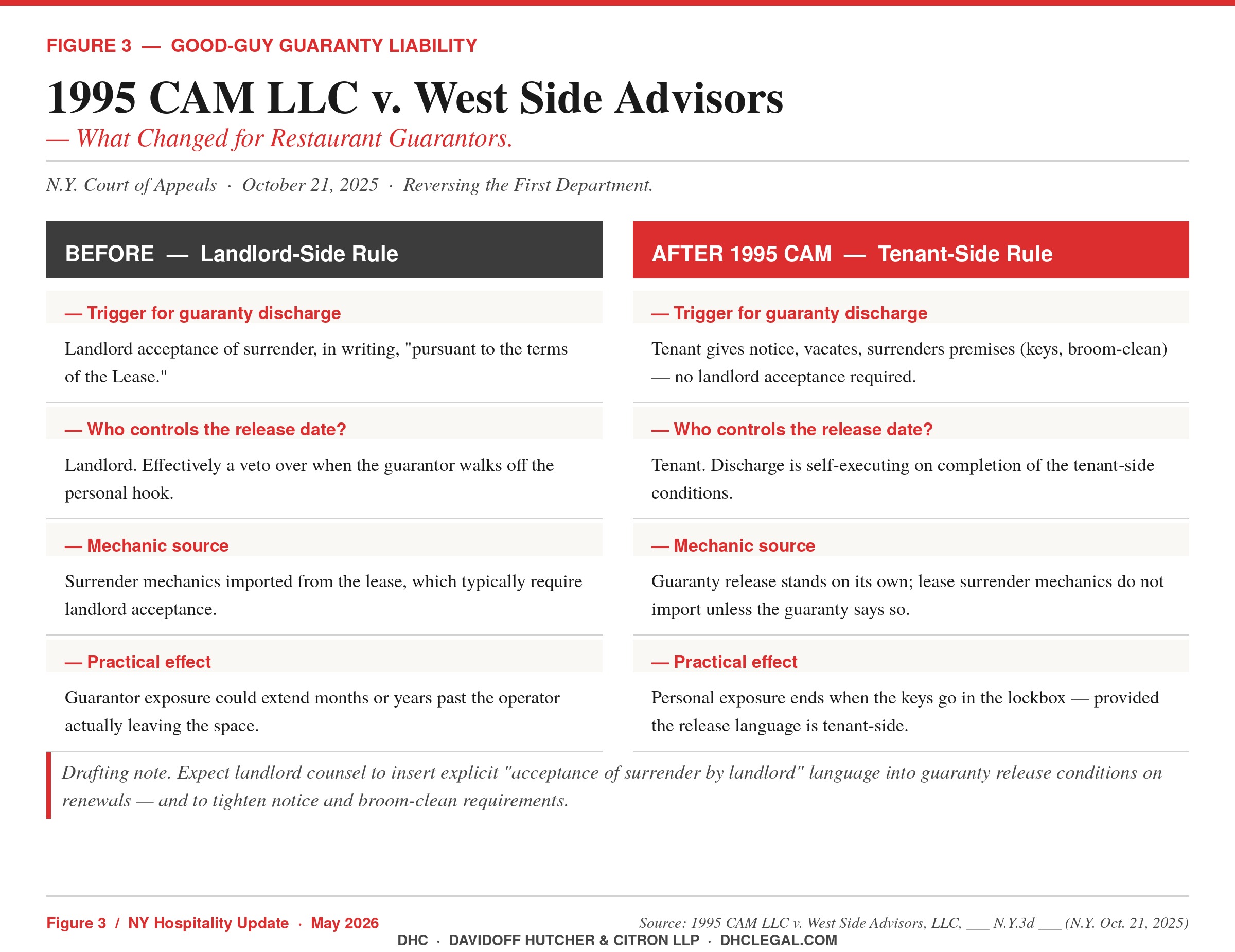
The headline case of the six months. The Court of Appeals, in a 5-2 decision (Wilson, C.J., writing for the majority; Singas, J., dissenting joined by Garcia, J.), reversed the First Department (221 A.D.3d 420) and held that a guarantor’s liability under a “good-guy” guaranty ends when the tenant vacates and surrenders the premises — even where the landlord never accepted that surrender in writing. The tenant gave 30 days’ written notice, completely vacated, and delivered the keys to the building superintendent; that was enough.
The decision deliberately rejects the prevailing landlord-side practice of tying the good-guy release to landlord acceptance of surrender “pursuant to the terms of the Lease,” which had effectively given landlords a veto over when a guarantor walked. The majority reasoned that the phrase “pursuant to the terms of the Lease” in the guaranty modified the physical condition of surrender (broom-clean, free and clear of subtenants) and not the lease’s formal surrender mechanics. Where the guaranty’s release language uses tenant-side language and does not incorporate the lease’s written-acceptance requirement by reference, guaranty discharge is self-executing.
The holding is fact-specific. Where a guaranty expressly incorporates the lease’s formal surrender mechanics — including the requirement of landlord’s written acceptance — the result may differ. See Elk 33 E. 33rd LLC v. Sticky’s Corp. LLC, 228 A.D.3d 455 (1st Dep’t 2024).
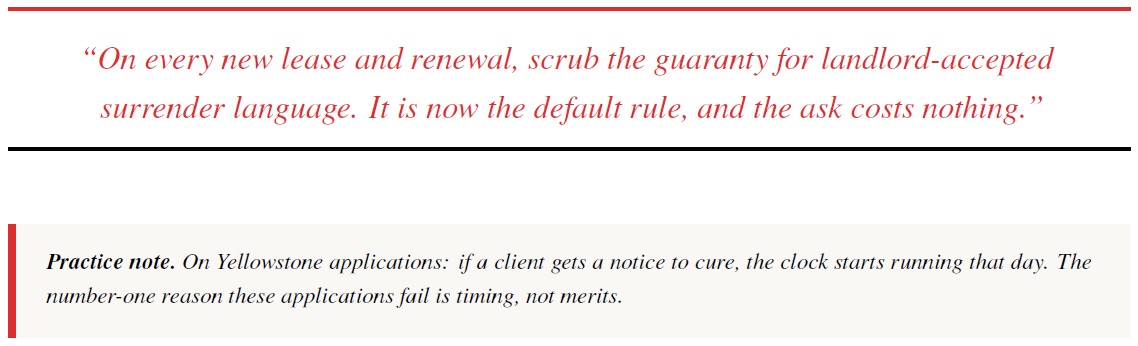
For restaurants on REBNY-form leases with bolt-on personal guaranties — which is essentially every privately owned restaurant in this town — this is a meaningful risk reallocation back toward the operator/principal. Landlord-side counsel is already drafting around it; expect explicit “acceptance of surrender by landlord” language pushed into guaranty release conditions on renewals.
Yellowstone — still the right tool, still strictly enforced.
The four-prong test from Graubard Mollen Horowitz Pomeranz & Shapiro v. 600 Third Ave. Assoc., 93 N.Y.2d 508 (1999), continues to bind: (1) a commercial lease, (2) a notice of default, cure, or termination, (3) application before the cure period and lease term expire, and (4) willingness and ability to cure by any means short of vacating. The First Department continues to apply it strictly. See Robert Marson Testamentary Tr. v. 4 W. 16 St. Corp., 233 A.D.3d 516 (1st Dep’t 2024); Gap, Inc. v. 44-45 Broadway Leasing Co., 191 A.D.3d 549 (1st Dep’t 2021). The Second Department applies the identical test. Middletown Flea Mkt., LLC v. Middletown Plaza Holdings, LLC, 216 A.D.3d 1084 (2d Dep’t 2023).
RPL §235-h, effective December 20, 2019, voids any commercial-lease provision waiving or prohibiting the tenant’s right to bring a declaratory judgment action — the statutory vehicle for Yellowstone relief — as against public policy. The legislature enacted §235-h to override 159 MP Corp. v. Redbridge Bedford, LLC, 33 N.Y.3d 353 (2019), which had enforced such a waiver. Functionally, this preserves Yellowstone rights. Landlords still try to insert these clauses, and they remain unenforceable.
– IV / LICENSING
The SLA Opened Categories That Did Not Legally Exist a Year Ago.
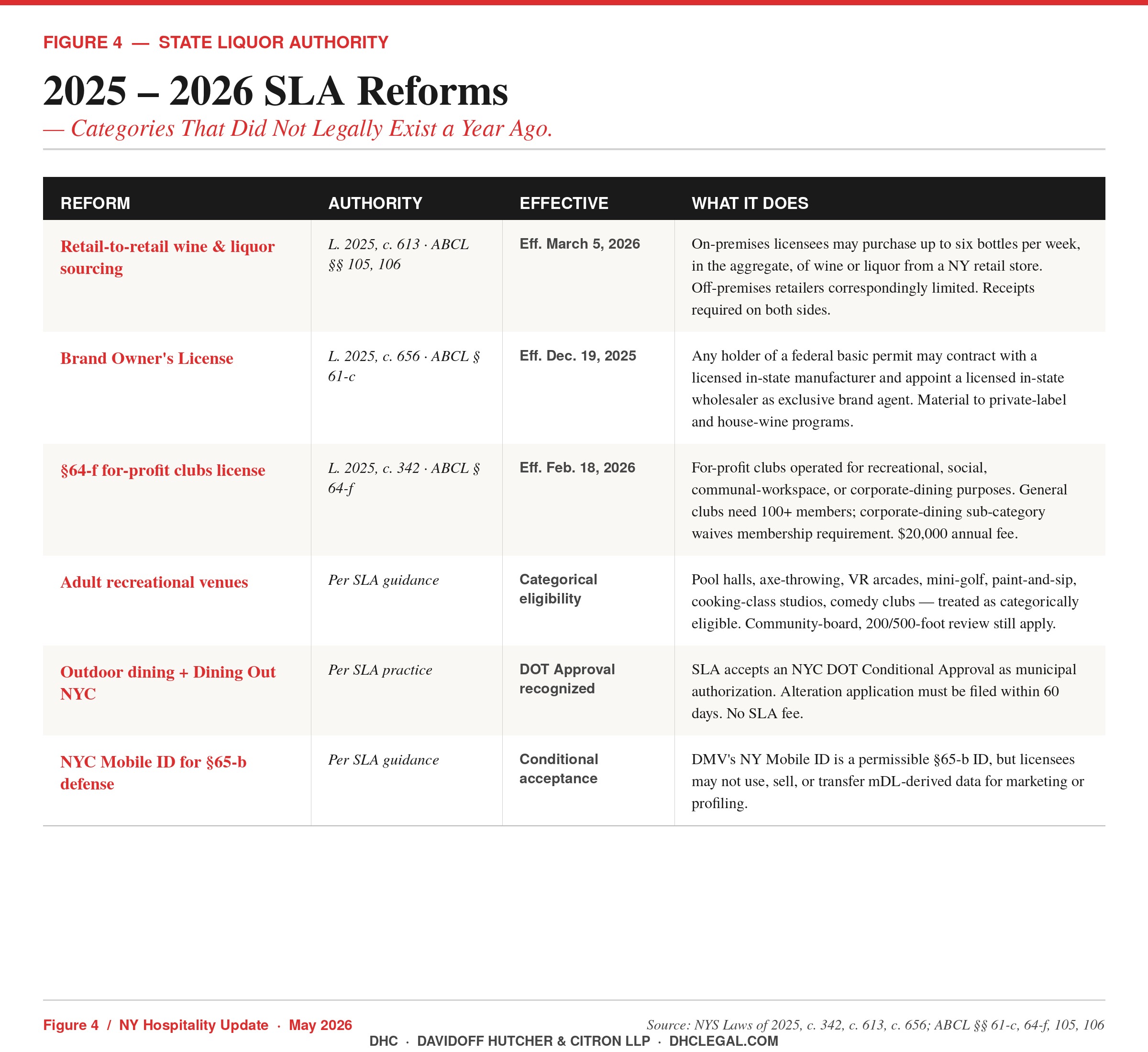
The State Liquor Authority and the Legislature, between January 2025 and March 2026, have authorized more than half a dozen licensing changes that materially expand what an on-premises operator can do. Most are quiet adjustments. Two — retail-to-retail sourcing and the §64-f for-profit clubs license — meaningfully change the strategic landscape.
What this means in practice.
The retail-to-retail crack in the three-tier wall is small (six bottles per week, in the aggregate) but operationally useful: the long-running headache of being one bottle short for a private dinner, a last-minute wine pairing, or an oddball bottle a guest specifically requests now has a legal path under L. 2025, c. 613 (effective March 5, 2026). Both sides have to keep receipts, and SLA will inspect them. The §64-f for-profit clubs license (L. 2025, c. 342, effective February 18, 2026) is the long-awaited fix for membership-driven concepts that previously had to shoehorn themselves into restaurant licenses with awkward public-access and menu requirements. The corporate-dining sub-category — which waives the 100-member requirement — opens a path for executive dining and supper-club formats that did not legally exist a year ago.
The Brand Owner’s License (L. 2025, c. 656, codified at ABCL § 61-c, effective December 19, 2025) gives independent New York brands a new structural option: a federal-permit holder can contract with a licensed in-state manufacturer and appoint a licensed in-state wholesaler as exclusive brand agent, without itself being licensed as a manufacturer or wholesaler. Material to private-label and house-wine programs.
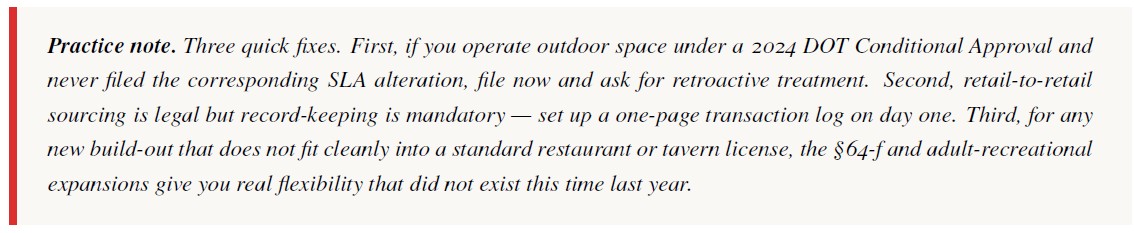
The Dining Out NYC / SLA interface is the one that catches operators by surprise. Per SLA practice, the SLA now accepts an NYC DOT Conditional Approval as municipal authorization, with the alteration application required within 60 days. If you operate outdoor space under a 2024 DOT Conditional Approval and never filed the corresponding SLA alteration, you are now out of compliance and may not know it. The alteration application is free at SLA, but the clock is short.
– V / INSPECTION
FDNY, DOB, Dining Out NYC —The Interagency Layer Is On.
FDNY — 2026 compliance changes for cooking operations.
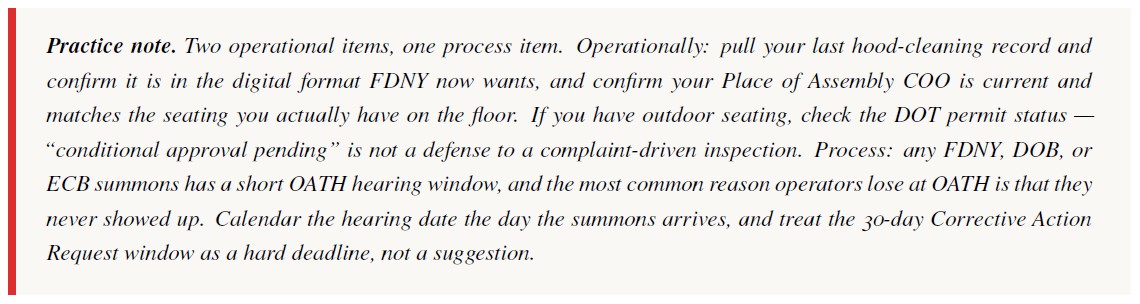
Effective in 2026, FDNY is requiring restaurants — pizza ovens drew the attention, but the rules cover commercial cooking broadly — to maintain digital logs for hood cleanings, suppression-system inspections, and airflow corrections, and to install hinge kits permitting safe access for cleaning. Inspectors are citing for paper-only or incomplete records and for exhaust airflow below FDNY’s CFM standards. Fines for fire-code violations now range from $800 to $5,000+ per summons, and FDNY issued more than 22,000 citywide violations in 2024. FDNY can also order immediate closure or vacate for serious life-safety violations — blocked exits, inoperable sprinklers, missing or expired Certificate of Fitness. Those follow the property through sale and refinancing indefinitely.
Dining Out NYC — the permit backlog is itself the enforcement risk.
The permanent Dining Out NYC program (adopted by the City Council in 2023) is now fully replacing the pandemic-era Open Restaurants regime. Roadway cafes are seasonal — April 1 through November 29, removed by November 30. Sidewalk cafes are year-round. Enforcement is interagency: DOT leads, with DSNY, NYPD, Health, FDNY, and the SLA in coordination.
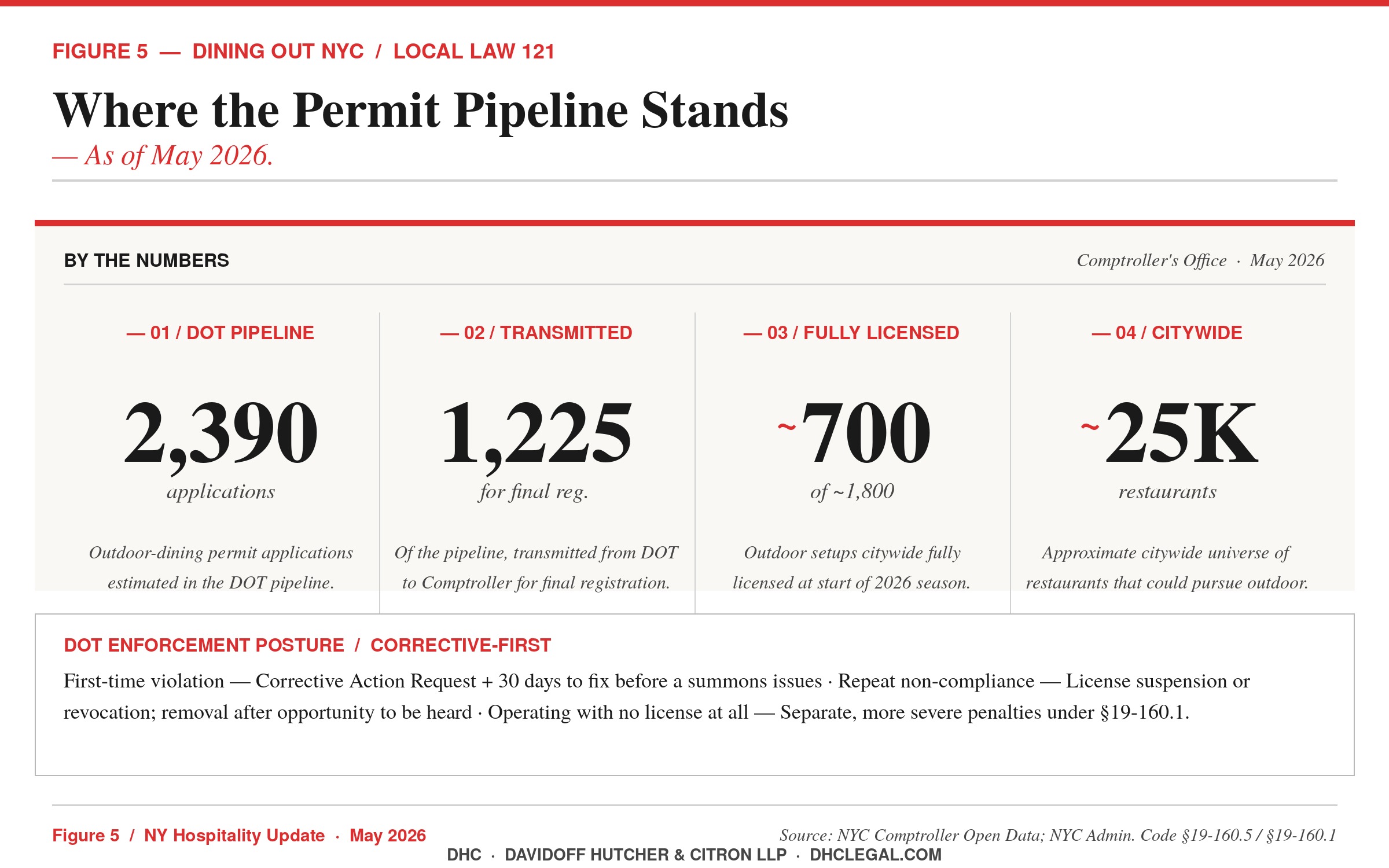
DOT’s posture is corrective-first: first violation typically yields a 30-day Corrective Action Request before summonses issue; repeat non-compliance gets license suspension or revocation. Operating with no license at all draws severe penalties under the NYC Administrative Code’s outdoor-dining enforcement provisions.
DOB and the ECB pipeline.
DOB monthly bulletins continue to highlight six- and seven-figure penalty actions against operators for illegal alterations, work-without-permit, and life-safety violations. ECB processes more than 125,000 violations annually with $78 million in civil penalties citywide. The recurring restaurant traps are unpermitted kitchen reconfigurations, illegal cellar build-outs, and Place of Assembly Certificate of Operation lapses — all of which compound across DOB, FDNY, and Health summonses.
– V / THIS WEEK
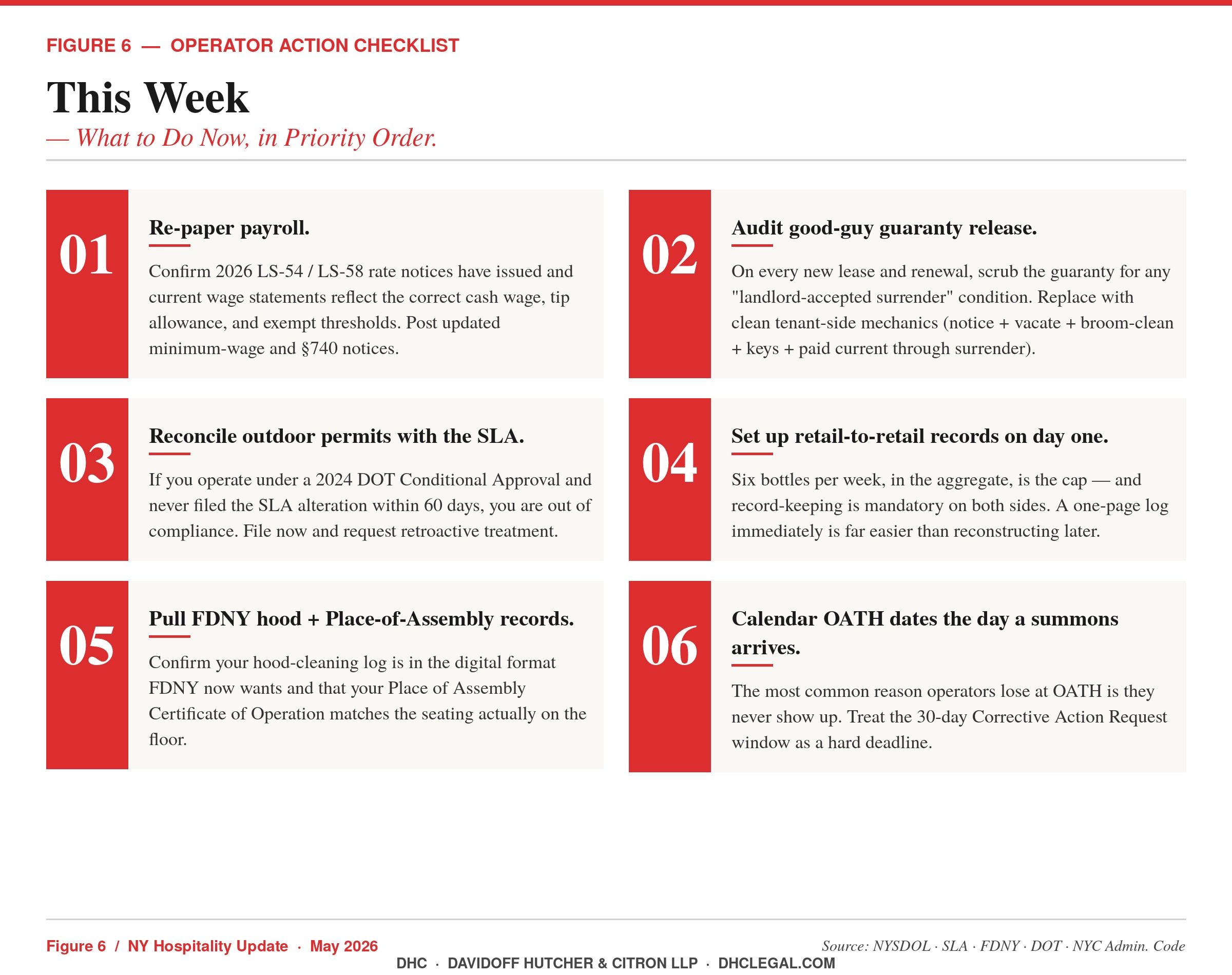
Six Things to Do, in Priority Order
The throughline, if there is one, is that the rules of the game in New York hospitality are now changing fast enough that operating-by-precedent is genuinely risky. The 1995 CAM decision flipped a fifty-year landlord assumption. The SLA reforms unlocked categories of business that did not legally exist a year ago. The §191 amendment cut exposure for a specific population of employers while the §740 expansion increased exposure for almost everyone. And the city is going to keep enforcing outdoor dining and FDNY compliance on operators who are already short-staffed in the back office.
The good news is that the action list is short and the items are self-contained. Most can be done in a week. None should wait a quarter.

– VII / AUTHOR
A Note on Me, and the Firm.
I am a partner at Davidoff Hutcher & Citron LLP in New York City, where I co-chair the firm’s Hospitality & Restaurant Law
Group. My practice focuses on the restaurant and hospitality industry, backed by the firm’s more than 50 years of experience
representing New York businesses. I represent restaurant, bar, hotel, and food-service operators on commercial leasing, SLA
licensing, employment, regulatory compliance, and workout matters.
The firm has cross-departmental capability that is unusual for a regional practice — corporate, real estate, employment,
bankruptcy and Subchapter V, and long-standing government relations work at the city, state, and federal levels — which we
deploy in coordinated fashion on hospitality matters.
—————————————————
About the Author
Andreas Koutsoudakis is a Partner and Co-Chair of the Hospitality & Restaurant Law Group at Davidoff Hutcher & Citron LLP. His practice focuses on the restaurant and hospitality industry, backed by the firm’s more than 50 years of experience representing New York businesses. He can be reached at aak@dhclegal.com.
This article is for informational purposes only and does not constitute legal advice. Every situation is different, and you should consult with qualified counsel to evaluate your specific circumstances.