


How to Limit Your Personal Risk in NYC Restaurant Leases
Most NYC restaurant leases come with a catch: the landlord wants you, not just your LLC, on the hook.
I’ve seen restaurant owners sign personal guarantees without fully understanding what they’re agreeing to—and then watch their personal savings, their home equity, and their retirement accounts become collateral for a restaurant that didn’t make it. The guarantee you sign today could follow you for a decade.
You may not be able to avoid guarantees entirely. But there’s a world of difference between an unlimited personal guarantee and a carefully tailored Good Guy Guarantee with caps, burn-offs, and exit mechanics. Understanding the difference—and negotiating hard—is about protecting your personal net worth.
The Full Personal Guarantee: Maximum Exposure
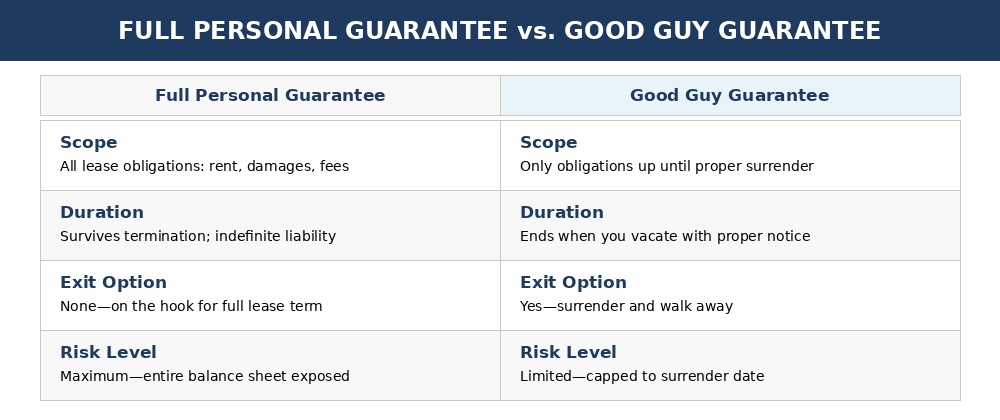
A full personal guarantee is exactly what it sounds like: you personally guarantee all obligations under the lease. This typically means:
- You’re personally liable for rent, additional rent, damages, attorneys’ fees, and any other lease obligations
- The landlord can sue you personally if the company defaults
- The guarantee often survives lease termination—meaning you’re on the hook even after the restaurant closes
This is the most landlord-friendly structure. Resist it or negotiate it down whenever possible.
The Good Guy Guarantee: A Better Alternative
The Good Guy Guarantee (GGG) is a uniquely New York creation, and it’s far more tenant-friendly than a full personal guarantee.
In basic terms: you personally guarantee rent and obligations only up until the date you properly vacate the premises and hand back the keys, typically with required notice and no undischarged rent arrears. If you “leave like a good guy,” the landlord pursues the entity—not you—for any future rent and damages.
This gives you an exit. If the restaurant isn’t working, you can surrender the space and walk away from future liability rather than being trapped for the full lease term.
FIGURE 1: Full Personal Guarantee vs. Good Guy Guarantee
Negotiating the Good Guy Guarantee
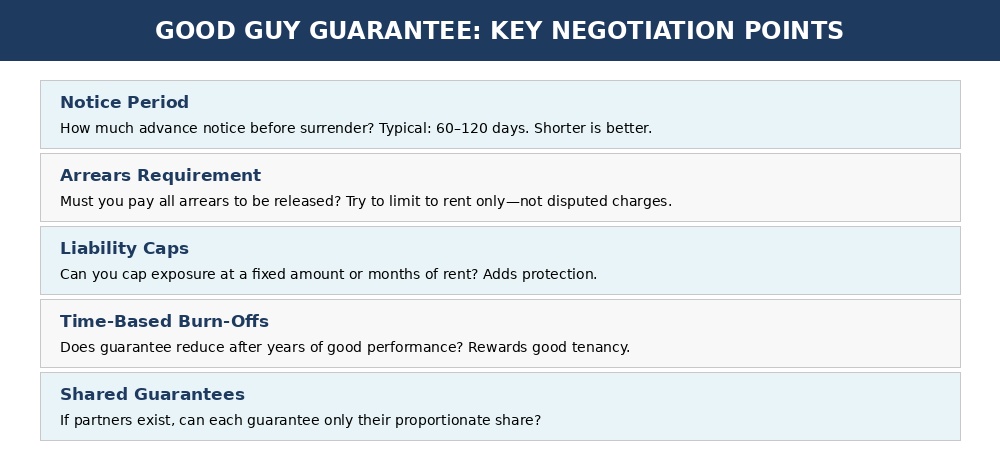
Not all Good Guy Guarantees are created equal. The devil is in the details:
FIGURE 2: Key Negotiation Points
Caps, Burn-Offs, and Shared Guarantees
Even with a Good Guy Guarantee, you can often negotiate additional protections:
- Liability caps: Limit your exposure to a fixed dollar amount or a set number of months’ rent (e.g., 12 months of base rent).
- Time-based burn-offs: Your guarantee reduces or disappears entirely after certain years of on-time performance (e.g., guarantee burns off 25% per year after year 3).
- Shared guarantees: If you have partners, each partner guarantees only their proportionate share, coordinated with ownership percentages. Don’t guarantee for everyone if you’re not the only owner.
Aligning Guarantees with Corporate and Exit Planning
Your guarantee structure should reflect your business reality and exit plans:
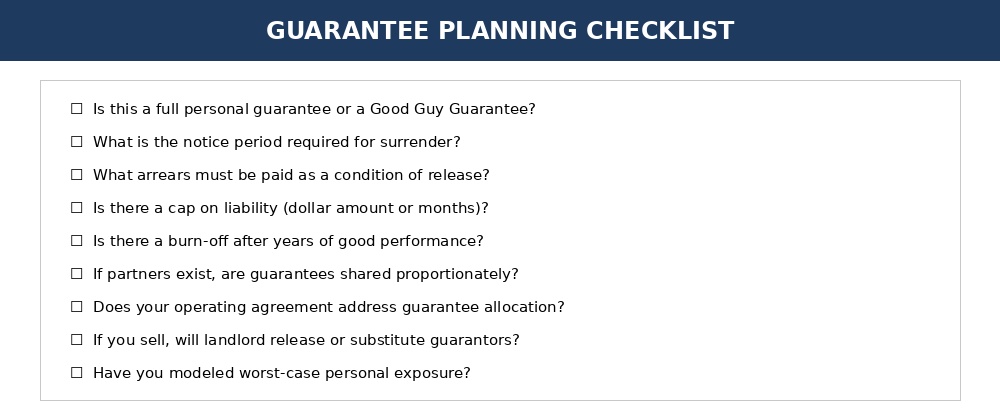
- Sale of the restaurant: If you plan to sell, will the landlord release you or substitute the buyer as guarantor? Get this addressed in the lease upfront.
- Partnership dynamics: Are all partners stepping up as guarantors, or are you effectively guaranteeing for everyone? If partners aren’t sharing the guarantee burden, address that in your operating agreement.
- Internal allocation: Does your operating or shareholder agreement address how guarantee risk is allocated among owners? It should.
FIGURE 3: Guarantee Planning Checklist
What Happens in a Default or Bankruptcy?
If the restaurant entity defaults or ends up in restructuring or bankruptcy:
- The landlord will often focus on you, the guarantor, as the most accessible source of payment. You’re easier to sue than a defunct LLC.
- Bankruptcy of the entity does not automatically wipe out your personal guarantee. The entity’s discharge doesn’t discharge your personal liability.
- Your guarantee is leverage in workout negotiations. The landlord’s desire to avoid chasing you—or litigating a complex claim—can be a bargaining chip. But it’s also your biggest liability.
Conclusion
In NYC restaurant leasing, guarantees are reality. Landlords want personal recourse, and you’ll rarely avoid it entirely. But there’s a massive difference between an unlimited personal guarantee and a carefully tailored Good Guy Guarantee with caps, burn-offs, and exit mechanics.
You can’t delegate this negotiation to anyone else—it’s about your personal net worth. Understand exactly what you’re signing, push for the protections you need, and make sure your internal partnership documents reflect the guarantee burden you’re carrying.
If you’re negotiating a lease and want help structuring your guarantee exposure—or if you’re already in a lease and facing a default situation—let’s talk.
About the Author
Andreas Koutsoudakis is a Partner and Co-Chair of the Hospitality & Restaurant Law Group at Davidoff Hutcher & Citron LLP. His practice focuses on the restaurant and hospitality industry, backed by the firm’s more than 50 years of experience representing New York businesses. He can be reached at aak@dhclegal.com.
———————————-
This article is for informational purposes only and does not constitute legal advice. Every lease and guarantee is different, and you should consult with qualified counsel to evaluate your specific situation.