


Selling the Restaurant: Due Diligence
- This white paper is based on a composite of real matters handled by the DHC Hospitality & Restaurant Law Group. Names, locations, cuisines, and identifying details have been changed to protect client confidentiality. The legal principles discussed are illustrative and should not be relied upon as legal advice for any specific situation.
In a restaurant sale, every problem the buyer uncovers in due diligence becomes a reason to cut the price. One owner looked first and closed at his number; another did not and lost $1.8 million.
The Offer
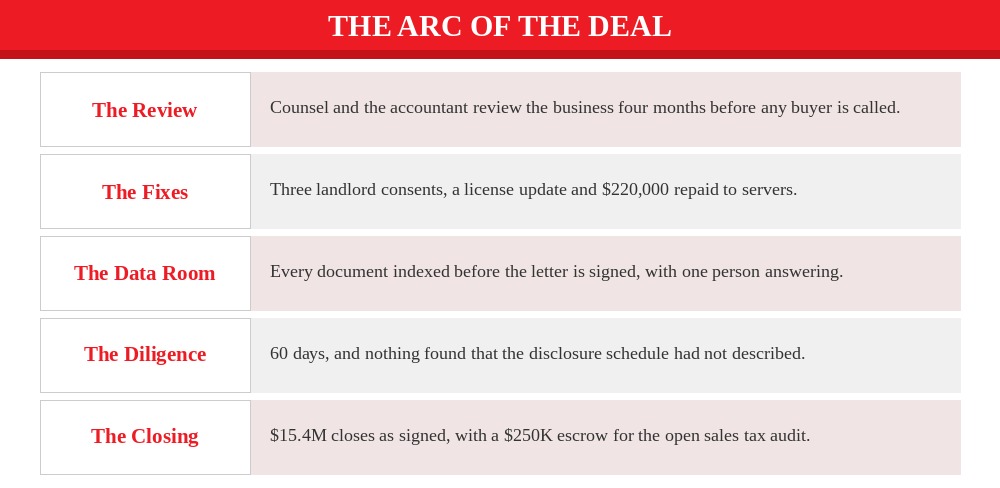
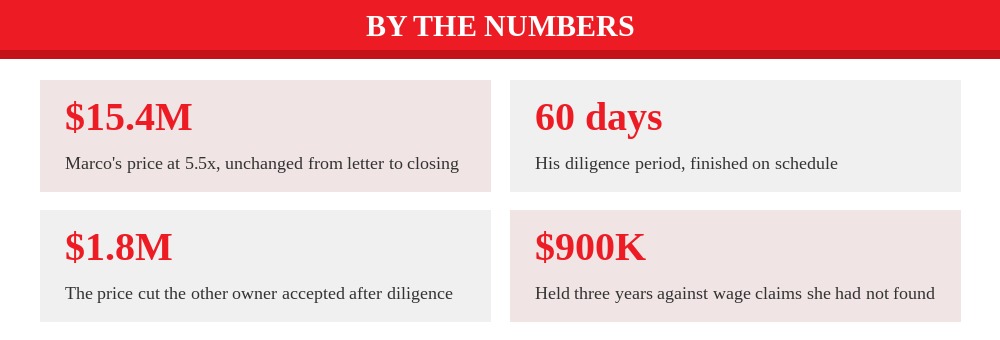
Marco built a six-location Italian group across Brooklyn, Manhattan and Westchester County over fourteen years. The six restaurants brought in about $25 million a year in sales and earned about $2.8 million before interest, taxes, depreciation and amortization. A private equity-backed platform offered five and a half times earnings, $15.4 million, in a letter of intent that gave the buyer sixty days for diligence and stated how the price would be adjusted at closing.
The Review
Four months before his banker contacted any buyer, Marco’s deal counsel and his transaction accountant reviewed the business the way a buyer would. They read every lease, license, permit, payroll policy and vendor contract, and they compared each location’s sales tax returns to its point-of-sale reports. The review turned up four problems. Three leases required the landlord’s consent to a change of control. One liquor license still listed a partner who had left the business years earlier. A floor manager had been sharing in the tip pool at four locations. One location also had an open sales tax audit.
The Fixes
Marco fixed what could be fixed before any buyer arrived. Counsel opened talks with all three landlords early, and the signed consents were in hand before diligence ended. Counsel also filed the ownership change with the State Liquor Authority so the license matched the current owners. Marco ended the floor manager’s share of the tip pool and, on counsel’s advice, repaid the servers $220,000. The sales tax audit could not be finished before a sale, so the accountant estimated the exposure at $250,000, and that figure went into the disclosure schedule with the audit file.
The Data Room
Every document a buyer would ask for was in an organized data room before the letter of intent was signed, indexed to a standard buyer’s request list. Requests came through deal counsel, and one person on Marco’s team answered them, so the buyer received the same answer to the same question every time. The buyer’s accountants and lawyers found nothing the disclosure schedule had not already described, and diligence finished inside the sixty days the letter allowed.
The Other Owner
An owner Marco knew from the industry signed a letter for her own six-unit group at $16 million. She sent documents as the buyer asked for them, and the buyer’s team found the problems before she did. Her managers had shared in the tip pool at every location. A basement build-out at one location had never been permitted. One lease had eighteen months left on it, with a renewal option she had not exercised. About a fifth of the earnings came from a catering contract the customer could end on thirty days’ notice. Each finding arrived as a separate request to reopen the price, and by the third month the other bidders had moved on.
The Closing
Marco closed at $15.4 million, the price in his letter. The buyer held ten percent of the price in a general escrow and $250,000 in a separate escrow for the sales tax audit, to be released when the audit closed. His colleague closed four months late at $14.2 million, $1.8 million below her letter. On top of its general escrow, her buyer held $900,000 for three years against wage claims her servers might bring. She had no other buyer to turn to, and she accepted the terms.
The Lesson
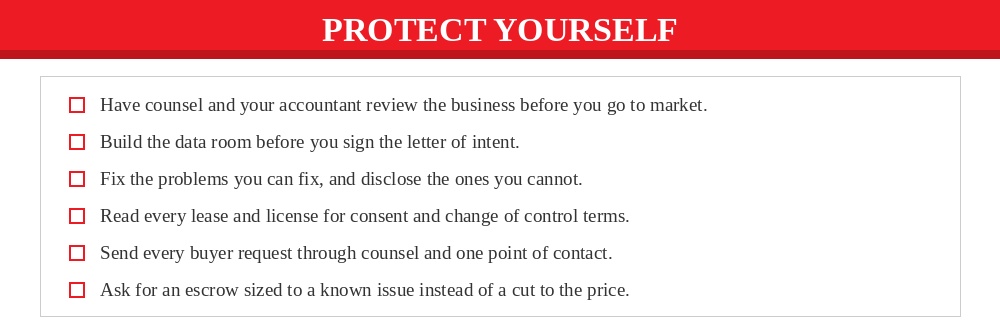
A buyer’s diligence is a search for reasons to pay less, and what the buyer finds first, the buyer prices. A problem the seller finds first can be fixed, or it can be disclosed and handled with an escrow sized to the actual exposure. Have counsel and your accountant review the business as a buyer would before your banker calls anyone. Build the data room before the letter of intent is signed, and send every request through one person. Read every lease and license for consent and change of control terms, and start on the consents early. When a known issue cannot be fixed before closing, ask for an escrow sized to it instead of accepting a cut to the price.
Marco’s business was no cleaner than his colleague’s when he started. He found his own problems while he still had time to fix them, before any buyer had a reason to lower his price.
If you recognize your situation in this story, you are not alone, and you have options.
The DHC Hospitality & Restaurant Law Group represents restaurant and hospitality owners in sales, acquisitions, partnership disputes, and ownership transitions throughout New York, backed by the firm’s more than 50 years of experience representing New York businesses.
—————————————
Contact us for a confidential consultation:
Andreas Koutsoudakis, Esq. | Partner & Co-Chair
(212) 557-7200 | aak@dhclegal.com
This article is for informational purposes only and does not constitute legal advice. Every situation is different, and you should consult with qualified counsel to evaluate your specific circumstances.