


Legal Tips for a Smooth Transition When It’s Time to Part Ways
Not every restaurant partnership is meant to last forever—and that’s not necessarily a bad thing.
I’ve represented partners on both sides of exit conversations: the one who wants out, and the one left behind trying to keep the restaurant running. When there’s a plan in place, these transitions can be orderly and even amicable. When there’s not, they turn into business divorces—with all the expense, distraction, and damage that phrase implies.
The difference between a clean exit and a contested one almost always comes down to one thing: whether the partners addressed the possibility of leaving before they needed to. This article covers the exit strategies that actually work in restaurant partnerships, and the mistakes that turn departures into litigation.
Why You Need an Exit Strategy Before You Need an Exit
Restaurant owners are optimists by nature. Nobody opens a restaurant planning for the partnership to end. But partnerships do end—regularly—for reasons that have nothing to do with the restaurant’s success. Retirement, health issues, family circumstances, differing visions, financial pressure, or simply wanting to move on.
When there’s no exit mechanism in the operating agreement, the departing partner has limited leverage, the remaining partner has limited certainty, and both sides spend money on lawyers arguing about things that should have been settled on paper years ago.
A good exit strategy does four things: it keeps the business running during the transition, it protects both sides financially, it prevents the kind of disputes that end up in court, and it gives everyone clarity about what happens next.
The Three Exit Paths That Actually Work
Every partnership exit, no matter how unique the circumstances feel, falls into one of three basic structures.
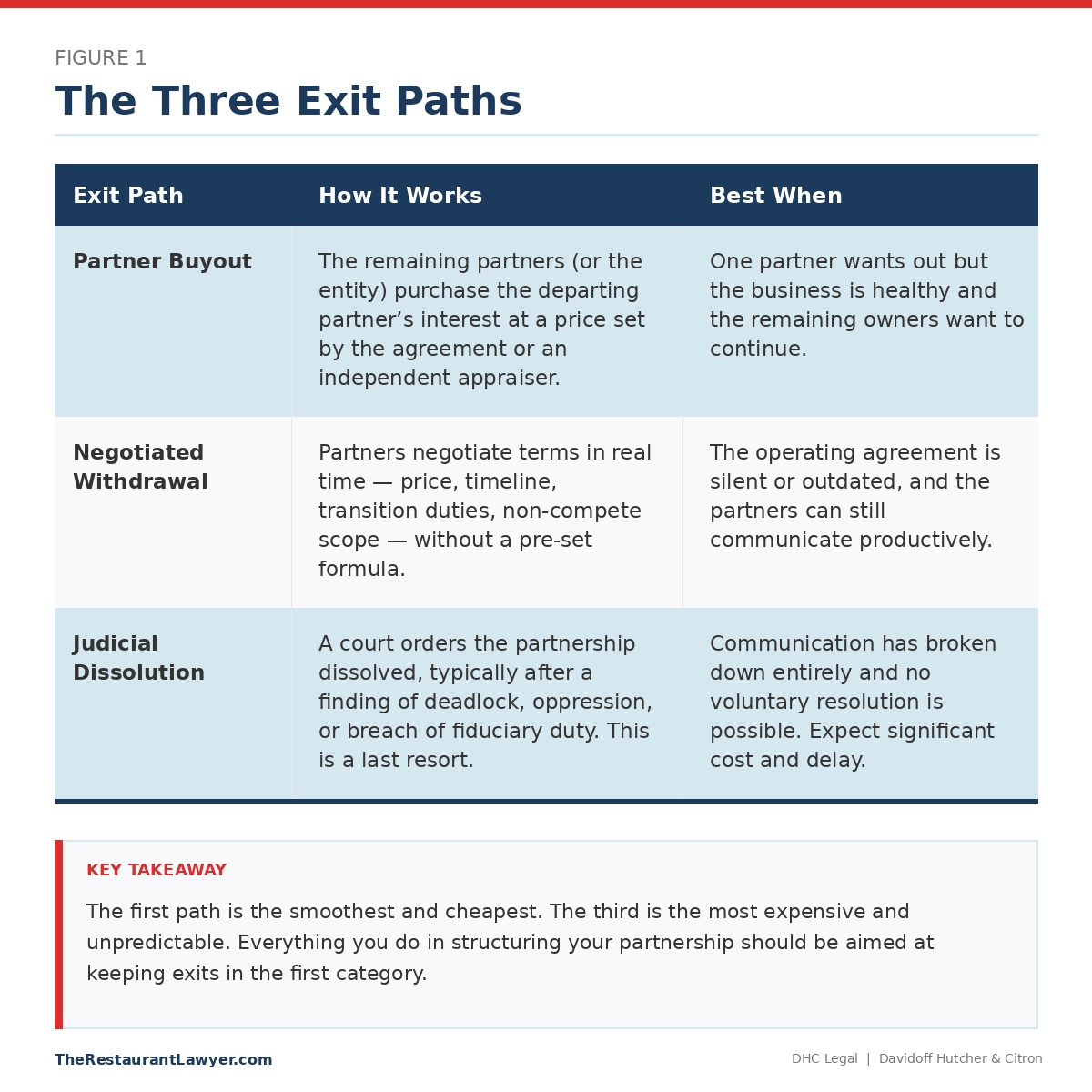
Partner Buyout. The remaining partners (or the entity itself) purchase the departing partner’s interest at a price set by the agreement or an independent appraiser. This is the cleanest path and works best when the business is healthy and the remaining owners want to continue operating.
Negotiated Withdrawal. The partners negotiate terms in real time—price, timeline, transition duties, non-compete scope—without relying on a pre-set formula. This is common when the operating agreement is silent or outdated, but the partners can still communicate productively.
Judicial Dissolution. A court orders the partnership dissolved, typically after a finding of deadlock, oppression, or breach of fiduciary duty. This is the most expensive and unpredictable outcome—and almost always avoidable with proper planning.
The first path is the smoothest and cheapest. The third is the most expensive and unpredictable. Everything you do in structuring your partnership should be aimed at keeping exits in the first category.
What Your Operating Agreement Should Say About Exits
The operating agreement is where exit strategy lives or dies. If your agreement doesn’t address these five elements, you’re exposed.
Triggering events. Define what circumstances create a right or obligation to exit: voluntary withdrawal, death, disability, divorce, bankruptcy, breach of fiduciary duty, or a fixed term expiration. Each trigger can have different mechanics and consequences.
Valuation methodology. Agree in advance on how the departing partner’s interest will be valued. Common approaches include fair market value determined by an independent appraiser, a pre-agreed formula (often based on a multiple of revenue or EBITDA), or book value from the restaurant’s accounting records. Fair market value through an appraiser is the most defensible, but the most expensive.
Buy-sell mechanics. Specify whether the remaining partners or the entity itself purchases the departing partner’s shares, and whether a right of first refusal applies before any outside sale. This prevents a departing partner from selling their interest to someone you’ve never met.
Payment terms. A lump-sum buyout can strain the restaurant’s cash flow. Most agreements allow installment payments over 12 to 36 months, sometimes secured by a promissory note. Define the timeline, interest rate, and what happens if a payment is missed.
Non-compete protections. A departing partner who takes the customer base, the recipes, or the operational know-how and opens across the street is every remaining owner’s nightmare. Non-compete clauses—limited in geographic scope and duration to be enforceable under New York law—are essential.
Valuation: Where Most Exit Disputes Start
More partnership exits blow up over valuation than over any other issue. One side thinks the restaurant is worth a fortune; the other thinks it’s barely worth the furniture. When there’s no agreed-upon methodology, both sides hire their own appraisers, and you end up in court with dueling expert reports.
Restaurants are hard to value. Unlike businesses with tangible assets, a restaurant’s value is heavily tied to goodwill, lease terms, location, liquor license status, and the owner’s personal involvement. Two appraisers can look at the same set of books and reach very different numbers.
Cash businesses create valuation problems. If the restaurant has historically underreported income, the departing partner may argue the real value is higher than the books show. This creates a painful situation for everyone involved.
Agree on a single appraiser. The best operating agreements provide for one jointly selected appraiser whose determination is binding, or a “baseball arbitration” approach where each side submits a number and the appraiser picks the one closest to fair value. This prevents drawn-out valuation battles.
Managing the Transition Without Losing the Business
Even with a clean legal structure, a partner’s departure can destabilize the restaurant if the transition isn’t handled carefully. Staff, vendors, and landlords all react to ownership changes, and how you manage the communication matters.
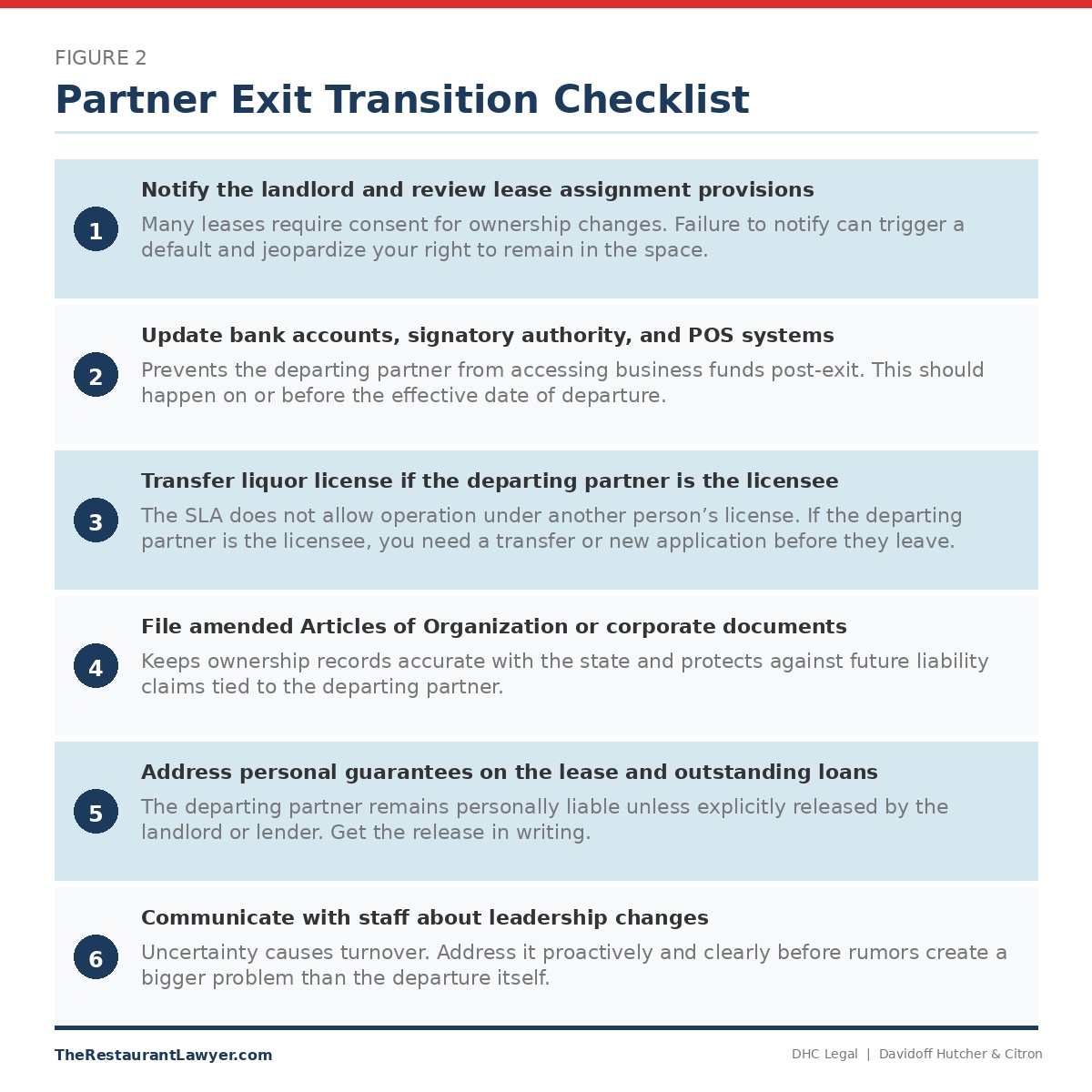
The liquor license issue deserves special attention. If the departing partner holds the license or is the sole principal on the SLA application, the remaining owners need a transfer or new application in place before the exit is finalized. Operating without a valid license—even for a short period—puts the entire business at risk.
The personal guarantee issue is just as critical. If the departing partner signed a Good Guy Guarantee or full personal guarantee on the lease, they remain personally liable unless the landlord agrees to a release or substitution. Many departing partners don’t realize this until it’s too late.
When Exits Go Wrong: The Litigation Path
When partners can’t agree on an exit, the situation typically escalates in a predictable pattern: lockouts, frozen bank accounts, competing claims of mismanagement, and eventually a lawsuit. At that point, you’re not negotiating an exit—you’re litigating a business divorce.
Business divorce litigation in the restaurant context is expensive and distracting. The legal fees alone can exceed what a negotiated buyout would have cost. And unlike many commercial disputes, restaurant partnership fights tend to become personal quickly—these are people who built something together, and the sense of betrayal runs deep.
If you’re already in a dispute, the best thing you can do is get to a resolution structure as fast as possible—whether that’s mediation, arbitration, or a negotiated buyout with counsel on both sides. Every week the dispute continues is a week the business suffers.
Conclusion
The best time to plan for an exit is when nobody wants one. An operating agreement that addresses valuation, buyout mechanics, payment terms, and non-competes turns a potentially devastating event into a manageable business transition.
If your current agreement doesn’t cover these issues—or if you’re already facing a partner who wants out or a partner you need to remove—the time to get legal counsel involved is now, not after positions have hardened and the relationship has deteriorated beyond repair.
If you’re navigating a partnership exit or want to build exit provisions into your operating agreement before they’re needed, let’s talk.
——————————————–
About the Author
Andreas Koutsoudakis is a Partner and Co-Chair of the Hospitality & Restaurant Law Group at Davidoff Hutcher & Citron LLP. His practice focuses on the restaurant and hospitality industry, backed by the firm’s more than 50 years of experience representing New York businesses. He can be reached at aak@dhclegal.com.
——————————————–
This article is for informational purposes only and does not constitute legal advice. Every partnership and operating agreement is different, and you should consult with qualified counsel to evaluate your specific situation.