


Work Letters, TI Allowances, and the Provisions That Protect Your Construction Budget
Building out a restaurant space in New York City is one of the most expensive and legally complex phases of any restaurant deal. The lease provisions that govern your build-out—the work letter, the tenant improvement allowance, permitting responsibilities, and construction timelines—will determine whether your opening is on schedule and on budget, or a financial disaster before you serve your first plate.
I’ve seen build-outs go sideways for every reason imaginable: landlords who promised a “turnkey” space and delivered bare walls, TI allowances structured as reimbursements the tenant couldn’t afford to front, permits that took six months longer than expected while rent was already running, and construction disputes that ended the tenancy before it started.
This article covers what your lease should say about the build-out—and what it probably doesn’t say that could cost you.
Landlord’s Work vs. Tenant’s Work
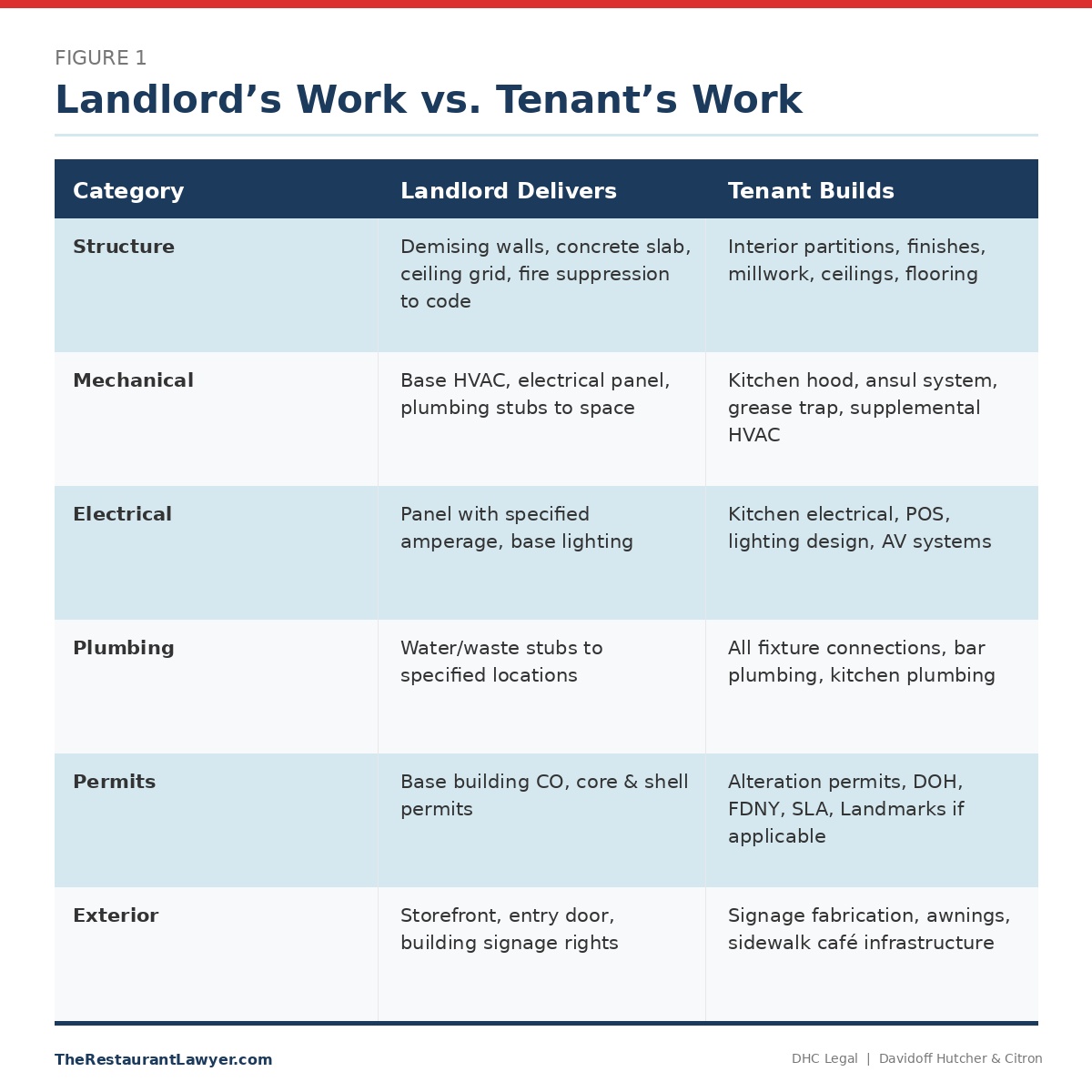
Every restaurant lease should clearly delineate what the landlord is responsible for delivering (landlord’s work) and what falls to the tenant (tenant’s work). This is typically spelled out in a work letter or exhibit attached to the lease.
Landlord’s work usually includes delivering the space in a “shell” or “vanilla box” condition—concrete floors, demising walls, basic HVAC, electrical panel, plumbing stubs, and a fire suppression system to code. Tenant’s work covers everything that makes the space a restaurant: kitchen buildout, hood and ansul systems, grease traps, finishes, fixtures, furniture, signage, and technology infrastructure.
The critical issue is specificity. “Shell condition” means different things to different landlords. If the lease doesn’t specify exactly what’s included—electrical capacity in amps, plumbing stub locations, HVAC tonnage, ceiling height—you’re negotiating in the dark. Get the landlord’s work described with engineering precision, not marketing language
The Tenant Improvement Allowance
A tenant improvement (TI) allowance is a dollar amount the landlord contributes toward the tenant’s build-out costs. In NYC restaurant leases, TI allowances typically range from $50 to $150 per square foot, depending on the space, the landlord’s motivation, and the tenant’s creditworthiness.
The structure of the TI allowance matters as much as the amount. Most allowances are structured as reimbursements—the tenant pays for the work, submits invoices and lien waivers, and the landlord reimburses after the work is completed and inspected. This means the tenant needs to front the entire construction cost and wait for reimbursement, which can take 30 to 90 days after submission.
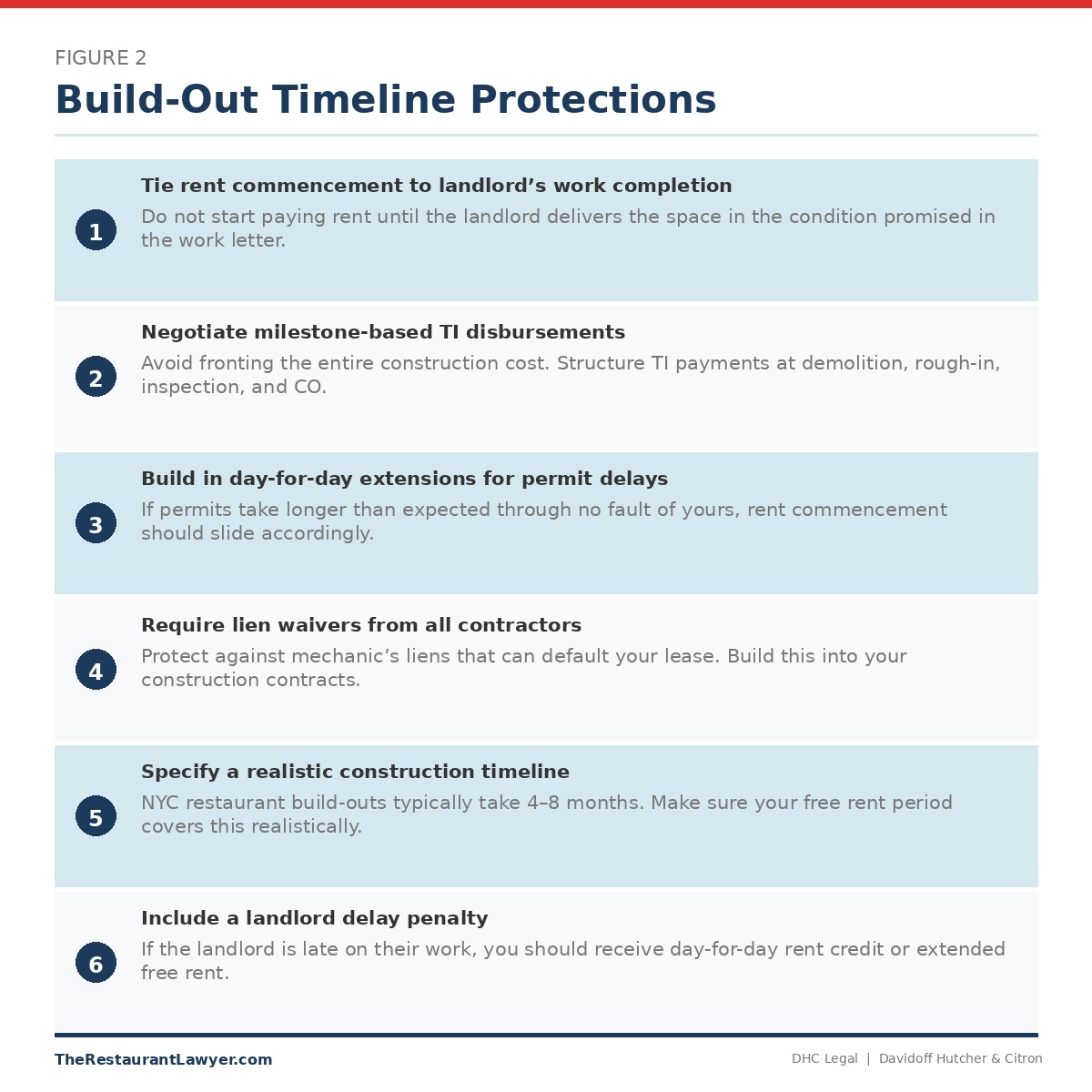
If your cash position can’t support that float, negotiate for milestone-based disbursements tied to construction progress (e.g., 25% at demolition complete, 25% at rough-in, 25% at inspection, 25% at CO). Some landlords will agree to direct payments to the general contractor, which reduces your cash exposure.
Rent Commencement and the Build-Out Timeline
Rent commencement—the date you start paying rent—should be tied to the later of a fixed date or the completion of landlord’s work plus a reasonable build-out period. If the landlord is late delivering the space, you should not be paying rent on a space you can’t build out.
Most NYC restaurant leases provide a free rent period during the build-out phase, typically three to six months. But the clock often starts running on lease signing or possession—not on the date you actually begin construction. If permits take longer than expected or the landlord’s work runs behind, your free rent period can burn off before you’ve even started your own work.
Negotiate a rent commencement date that is triggered by the later of: (a) substantial completion of landlord’s work, (b) issuance of your building permits, or (c) a date certain that accounts for realistic construction timelines in NYC. And build in a penalty or day-for-day extension if the landlord’s work is delayed.
Permits, Approvals, and the Certificate of Occupancy
In New York City, the permitting process for a restaurant build-out involves the Department of Buildings (DOB), the Fire Department (FDNY), the Department of Health and Mental Hygiene (DOHMH), and potentially the Landmarks Preservation Commission, the State Liquor Authority, and Community Board review.
Your lease should specify who is responsible for obtaining which permits. The landlord typically handles the base building permits and CO. The tenant handles the alteration permits for the restaurant build-out. But gray areas—like venting approvals that require landlord cooperation, or landmark reviews that depend on the landlord’s architect—need to be addressed explicitly.
Build a permitting timeline into the lease. If permits take longer than X days through no fault of the tenant, rent commencement should be pushed back day-for-day. This protects you from paying rent on a space you can’t legally occupy.
Mechanic’s Liens and Contractor Protections
When you hire contractors to build out your restaurant, those contractors can file mechanic’s liens against the property if they’re not paid. This creates a problem for the landlord—and most leases require the tenant to discharge any mechanic’s lien within a short window (often 10 to 30 days) or face a lease default.
Protect yourself by requiring lien waivers from all contractors and subcontractors as a condition of each payment. Build this into your construction contracts, not just your lease. And negotiate a reasonable cure period in the lease—30 days is standard, but 10 days is often not enough to resolve a disputed lien.
Conclusion
The build-out phase is where restaurants are most financially vulnerable. You’re spending capital before generating revenue, navigating a permitting process that runs on its own timeline, and relying on a landlord to deliver what was promised. Every dollar of exposure during this phase should be accounted for in the lease.
If you’re negotiating a restaurant lease and want help structuring the work letter, TI allowance, and build-out protections, let’s talk.
—————————————————
About the Author
Andreas Koutsoudakis is a Partner and Co-Chair of the Hospitality & Restaurant Law Group at Davidoff Hutcher & Citron LLP. His practice focuses on the restaurant and hospitality industry, backed by the firm’s more than 50 years of experience representing New York businesses. He can be reached at aak@dhclegal.com.
This article is for informational purposes only and does not constitute legal advice. Every situation is different, and you should consult with qualified counsel to evaluate your specific circumstances.