


Raising Capital from Friends, Family, and Private Investors for Your Restaurant
Most independent restaurants aren’t funded by banks or venture capital. They’re funded by some combination of the owner’s savings, money from friends and family, and a handful of private investors who believe in the concept.
I’ve seen these arrangements create lifelong resentment—or worse, securities-law problems—when they’re done casually. And I’ve seen them fuel real growth when they’re done correctly, with clear structures, realistic expectations, and proper documentation.
The difference isn’t just legal. It’s whether you’ll still be speaking to your investors three years from now.
First Question: Loan, Equity, or Hybrid?
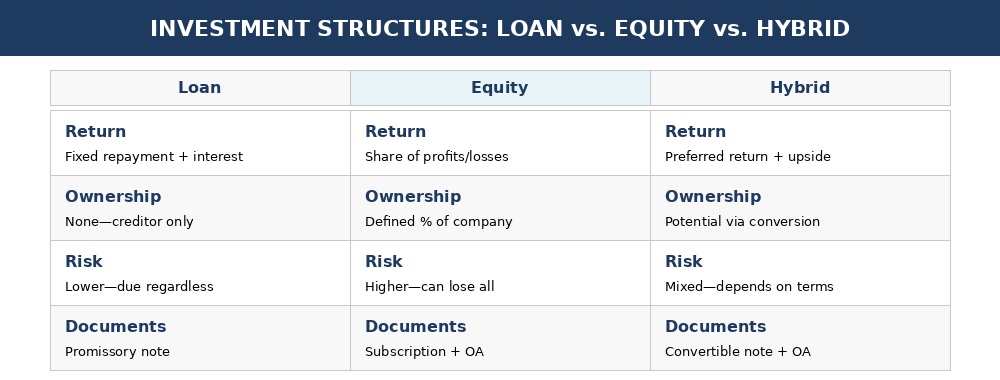
Before you take anyone’s money, label the deal clearly:
- Loan: Fixed repayment with interest. No ownership, no profit share. The investor is a creditor.
- Equity: The investor owns a defined percentage of the company and participates in profits and losses.
- Hybrid: Some combination—a preferred return plus profit share, or a loan with warrants or options that convert to equity.
Never call something a “loan” if in reality the investor only expects repayment from profits. That’s an equity-like risk profile and should be structured as such. Mislabeling it creates confusion, tax issues, and potential legal exposure.
FIGURE 1: Investment Structures
Key Terms for Equity Investors
If you’re bringing in equity investors, you need to define the terms clearly—in writing—before money changes hands:
FIGURE 2: Key Terms for Equity Investors
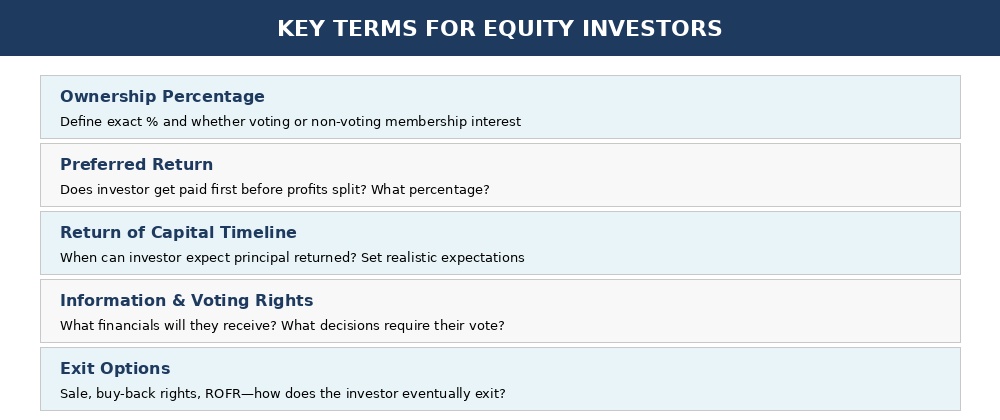
Put these terms in a written subscription agreement and your operating or shareholders’ agreement. Handshake deals don’t work—and they’re often unenforceable.
Protecting Relationships with Friends and Family
Friends and family money is both the easiest to raise and the most dangerous to your personal life if things go wrong.
A few rules:
- Be brutally clear about risk. They can lose all of their investment. Say it out loud. Put it in writing.
- Never over-promise. Avoid specific timelines or anything that sounds like a “guaranteed” return. Restaurants fail. Restaurants take longer than expected to become profitable.
- Consider non-voting interests. If they’re not involved in management, they probably shouldn’t have voting rights on day-to-day decisions.
- Provide regular, honest updates. Good or bad. Silence breeds suspicion.
Counterintuitively, documenting everything helps preserve the personal relationship. Clear expectations mean fewer arguments later.
FIGURE 3: Friends & Family Investment Checklist

Basic Securities-Law Hygiene
Even small private offerings must respect securities laws. This isn’t just for tech startups raising millions—it applies to your restaurant too.
The basics:
- Provide truthful, non-misleading information about risks and financials. No puffery, no hiding problems.
- Use appropriate exemptions for private offerings. Regulation D and similar exemptions allow you to raise capital privately without registering with the SEC—but you have to follow the rules.
- Avoid general public solicitation unless your structure supports it. Posting on social media that you’re “looking for investors” can blow your exemption.
Your corporate counsel should help you structure the raise so you aren’t unintentionally violating securities rules. The penalties for getting this wrong are severe.
Future Rounds and Anti-Dilution
If you might raise more capital later—for expansion, a second location, or just to get through a rough patch—plan for it now:
- Pro-rata rights: Can early investors participate in future rounds to maintain their percentage ownership?
- Anti-dilution: If later investors come in on better terms, what happens to existing investors? Do they get protection?
- Build the rules in now. Negotiating these provisions after you need the money puts you in a weak position.
Conclusion
Capital is the lifeblood of a restaurant, but how you take it in matters just as much as how you spend it.
Clear, written agreements and realistic expectations protect both your business and your relationships. The friends and family who invest in your restaurant today should still want to eat there five years from now—whether the investment worked out or not.
If you’re raising capital for a restaurant and want help structuring the deal, let’s talk.
—————————————————
About the Author
Andreas Koutsoudakis is a Partner and Co-Chair of the Hospitality & Restaurant Law Group at Davidoff Hutcher & Citron LLP. His practice focuses on the restaurant and hospitality industry, backed by the firm’s more than 50 years of experience representing New York businesses. He can be reached at aak@dhclegal.com.
This article is for informational purposes only and does not constitute legal advice. Every situation is different, and you should consult with qualified counsel to evaluate your specific circumstances.