


Understanding the True Cost of Your NYC Restaurant Lease
When someone asks, “What’s your rent?” most restaurant owners quote the base number. In New York City, that’s only one piece of the puzzle.
I’ve watched owners sign leases thinking they had a $15,000-a-month deal, only to discover their actual occupancy cost—once you add real estate tax escalations, operating expenses, utilities, and percentage rent—was closer to $22,000. That difference can be the margin between a viable restaurant and one that’s underwater from day one.
Let’s break down the components so you can actually model your numbers before you commit.
FIGURE 1: Components of Total Occupancy Cost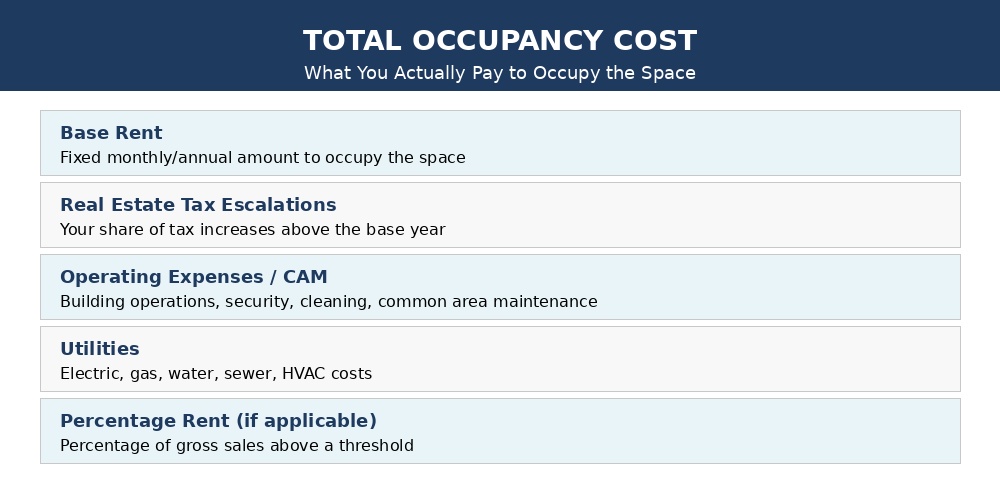
Base Rent: The Starting Point
Base rent is the fixed monthly or annual amount you pay just to occupy the space. It’s the headline number—but rarely the full story.
Before you focus on anything else, understand:
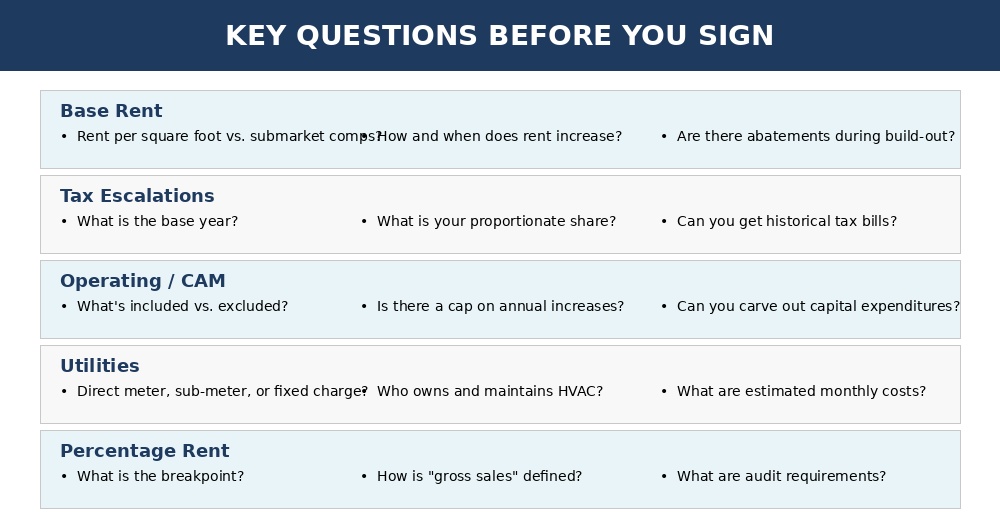
- Rent per square foot and how it compares to the submarket. Is this a fair deal for this location?
- Escalation structure: How and when does rent increase? Fixed steps (3% annually), CPI-based, or a hybrid?
- Abatement periods: Are there rent-free months during build-out? This affects your cash flow modeling significantly.
Real Estate Tax Escalations
Most NYC commercial tenants pay their share of real estate tax increases above a base year. This can be a significant line item—and one that catches new restaurant owners off guard.
Key concepts:
- Base year: The starting tax year against which future increases are measured. A recent base year means lower escalations early on.
- Proportionate share: Your percentage of the building’s total rentable area. Verify this calculation.
- Historical bills: Ask for prior years’ tax bills or estimates so you can project future exposure.
Operating Expenses and CAM
In many buildings—especially larger mixed-use or new developments—you’ll also pay a share of building operating expenses and common area maintenance (CAM):
- Building operations: security, cleaning, repairs, management fees
- Common area maintenance: lobbies, restrooms, trash rooms, shared corridors
Questions to ask: What’s included vs. excluded? Is there a cap on annual increases? Can you carve out capital expenditures (which benefit the building long-term) from true operating costs?
Utilities and Services
Utility costs can vary dramatically based on how the building is metered and who owns the equipment:
- Electric: Direct meter (you pay Con Ed directly), sub-meter (landlord bills you), or fixed monthly charge? Direct meters are usually better for restaurants with predictable usage.
- Gas, water, sewer: Same questions apply.
- HVAC: Do you have your own unit? Who pays for repair and replacement? In older buildings, HVAC can be a major surprise expense.
Percentage Rent
Some landlords want a cut of your upside. Percentage rent means you pay base rent plus a percentage of gross sales above a certain threshold (the “breakpoint”).
This can align landlord and tenant interests—the landlord benefits when you succeed. But only if the breakpoint is realistic for your concept.
If you agree to percentage rent, negotiate:
- Clear definitions of “gross sales”: Exclude sales tax, comps, gift card sales (until redeemed), delivery platform fees, catering deposits, etc.
- Realistic breakpoint: The threshold should be achievable but meaningful. Too low, and you’re paying percentage rent from day one.
- Reporting and audit rights: How often do you report? What are the landlord’s audit rights? How are disputes resolved?
FIGURE 2: Key Questions Before You Sign
Putting It All Together: The Viability Test
For restaurant viability, you should think in terms of total occupancy cost as a percentage of projected gross sales—not just base rent.
FIGURE 3: The Viability Test
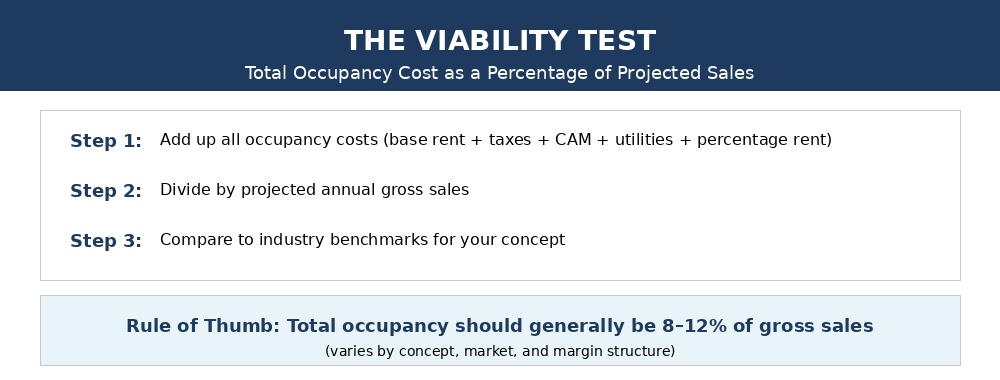
If your total occupancy cost is 15% of projected sales, you’re probably in trouble before you open. If it’s 8%, you have breathing room. The specific threshold depends on your concept’s margin structure—fast casual can often absorb higher occupancy than fine dining—but the analysis is essential.
Conclusion
In New York City, “rent” is a bundle of obligations. Understanding base rent, percentage rent, and additional rent—and modeling them together—is the only way to know if a space is truly affordable for your restaurant.
Don’t sign a lease based on the headline number. Build a complete occupancy cost model, stress-test it against realistic (and pessimistic) sales projections, and make sure the math works before you commit.
If you’re evaluating a lease and want help running the numbers—or negotiating better terms—let’s talk.
About the Author
Andreas Koutsoudakis is a Partner and Co-Chair of the Hospitality & Restaurant Law Group at Davidoff Hutcher & Citron LLP. He can be reached at aak@dhclegal.com.
———————————-
This article is for informational purposes only and does not constitute legal advice.