


For a New York restaurant, the lease is the most valuable asset and the biggest personal exposure. Plan for it as both.
- This white paper is based on a composite of real cases handled by the DHC Hospitality & Restaurant Law Group. Names, locations, cuisines, and identifying details have been changed to protect client confidentiality. The legal principles discussed are illustrative and should not be relied upon as legal advice for any specific situation.
Most restaurant owners think of the lease as a real estate document. You negotiate it, sign it, file it, and pull it out when the landlord sends a notice. In practice it is the most valuable asset the business owns and, through the personal guaranty, the largest exposure most owners carry.
In the restaurant disputes I handle, the lease is almost always in the middle of it. It is the asset one partner tries to take, the guaranty another partner is stuck with after he leaves, or the deadline that decides whether there is still a business to save. The owners who come through those situations in the best shape are the ones who treated the lease as part of their corporate and restructuring planning from the start, not as something to deal with when the trouble arrives.
The Location Is the Business
A restaurant cannot pick up and move the way an office can. The build-out, the neighborhood, the liquor license, and the customers are all tied to that address. That makes the lease the asset everyone fights over when a partnership breaks down.
New York courts have seen what happens when one owner treats it as his own. In one New York case, the majority owner of a restaurant transferred its lease to other companies he owned, ran the restaurant through those companies’ bank accounts, and paid the profits to himself. His 25 percent partner won summary judgment on breach of fiduciary duty and on dissolution, and the Appellate Division affirmed. The lesson runs in both directions. The lease belongs to the company, and the governing documents should make it impossible for any one owner to move, amend, or surrender it without the others’ consent.
Put the Lease in the Right Entity
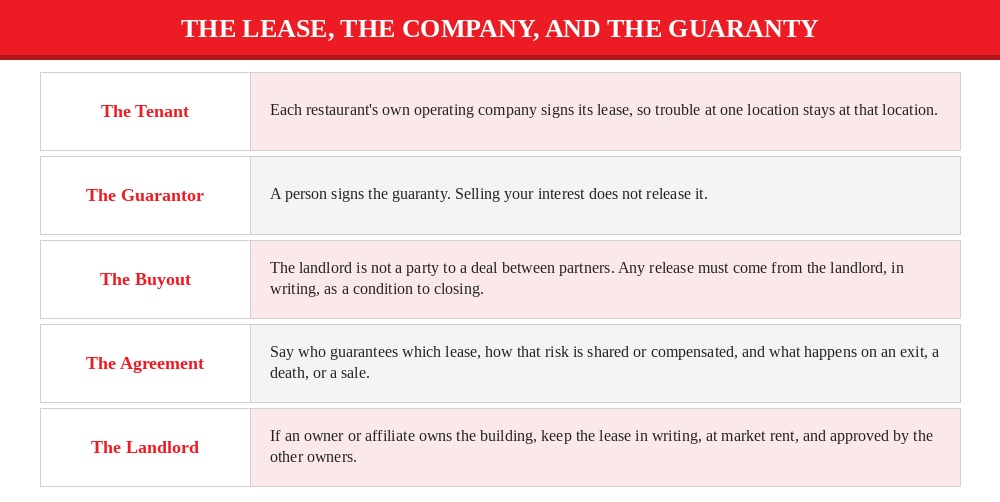
Which company signs the lease is a structural decision, not a formality. In a well-organized group, each restaurant runs through its own operating company that holds that location’s lease, liquor license, and payroll. If one location struggles, its lease problem stays with that company and does not reach the others. Put two restaurants under one tenant entity, or let a holding company sign as tenant, and you have tied the fate of a healthy location to a failing one.
The same thinking applies when an owner or affiliate owns the building. A lease between the restaurant and a related landlord should be in writing, at market terms, and approved by the owners who are not on both sides of it. Above-market rent paid to an insider is one of the most common ways profit leaves a restaurant without ever being called a distribution, and it is one of the first things the other partners’ lawyer will look for.
The Guaranty Outlives the Partnership
The lease is signed by the company. The guaranty is signed by a person. That split is where many owners get hurt.
When a partner exits, he does not get released from his guaranty just because he sold his interest. A buyout between partners does not release anyone, because the landlord is not a party to it. The departing partner can find himself liable for the rent of a restaurant he no longer owns, and the remaining partners can find that the landlord is still relying on a guarantor who has walked away. Any release has to be negotiated with the landlord directly, and the landlord’s written consent should be a condition to closing the buyout, confirmed before your client signs away his own claims.
The operating agreement should deal with this before anyone leaves. It should say which owners guarantee which leases, how that risk is shared or compensated among the partners, and what happens to each guaranty when an owner exits, dies, or sells. Without those terms, one partner can quietly carry all of the personal risk while the others share equally in the upside. A good guy guaranty, which limits the guarantor’s exposure if the tenant surrenders the space properly, helps, but only if its notice and surrender conditions are actually met.
What Bankruptcy Can and Cannot Do for a Lease
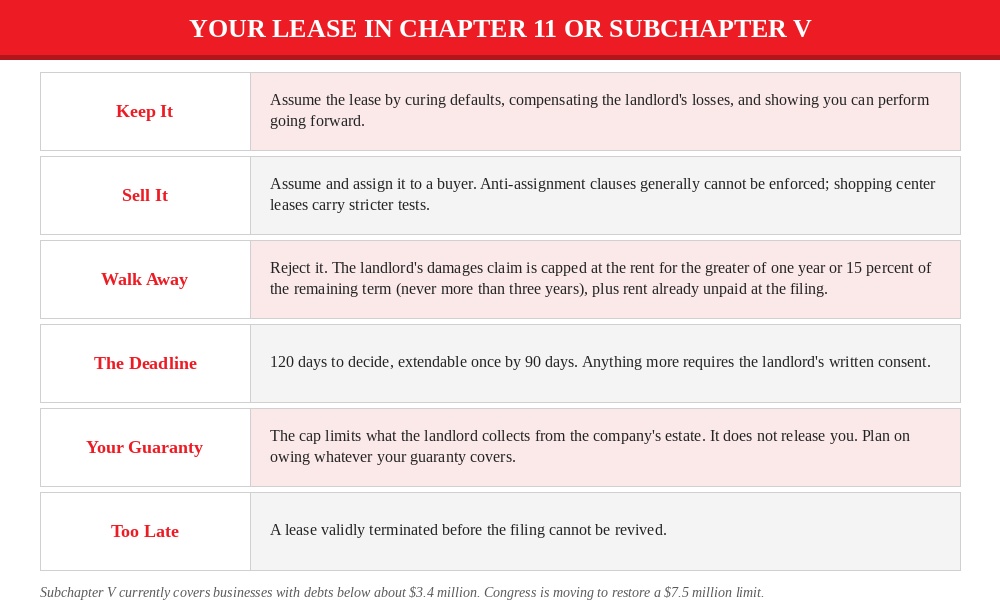
When a restaurant is in trouble, Chapter 11, and especially the streamlined Subchapter V available to smaller businesses, gives the company real tools for dealing with its leases. Subchapter V is currently available when the company’s debts are below about $3.4 million, a limit that dropped back from $7.5 million in 2024. The House and the Senate have each passed a version of a bill that would restore the $7.5 million limit permanently, so check whether it has become law before relying on either number. Here is what the Bankruptcy Code allows, and where its limits are.
- Keep the lease. The company can assume a lease it wants to keep, but only if it cures the past-due rent and other defaults, compensates the landlord for its losses, and shows it can perform going forward.
- Sell the lease. The company can assume the lease and assign it to a buyer, even if the lease prohibits assignment. Clauses that bar assignment, or that terminate the lease or change its terms because of an assignment, generally cannot be enforced in bankruptcy. The buyer must still show it can perform, and leases in shopping centers carry stricter requirements, including use and exclusivity provisions.
- Walk away from the lease. The company can reject a lease that no longer makes sense. The landlord’s claim for damages from the terminated lease is then capped at the rent for the greater of one year or 15 percent of the remaining term, never more than three years, plus any rent already unpaid when the case was filed or the landlord got the space back, whichever came first.
- But the clock runs fast. The company has 120 days to decide whether to keep or reject each lease, extendable once by 90 days. After that, any further extension requires the landlord’s written consent. In the meantime, rent that comes due after the filing has to be paid on time.
Two limits matter more than anything else on that list. First, the cap limits what the landlord can collect from the company’s bankruptcy estate. It is not a release of the owner who signed the guaranty. An owner who stays out of bankruptcy should not assume the cap protects him and should plan on owing whatever his guaranty covers. If the guarantor files for bankruptcy too, the analysis changes; a federal court in Manhattan has held that the cap applies to a landlord’s claim against a guarantor that is itself in bankruptcy. Second, bankruptcy cannot revive a lease that the landlord validly terminated before the filing. If the termination is complete under New York law before the petition is filed, the lease is gone, and with it the location.
The Lease Terms That Matter When Things Go Wrong
Bankruptcy overrides some lease terms, but most restaurant problems are solved outside of court, through a sale, a workout with the landlord, or a negotiated surrender. In those settings the lease language controls, so read it with an exit in mind before you sign.
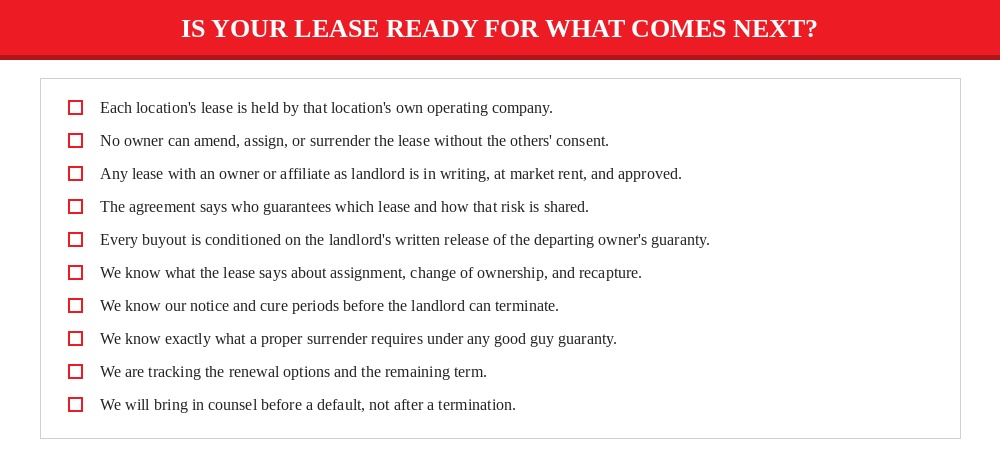
- Assignment and subletting. Can you sell the restaurant, or bring in a new partner, without the landlord’s consent? Does a change in ownership count as an assignment?
- Default and cure. How much notice do you get, and how long to cure, before the landlord can terminate?
- Can the landlord take the space back, and the value you built, when you try to sell?
- Use, exclusivity, and go-dark rights. Can you change the concept, and can you close temporarily without defaulting?
- Guaranty terms. Does the guaranty burn off over time or end on a proper surrender, and what exactly does a proper surrender require?
A lease with market rent and workable assignment rights is an asset a buyer, a lender, or a court will pay for. A lease with above-market rent and a landlord veto over every transfer is a liability, and it will be priced that way the day you try to sell.
Timing Is Everything
Every option on this list gets worse as the default gets older. Before the lease is in default, you can negotiate a sale, an assignment, a surrender, or a key-money deal on your own terms. Once the landlord has served notices and started to terminate, your choices narrow, and if the termination is completed before you act, even bankruptcy cannot bring the lease back. Watch the renewal options and the remaining term, keep the landlord relationship in good repair, and bring in counsel while you still have room to move.
Conclusion
For a New York restaurant, the lease sits where real estate, corporate law, and bankruptcy meet. Owners who plan for it on all three fronts, from the entity that signs it to the guaranty behind it to the deadline that would govern it in a restructuring, have leverage and choices at every stage. Owners who sign it and file it away usually find out what it says at the worst possible time.
—————————————
Contact us for a confidential consultation:
Andreas Koutsoudakis, Esq. | Partner & Co-Chair
(212) 557-7200 | aak@dhclegal.com
This article is for informational purposes only and does not constitute legal advice. Every situation is different, and you should consult with qualified counsel to evaluate your specific circumstances.