

DHC’s Economic Development and Tax Incentives Practice Group helps clients navigate tax incentive programs and economic development benefits from New York City and New York State economic development organizations. Our practice group has secured significant, often multi-million-dollar savings, for a diverse range of commercial and nonprofit clients. Meet our Economic Development and Tax Incentives Team.
NEW YORK ECONOMIC DEVELOPMENT ROUNDUP
Economic Development News & Intelligence 9/30/26
There are billions of dollars in New York tax incentives on the table right now for developers and business owners looking to expand or build — but accessing, applying for, and closing on them takes skilled legal guidance every step of the way. The city’s $100 million tax break for Tishman Speyer’s 99 Hudson Boulevard tower was tabled for a second time, with the IDA unable to revisit it for more than two months — and a similar $2 billion incentive package for Related Companies’ Hudson Yards platform is now in limbo too. It’s the first real test of Mayor Mamdani’s approach to commercial incentives, and a reminder that these deals can hinge as much on political timing as paperwork, which is exactly where experienced government affairs support earns its keep. Meanwhile, the city’s office-to-residential conversion wave rolled on: BLDG Management and David Werner Real Estate Investments landed a $219 million construction loan for their 100 Wall Street conversion using the 467-m tax incentive, the same program powering a wave of similar deals across Lower Manhattan and Downtown Brooklyn. And upstate in Peekskill, the city and its IDA both threw their support behind the Broad Howard affordable housing project’s state tax credit application, with a PILOT agreement still pending — a good example of how local government buy-in can make or break a project’s incentive package. Whether a deal needs financing structured, incentives negotiated, entitlements secured, or the right relationships in Albany or City Hall, DHC’s economic development, project financing, real estate, zoning and land use, and government affairs teams handle it all under one roof — reach out if we can help.
BUILDING NEW YORK – DEVELOPMENT IN MOTION
Money Left on the Table
In my years working both inside government as an economic development executive and now in private practice, I have seen firsthand how often businesses leave significant money on the table simply because they are unaware of the tax incentives available to them. One of the most tangible — and frequently overlooked — of those incentives is the sales tax exemption offered through New York State’s Industrial Development Agencies (“IDAs”).
If your business is planning a capital project in New York State, whether that means constructing a new facility, renovating an existing one, or purchasing machinery and equipment, you should know about this benefit before you break ground or sign a purchase order.
What is an IDA?
IDAs are public benefit corporations created under New York State law and authorized by the New York State Industrial Development Agency Act (General Municipal Law Article 18-A). There are IDAs operating in virtually every county across the state. Their statutory mission is to promote, develop, encourage, and assist in the acquiring, constructing, reconstructing, improving, maintaining, equipping, and furnishing of industrial, manufacturing, warehousing, commercial, and research projects.
In practice, IDAs serve as the primary vehicle through which local governments deliver tax incentives to businesses and developers undertaking qualifying projects within their respective jurisdictions. In my experience representing clients before IDAs across New York — and having sat on the other side of the table as a municipal economic development professional — the sales tax exemption is often one of the first incentives that applicants underestimate, but one that yields significant tax savings.
How Does the IDA Sales Tax Exemption Work?
When an IDA approves a project, the IDA holds title to, or holds a leasehold interest in, the project property. Because the IDA is a government entity, it is exempt from New York State and local sales and use taxes. The business, acting as an agent of the IDA, can then purchase materials, equipment, and services in connection with the approved project free of sales tax.

The exemption generally applies to:
- Building materials and supplies used in the construction or renovation of the project facility; and
- Furniture, fixtures, and equipment that are part of the approved project scope.
Importantly, the exemption applies only to purchases made during the approved project period and only for items within the approved project scope — not for the ongoing operational purchases of the business.
Who Qualifies?
Not every business or project is automatically eligible. IDAs evaluate applications based on criteria that typically include the nature of the project, anticipated capital investment, job creation or retention commitments, the financial health of the applicant, and the broader economic impact on the community.

Eligible project types generally include manufacturing, distribution, warehousing, commercial, mixed-use real estate development, and multifamily residential rental projects. While IDAs were historically focused on industrial and manufacturing projects, the scope of eligible projects has expanded considerably over the decades, and today IDAs routinely approve incentive packages for office buildings, hotels, healthcare facilities, and mixed-use developments. Each IDA also has its own policies and preferences, which is why understanding the specific IDA you are dealing with — and having experienced counsel — matters enormously.
Recapture: The Risk You Need to Understand
One critical element that applicants must understand before seeking IDA benefits is the recapture provision. If an approved project fails to meet its commitments — whether that means falling short of job creation targets, abandoning the project, or otherwise failing to comply with the terms of the IDA agreement — the IDA can require the business to repay all or a portion of the sales tax exemption benefits it received.
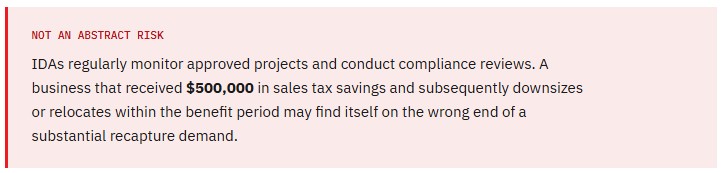
Understanding the terms of your IDA agreement, and building realistic projections before you commit, is essential.
The Bottom Line
New York State has a reputation — not entirely undeserved — for being a high-tax, high-cost environment for business. But IDAs exist precisely to address that challenge by making targeted, impactful investments in projects that generate economic activity, jobs, and tax revenue over time. The sales tax exemption is one of the most direct and immediate financial benefits available to businesses willing to navigate the IDA process.
If you are planning a capital investment in New York State, the question is not whether you can afford to apply for IDA benefits. The question is whether you can afford not to.
—————————————————
This article is for informational purposes only and does not constitute legal advice. Every situation is different, and you should consult with qualified counsel to evaluate your specific circumstances.