


Your operating agreement was written before anyone in the company was building agents. Here is how to close the gap.
- This white paper is based on a composite of real cases handled by the DHC Hospitality & Restaurant Law Group. Names, locations, cuisines, and identifying details have been changed to protect client confidentiality. The legal principles discussed are illustrative and should not be relied upon as legal advice for any specific situation.
Most operating agreements and shareholder agreements in New York were written for a business that ran on people, equipment, and client relationships. They say who owns the company, who makes decisions, and what happens when an owner leaves. Very few say a word about the tools that now do a growing share of the work.
That gap is getting expensive. In the business disputes I see, the fight increasingly turns on things the governing documents never contemplated. A partner built the automations that run the back office, and nobody can say whether they belong to him or to the company. A departing member holds the only administrator login to the platform where the firm’s workflows live. One owner wants to replace half the staff with software, and the others believe that decision needed their consent.
A technology policy sitting in a shared drive does not fix any of this. The fix belongs in the documents that govern ownership of the business, and the time to put it there is while the owners still agree. Here are the five provisions I recommend every closely held company review.
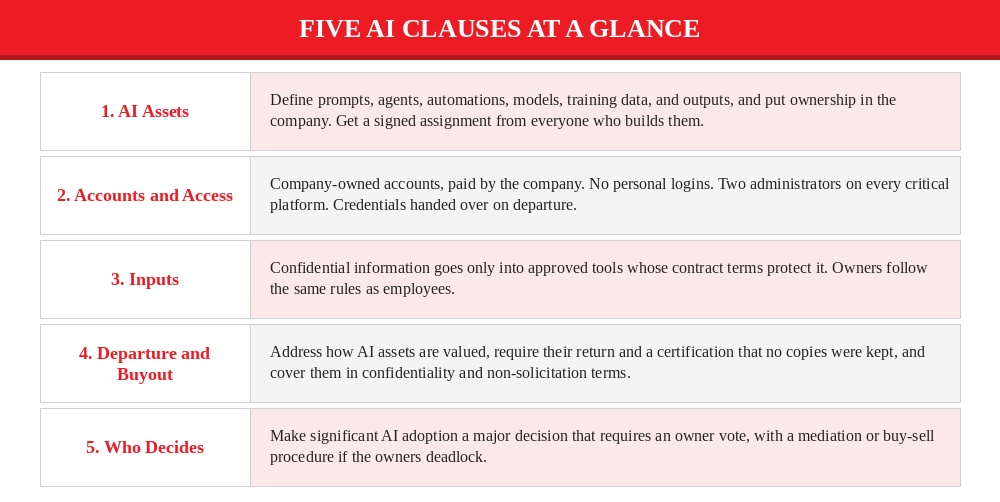
1. Define AI assets and put ownership in the company
Start with a definition. Most agreements define company property in terms that predate this technology, such as equipment, intellectual property, customer lists, and goodwill. Whether those words capture a library of prompts, a set of custom agents, or a model trained on the company’s data is an open question, and open questions become litigation.
A well-drafted clause defines “AI Assets” broadly. It should include prompts, instructions, agents, automations, workflow configurations, custom or fine-tuned models, the datasets used to build or train them, and the outputs they generate for the business. It should then state plainly that all AI Assets created in the course of the company’s business belong to the company, regardless of which owner, employee, or contractor built them.
This matters more than many owners realize, because copyright may not protect much of this material. A federal appeals court held in 2025 that the Copyright Act requires a work to be authored by a human being, and in March 2026 the Supreme Court declined to review that decision. The court noted that the rule does not bar protection for work a person creates with the help of AI, as long as a human is the author, and under Copyright Office guidance that protection covers the person’s own creative contribution. Where copyright does not reach an asset, ownership rests on contract and on trade secret law. The contract is the part you control.
The same ownership language belongs in employment agreements and independent contractor agreements. It should include an assignment of rights, not only a statement of company ownership. An owner who never signed an assignment, or a contractor engaged on a one-page proposal, can create a real dispute over who owns what they built.
2. Control the accounts, not just the assets
Owning an asset means little if someone else holds the keys. In practice, AI tools live inside subscription accounts, API keys, and vendor platforms. If those accounts are registered to an individual owner’s personal email, paid on a personal card, or administered by one person, that person has practical control over the company’s operations, whatever the agreement says about ownership.
A sound provision does four things. It requires that all accounts used for company business be opened in the company’s name and paid by the company. It prohibits owners and employees from using personal accounts for company work. It requires that at least two authorized people hold administrator access to every critical platform. And it obligates any departing owner or employee to transfer credentials, administrator rights, and any associated data within a short, fixed period.
3. Set rules for what goes into the tools
The third clause governs inputs. Owners and employees routinely paste client information, financial data, pricing, and internal strategy into AI tools. Depending on the tool and its terms of service, that information may be retained by the vendor, used to train the vendor’s models, or exposed to a data breach outside the company’s control.
There are two reasons this belongs in the ownership documents and not only in an employee handbook. First, many businesses owe confidentiality obligations to their own clients, and a careless disclosure by one owner can create liability for all of them. Second, under the federal Defend Trade Secrets Act, trade secret protection depends on the company taking reasonable measures to keep its information secret, and New York law asks a similar question. Federal courts in New York look for written confidentiality agreements, access limited to the people who need it, password protection, and policies that are actually followed. A confidentiality agreement or a verbal reminder, standing alone, often is not enough. A company that lets its owners feed confidential processes into public tools without any restriction may find, when it needs to enforce its rights against a departing partner or a competitor, that a court doubts the information was ever treated as secret.
Courts are beginning to address how these tools affect confidentiality, and they do not agree. In February 2026, Judge Jed S. Rakoff of the federal court in Manhattan ruled in a criminal case that documents recording a defendant’s exchanges with a publicly available AI platform were not protected by the attorney-client privilege, in part because the platform’s privacy policy allowed the provider to collect what users typed and to disclose it to third parties. The next month, a federal magistrate judge in Colorado took a different view in a civil case brought by a self-represented plaintiff. She held that his AI materials could be protected as litigation work product, finding it reasonable to expect some privacy in these tools even though the provider stores what users type. Neither was a trade secret case.
The Colorado decision is more useful for what the court did next. It amended the protective order to bar both sides from putting confidential information into any AI platform unless the provider is contractually prohibited from storing or using the inputs to train its model and from disclosing them to third parties, and must let the user delete the information on request. The court acknowledged that this would rule out most mainstream low-cost tools. It is a sensible benchmark for a company’s own clause.
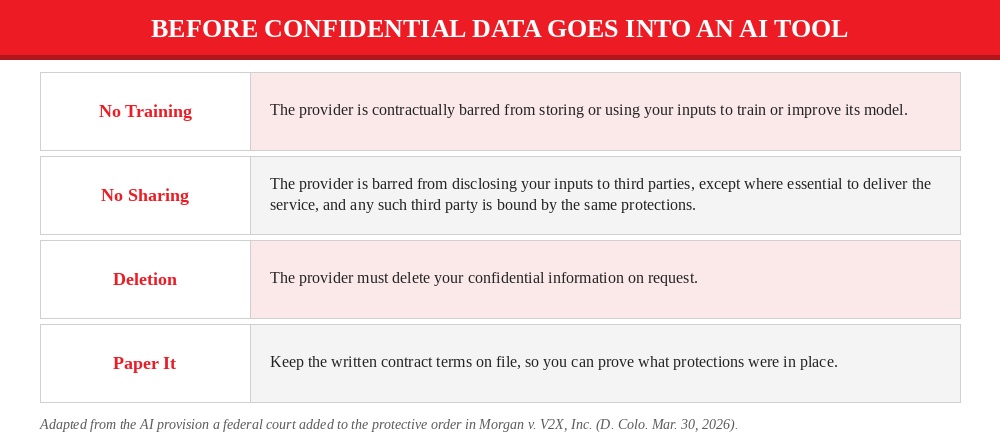
The clause should require that company confidential information be used only in tools the company has approved, and approval should turn on the vendor’s contract terms: no training on company data, no disclosure to third parties, and the ability to delete. It should bind every owner to the same restrictions the company imposes on its employees.
4. Build AI into departure and buyout terms
Every buyout provision rests on a valuation, and AI is making valuation harder. A business can gain or lose substantial value in a short period as automation changes its cost structure or erodes its core service. An owner who leaves when the numbers look strong and an owner who leaves after a client base has shifted to cheaper automated alternatives may receive very different prices under the same formula.
Owners should revisit three parts of their exit terms. The first is the valuation date and method. Consider whether the formula should be measured on a trailing basis, whether AI Assets should be valued separately, and whether an independent appraiser should be required when the parties disagree. The second is the departing owner’s obligations. These should include the return of all AI Assets, the transfer of all accounts and credentials, and a written certification that no copies were retained, with a reasonable transition period during which the departing owner explains how the systems work.
The third is restrictive covenants. Non-solicitation and confidentiality provisions should expressly cover AI Assets and the data behind them. New York has no statute banning non-competes, although the legislature passed one in 2023 that the Governor vetoed. Courts therefore apply a common-law reasonableness test, and they apply it more strictly to covenants signed by employees than to covenants given by owners who sell the business or an interest in it, together with its goodwill. Courts look at the substance of the deal and not its label. A covenant that was part of the sale of an owner’s interest can receive the more lenient treatment even when it appears in the owner’s later employment or partnership agreement, but only to protect the goodwill that was actually sold, not clients the owner developed on his own afterward. An owner who simply leaves, without selling, should not assume the more lenient standard applies. These provisions still need careful drafting and periodic review, because the law in this area continues to change.
5. Decide who decides to automate
The last clause is about governance, and it is the one most likely to prevent a business divorce altogether.
Adopting AI is no longer a routine operating decision. It can mean eliminating positions, changing the company’s service model, entering multiyear vendor commitments, or changing what the company tells its clients about how their work is performed. Owners frequently disagree about these choices. One sees survival, and another sees the abandonment of what made the business valuable. When the agreement treats these decisions as ordinary management matters, the owner who controls day-to-day operations can make them alone, and the others are left to object after the fact.
Owners should consider adding significant AI adoption to the list of major decisions that require the consent of a stated percentage of the owners. The definition should be practical and should capture decisions that materially change headcount, the business model, or the company’s contractual commitments. The agreement should also say what happens when the owners cannot agree. That may be a mediation step, a defined buy-sell mechanism, or another deadlock procedure. Without one, the only exit may be a petition for dissolution, which is the most expensive and least predictable way to resolve a disagreement between owners.
Putting it into practice
Most of these changes can be made through an amendment to the existing operating agreement or shareholder agreement, adopted under the amendment procedure the agreement already contains. The work should be coordinated with updates to employment agreements, contractor agreements, and the company’s written policies, so that every document uses the same definitions and imposes the same obligations.
These provisions should not be adopted from a template. The right terms depend on how the business uses AI today, how it expects to use it over the next several years, and how its owners’ interests differ.
The best time to address these questions is while the owners still agree on them. Once a dispute begins, every one of these provisions becomes a point of negotiation, and often a point of litigation. A few hours spent now will cost far less than the fight these clauses are designed to prevent.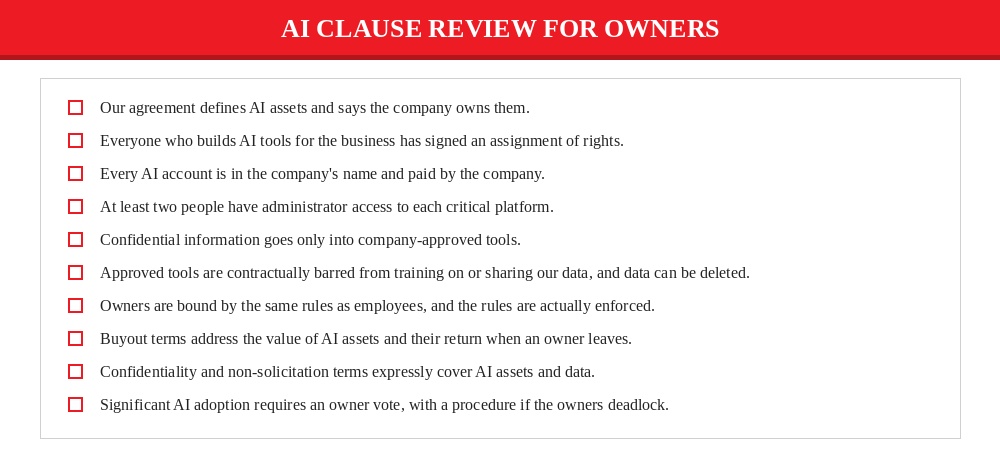
—————————————
Contact us for a confidential consultation:
Andreas Koutsoudakis, Esq. | Partner & Co-Chair
(212) 557-7200 | aak@dhclegal.com
This article is for informational purposes only and does not constitute legal advice. Every situation is different, and you should consult with qualified counsel to evaluate your specific circumstances.