


When the Offer Across the Table Is Real Money, and When It Is Bait
Selling the Restaurant: Know Your Buyer
- This white paper is based on a composite of real cases handled by the DHC Hospitality & Restaurant Law Group. Names, locations, cuisines, and identifying details have been changed to protect client confidentiality. The legal principles discussed are illustrative and should not be relied upon as legal advice for any specific situation.
Every owner remembers the first serious offer. What most owners never learn until it is too late is that buyers are not interchangeable, and neither are their offers. The number on the page means nothing until you know who wrote it, whose money stands behind it, and what happens to your business while you find out. This is the story of an owner who learned the difference between a buyer and someone playing one, and what the lesson cost him.
The Approach
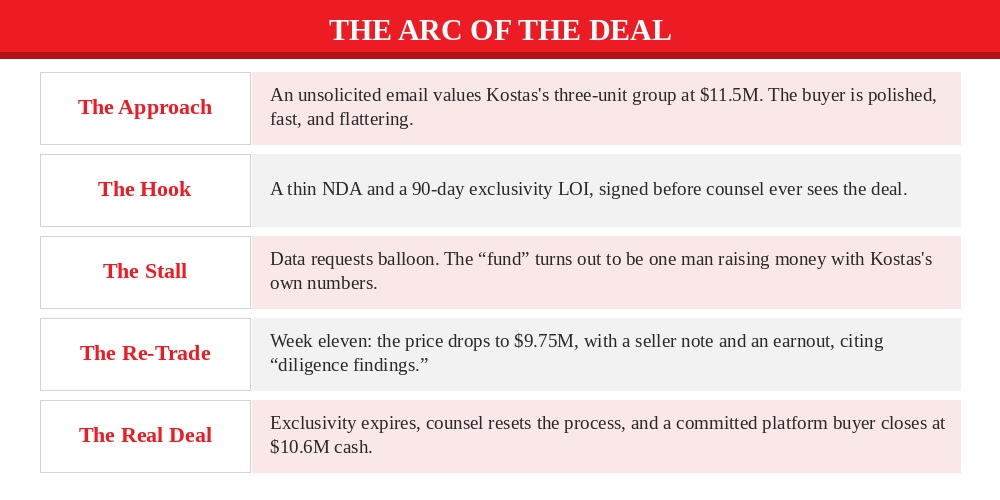
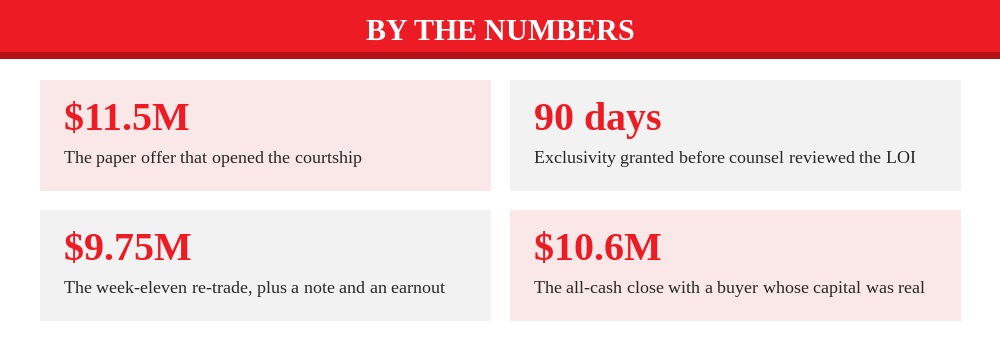
Kostas built a three-location Mediterranean fast-casual group across Manhattan and Brooklyn over eleven years: strong unit economics, a loyal lunch trade, and clean, boring books, the kind buyers pay for. The email arrived on a Tuesday. A “private investment group” had been “following the brand’s growth” and saw a platform opportunity. Within two weeks there were dinners, compliments, and a value indication of $11.5 million. The principal spoke fluently about his “investor base,” his “acquisition pipeline,” and his timeline: fast. Kostas, flattered and picturing the wire, saw no reason to slow things down with lawyers just yet.
The Hook
The buyer sent a short NDA, which Kostas signed as-is. It had no non-contact provisions, no restriction on sharing his information with unnamed “financing sources,” and no teeth. Then came the letter of intent: $11.5 million, subject to diligence, with one condition the buyer called standard: ninety days of exclusivity. Kostas signed that too. He had now taken his business off the market for a full quarter for a buyer he had never verified, on the strength of an email signature and two good dinners.
The Stall
The diligence requests started reasonably, then ballooned: five years of financials, vendor contracts, lease abstracts, staffing costs by location. Deadlines slipped. The “investment committee” needed another week, twice. In month two, a broker Kostas knew mentioned that a deck describing a “Mediterranean fast-casual platform opportunity” was circulating among family offices, with numbers that looked very familiar. The truth assembled itself: the principal was an independent sponsor, one man with a deck. There was no fund. There was no committee. He was using Kostas’s own financials to raise the money to buy him, and the exclusivity Kostas had signed was the runway for that raise. Worse, a genuine buyer, a private equity-backed platform actively acquiring in the category, had reached out in month two. Under the exclusivity, Kostas could not even reply.
The Re-Trade
In week eleven, the sponsor came back with a revised structure: $9.75 million, citing “diligence findings” that were never quite specified, with a seller note for $1.5 million of it and an earnout tied to targets Kostas would have no power to control after closing. This is the classic move of a buyer who never had the money: lock the seller up, run the clock, then reprice against the seller’s sunk time and deal fatigue. Kostas had spent roughly $95,000 on accountants and advisors by then, and seven months of momentum.
The Response
Counsel, brought in at last, did three things. First, no extension: the exclusivity was allowed to expire on its own terms, and the sponsor’s request for “just thirty more days” was declined in writing. Second, a demand letter addressed the circulating deck, which violated even the weak NDA’s confidentiality terms, and required its retrieval. Third, the process was rebuilt the way it should have run from the start: a real confidentiality agreement with non-contact and non-solicitation provisions, a buyer-qualification step requiring proof of committed capital before data-room access, and a rule that any future exclusivity would be short, milestone-based, and earned.
The Resolution
The platform buyer was still interested. Its diligence was demanding but disciplined, its questions were the questions of people who had closed a dozen of these, and its capital was committed before the LOI was signed. Nine months after the first fraudulent courtship began, Kostas closed at $10.6 million, all cash at closing, no note, no earnout. Less than the number that had opened the story, and worth more than every dollar of it was real.
The Lesson
The identity of the buyer determines everything downstream: the price that is real, the speed that is possible, the diligence you will endure, and whether the process ends in a wire or a write-off. Strategic operators, private equity platforms, PE-backed add-ons, family offices, search funds, and independent sponsors are different animals with different money, and one of them is sometimes not a buyer at all. Five questions separate them, and every owner should ask them before the first financial statement leaves the building: Whose capital is this, and is it committed? What have you closed in the last twenty-four months? What is the plan for the business and my people? What is your hold plan? And why us? A real buyer answers all five without flinching.
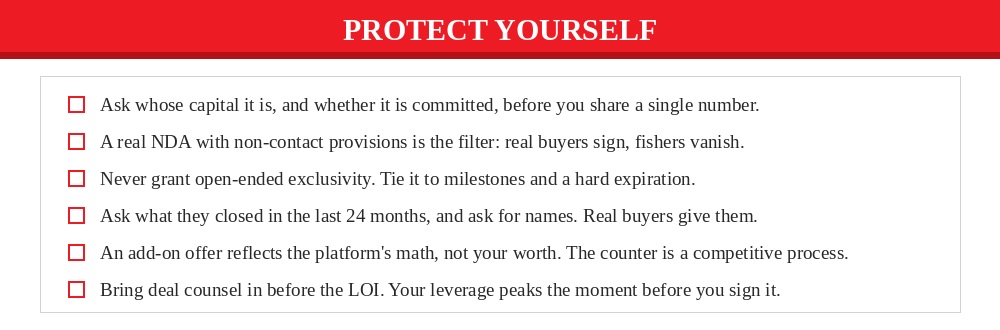
Kostas’s mistake was not greed and it was not carelessness with his restaurants; it was granting a stranger the two most valuable things a seller has, his information and his time, before verifying the one thing that matters, the money. The NDA is the filter and committed capital is the test. Everything else is dinner conversation.
If you recognize your situation in this story, you are not alone, and you have options.
The DHC Hospitality & Restaurant Law Group represents restaurant and hospitality owners in sales, acquisitions, partnership disputes, and ownership transitions throughout New York, backed by the firm’s more than 50 years of experience representing New York businesses.
—————————————
Contact us for a confidential consultation:
Andreas Koutsoudakis, Esq. | Partner & Co-Chair
(212) 557-7200 | aak@dhclegal.com
This article is for informational purposes only and does not constitute legal advice. Every situation is different, and you should consult with qualified counsel to evaluate your specific circumstances.