


A Major Victory for Restaurants Drowning in Merchant Cash Advance Debt
FIGURE 1: Case Victory Summary
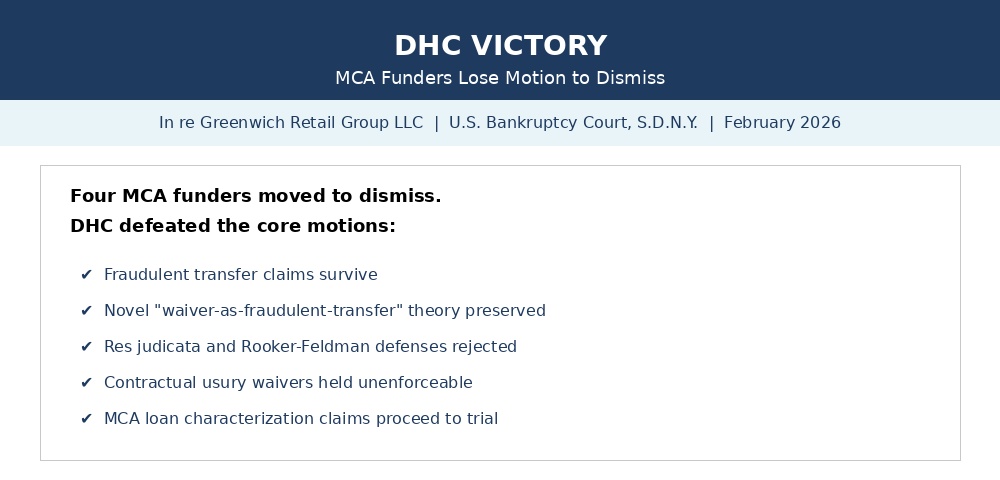
If your restaurant is carrying merchant cash advance debt with triple-digit implied interest rates, pay attention. Our bankruptcy team just secured a major victory that changes the landscape for MCA litigation—and it has direct implications for restaurant owners who thought they were trapped.
In In re Greenwich Retail Group LLC, decided February 20, 2026, Judge Michael E. Wiles of the U.S. Bankruptcy Court for the Southern District of New York denied motions to dismiss filed by four MCA funders—preserving our client’s claims that the MCA agreements were disguised usurious loans and securing the right to pursue recovery of all prior payments through the bankruptcy process.
This wasn’t a close call. The court’s 2026 WL 482170 opinion is analytically rigorous and addresses several unsettled questions at the intersection of fraudulent transfer law, New York usury doctrine, and MCA litigation. We believe it will be frequently cited—and it should give hope to every restaurant owner who feels crushed under stacked MCA obligations.
The MCA Trap: What Restaurant Owners Face
Merchant cash advances are marketed as “not loans”—purchases of future receivables that supposedly fall outside usury laws. In practice, they function exactly like loans, often with implied APRs of 50%, 100%, or higher. Our client in this case faced MCA agreements with implied APRs ranging from 65.25% to 132.67%.
MCA funders protect themselves with:
- Confessions of judgment that let them obtain court judgments without notice
- Contractual waivers of usury defenses
- Daily ACH withdrawals that drain cash flow before you can react
- Stacking arrangements where multiple funders pile on the same business
When a restaurant defaults, the funder has already positioned itself to win: confession of judgment in hand, contractual defenses supposedly waived, and the business owner convinced there’s no way out.
This case shows there is a way out—through Chapter 11.
What Our Team Won
Our Bankruptcy & Restructuring team, led by Robert L. Rattet and James B. Glucksman, brought a 28-count adversary proceeding on behalf of the debtors-in-possession. All four MCA defendants moved to dismiss. We defeated the core motions:
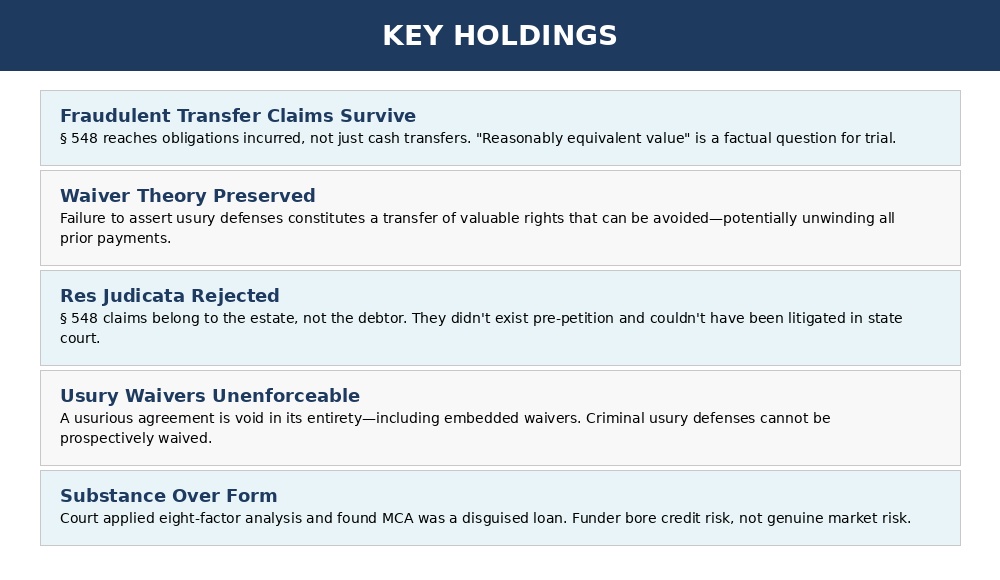
FIGURE 2: Key Holdings
The Novel Theory: Waiver as Fraudulent Transfer
The most significant aspect of this decision is the court’s acceptance of our novel “waiver-as-fraudulent-transfer” theory.
Here’s the problem: Under New York law, LLCs generally cannot bring affirmative usury claims to recover payments already made. The usury statutes protect individuals, not business entities. This has been a major barrier for restaurants—most of which operate as LLCs—seeking to challenge MCA agreements.
Our team argued that when the debtor failed to assert criminal usury defenses—at the time each payment was made, and when Itria obtained its confession of judgment—that failure constituted a transfer of valuable rights under Bankruptcy Code § 101(54). Because those rights were transferred without reasonably equivalent value, they can be avoided as fraudulent transfers under § 548.
The court agreed this theory survives a motion to dismiss. If proven at trial, it could unwind all prior MCA payments and the state court judgment—regardless of the limitations New York law otherwise imposes on LLC usury claims.
Why This Matters for Restaurant Owners
FIGURE 3: Chapter 11 Tools Against MCA Funders
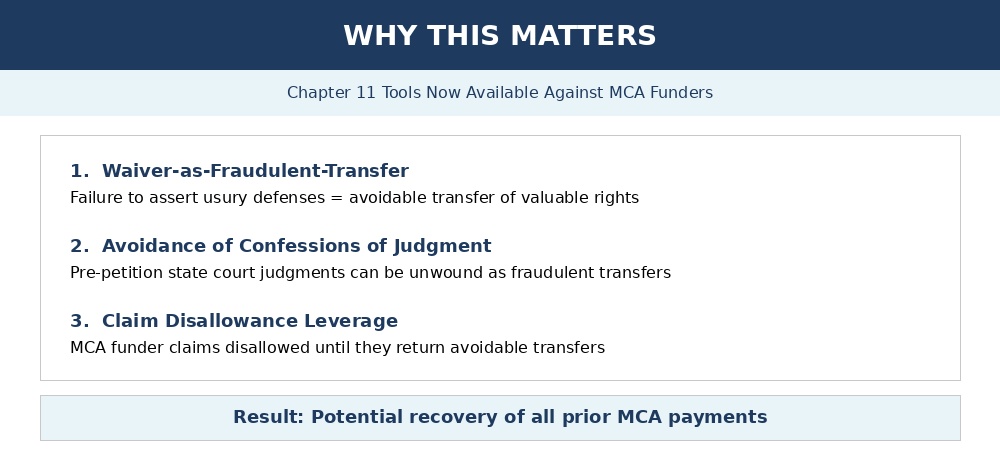
This decision demonstrates that Chapter 11 provides tools against MCA funders that simply don’t exist outside of bankruptcy:
- Avoidance of Prior Payments. Under the waiver-as-fraudulent-transfer theory, all payments made under usurious MCA agreements may be recoverable for the estate.
- Avoidance of Confessions of Judgment. Pre-petition state court judgments obtained through confession of judgment can be avoided as fraudulent transfers. Res judicata doesn’t apply because the avoidance claims belong to the estate and didn’t exist before the petition.
- Claim Disallowance Leverage. Under § 502(d), an MCA funder’s claim can be disallowed until it returns any avoidable transfers. This creates powerful negotiating leverage.
- Contractual Waivers Are Void. The court confirmed that usury waivers embedded in MCA agreements are unenforceable—the entire usurious contract is void, including any waivers.
Who Should Pay Attention
This decision is directly relevant if:
- You have one or more MCA agreements with implied APRs above 25%
- An MCA funder has obtained or threatened a confession of judgment
- You’ve been told that usury defenses are waived under your MCA contract
- You’re considering Chapter 11 and have significant MCA exposure
- You represent clients in MCA disputes and want to understand the new landscape
Conclusion
MCA funders have operated for years on the assumption that their confessions of judgment, contractual waivers, and “not a loan” characterizations would protect them from meaningful challenge. This decision shows that assumption is wrong—at least in bankruptcy court.
Our Hospitality & Restaurant Law Group and Bankruptcy & Restructuring team handle the full continuum from out-of-court workouts to Chapter 11 reorganizations, with particular depth in the restaurant, food service, and hospitality sectors. If MCA debt is strangling your restaurant, let’s discuss whether Chapter 11 offers a path forward.
Case Information
Matter: In re Greenwich Retail Group LLC, Case No. 25-11295 (MEW), Adv. Proc. No. 25-01106 (MEW)
Court: U.S. Bankruptcy Court, S.D.N.Y. (Hon. Michael E. Wiles)
Decided: February 20, 2026 | 2026 WL 482170
DHC Counsel: James B. Glucksman, Esq.
For More Information
Restaurant and hospitality clients facing MCA exposure should contact:
Andreas Koutsoudakis, Esq. | Co-Chair, Hospitality & Restaurant Law Group
(646) 428-3235 | aak@dhclegal.com
Robert L. Rattet, Esq. | Chair, Bankruptcy & Restructuring
(646) 428-3123 | rlr@dhclegal.com
James B. Glucksman, Esq. | Bankruptcy & Restructuring
(646) 423-3236 | jbg@dhclegal.com
ATTORNEY ADVERTISING. Prior results do not guarantee a similar outcome. This article is for informational purposes only and does not constitute legal advice.